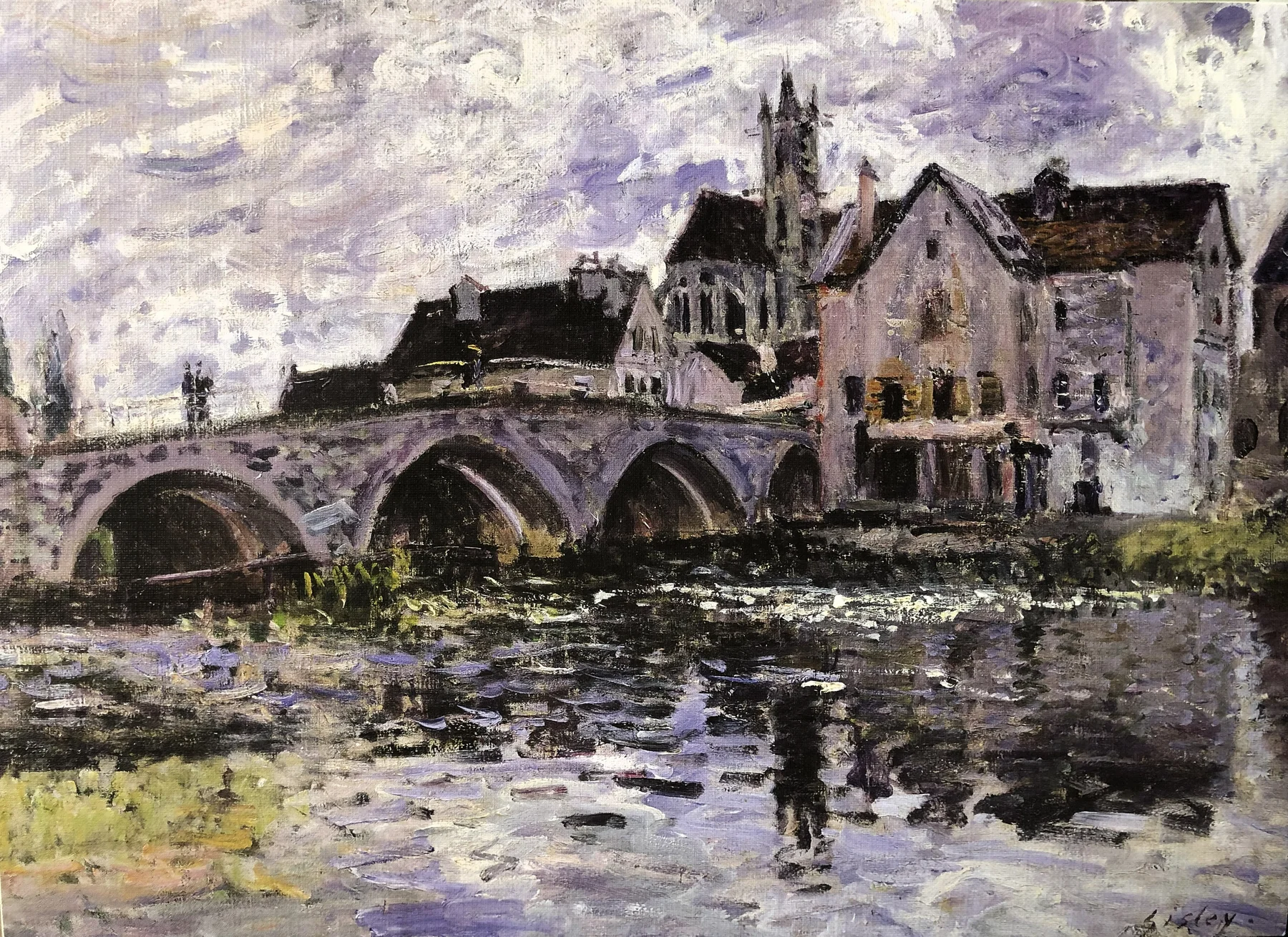
THE BRIDGE AT MORET-SUR-LOING
Alfred Sisley
- Artist
- Alfred Sisley (1839–1899)
- Date
- 1887–1888
- Dimensions
- 63 x 51 cm
- Medium
- Oil on canvas
- Location
- Musée des Beaux-Arts André Malraux, Le Havre, France
Over an artistic career spanning four decades the Englishman Alfred Sisley embodied the archetype of the French Impressionist painter. Unlike his more famous fellow painters Monet and Renoir, he never strayed from the path of Impressionism; he always painted his landscapes outdoors, constantly concentrating on the fleeting effects of light and atmosphere that captivated him all his life. Sisley was never interested in dramatic compositions; instead he sought to depict simple, picturesque scenes, which he put on canvas with a sensitivity matched by few. Although he never achieved success comparable to that of his Impressionist companions, towards the end of his life, when he lived and painted in the charming riverside town of Moret, he did receive some recognition. Inspired by the idyllic surroundings, in his last years Sisley made some of the finest works of his career here.
An Impressionist Garden of Eden
Sisley first moved in the early 1880s to the town of Moret, south-east of Paris, which became his permanent home from 1889. The quaint, medieval-feeling, charming town was a kind of Impressionist Garden of Eden, offering many motifs for Sisley’s paintings, from its fine Gothic church and lazy watermills to its narrow, winding lanes and old stone bridge. Sisley was so enthused by his surroundings that he immediately wrote a gushing letter to his friend Monet: “Moret is only two hours’ journey from Paris… There is a market once a week, and wonderful sights everywhere… If you are thinking of moving, why not come and have a look?” In truth the simple beauty of the town was more in tune with Sisley’s “puritan solemnity” than with Monet’s increasingly grandiose style, but the letter shows Sisley’s renewed vitality after a truly fateful decade.
A Troubled Decade
The troubles began with the Franco-Prussian War of 1870–71, which ruined his father’s business and cut the financial lifeline that had until then ensured Sisley’s survival. To make matters worse, he lost all his possessions when the Prussians began looting the area around his home in Bougival. After that Sisley, who had until then painted only for his own pleasure, had to support his wife and two children from the sale of his paintings, which was no easy task, since the Impressionist style was not yet widely appreciated. The sharply criticised Impressionist exhibitions held during the decade did not raise his reputation either, and his confidence in his own talent was increasingly shaken. At that time he lived largely on the generous support of friends and a few patrons, including the art dealer Paul Durand-Ruel and the restaurant owner Eugène Murer, the latter sometimes providing Sisley and Renoir with food in exchange for the occasional picture.
New Pleasures
Whether through a change of outlook or simply the change of air that came with the move to Moret, the wonderful, inspiring new surroundings revived Sisley’s creative powers, and from then on his paintings reveal fresh optimism and self-confidence. His brushwork became faster, his style looser and more confident, his colours more vivid. Over the next two decades he made more than 400 pictures of the picturesque Moret area, focusing mainly on the riverbank, the poplar-lined roads and, above all, his favourite subject, the old bridge symbolising the entrance to the town. Sisley portrayed the beautifully arched bridge he loved so much on many occasions, mostly from the riverbank opposite the town, which offered the finest view, and it was here, under the wide sky, that he painted The Bridge at Moret-sur-Loing.
A Stormy Subject
The full title of Sisley’s painting is The Bridge at Moret-sur-Loing, Storm Effects, and although it is rarely used, it reflects the artist’s unbroken faith in Impressionism, which emphasised depicting the pictorial effects of different weather conditions. Accordingly, the two most important elements in his works are always water, with its shimmering reflections, and the sky, which Sisley regarded as “not merely a background” but the factor that most determines the mood of the painting. Sisley later painted the bridge at Moret in every season and in many kinds of weather. For him the subject was never the town itself, but rather the subtle changes in light and atmosphere that coloured it, which each time produced a new and unexpected result.
Moods of Nature
It was once said of Sisley that his paintings capture “the smiling face of nature”, but here he shows another side. In The Bridge at Moret-sur-Loing Sisley depicts the ever-changing, threatening, stormy sky with powerful, swirling brushstrokes and thickly applied “impasto” colours. Only a faint ray of light filters through the sky, casting a pink tint on the stone walls of the otherwise bluish-grey houses. Below, the surface of the water trembles restlessly, rippling waves and white foam distorting the pitch-black reflections. The storm is palpably close, and the painting seems a world away from other versions of the same subject, such as the serenely calm The Bridge at Moret at Sunset (1892) and the light-drenched The Bridge at Moret in Sunshine (1893). These paintings bear entirely different features, and the emotional contrast between them reveals Sisley’s true talent: his intuitive ability to understand and depict the countless elements of mood that span the full spectrum of nature.
- The Loing at Moret, September morning
- Sisley’s father, William
- The Bridge at Moret in Sunshine