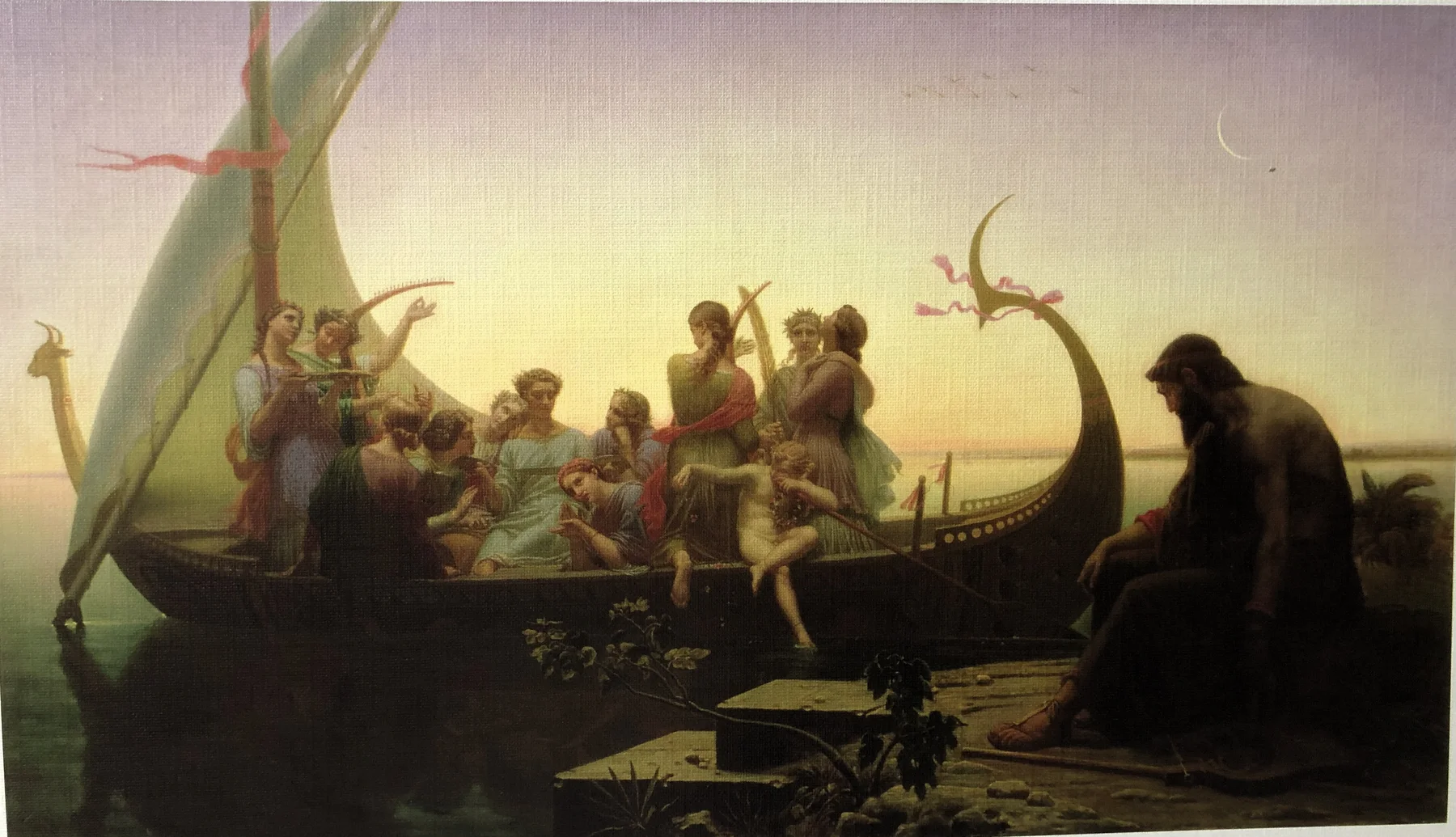
EVENING
Charles Gleyre
- Artist
- Charles Gleyre (1806–1874)
- Date
- Between 1865 and 1867
- Dimensions
- 86.5 x 150.5 cm
- Medium
- Oil on canvas
- Location
- Walters Art Museum, Baltimore, Maryland, USA
The Lausanne-born Swiss painter Marc-Charles-Gabriel Gleyre, better known as Charles Gleyre, was the leading teacher at the most influential private art school in Paris in the mid-19th century, and he actively contributed to the creation of the “juste milieu”, the “happy medium” or “golden mean”, in painting. This artistic movement represented a compromise between painters of the conservative academic style and more independent artists who moved away from the official line and joined the Impressionist group.
A Repeated Success
Evening, also titled Lost Illusions, was painted by Charles Gleyre between 1865 and 1867, at around the age of 60. The work was begun by one of Gleyre’s pupils, Léon Dussart, and later reworked by the French academic teacher himself. The painting recalls an earlier work by Charles Gleyre, also titled Evening, which was the artist’s first major success at the prestigious Paris Salon exhibition of 1843, when he was still only in his thirties. The earlier work is almost identical to this one, only painted in darker tones, which give the composition a gloomier mood.
Both paintings depict an old, bearded poet sitting on the lower step of a quay as a boat full of pretty girls glides past him. The picture is allegorical: the group of ancient female musicians and the naked figure of Cupid symbolise the passing of the poet’s youthful hopes and dreams. It is not known whether the poet is close to death or not, […] the love embodied by Cupid scattering flowers has already passed, and the beautiful music-making muses are also departing. The poet has laid down his walking stick and his ancient instrument, the lyre.
Seeing the somewhat lighter palette of the work painted in the 1860s, the viewer might suppose that the artist depicted the “lost illusions” named in the alternative title in a more optimistic light. But what we know of the artist’s life seems to contradict this reading: in old age Gleyre became increasingly withdrawn and misanthropic. He presents the poet brooding on the past with particular pathos, and through his own example suggests that even if the artist were to begin creating again, his best work is already behind him.
Heightened Pathos
There is something moving in the way Charles Gleyre returned to one of his most successful subjects. More than twenty years after the original painting, we can truly see the painter himself in the ageing poet. The water […] in any case the evening sky of the scene is a symbolic allusion to the hopeless longing of a man past the prime of life for his missed opportunities. Evening reflects one of Gleyre’s visions, which came over him during his journey to Egypt in 1834–35, when as a young artist in his twenties he sat on the banks of the Nile near Abydos.
A Bequest to the City
The later version of Evening was bought by William T. Walters of Baltimore shortly after the picture was finished, in 1867, through the French art dealers Goupil & Cie. The painting was inherited by his son, Henry Walters, in 1894. Evening was donated to the city of Baltimore together with nearly 22,000 other works of art from the Walters bequest, and today it enriches the collection of the Walters Art Museum.
Masterpiece Connection
In the early 1860s Charles Gleyre sent his pupils to the Forest of Fontainebleau (pictured) to paint in the open air the landscape that had played a significant part in the history of modern art from Rousseau and Millet onwards. The later Impressionist painters Claude Monet, Pierre-Auguste Renoir, Alfred Sisley and Frédéric Bazille all attended Gleyre’s studio briefly in 1863. Charles Gleyre also taught French academic painters such as Jean-Léon Gérôme, and he was the teacher of the hugely influential expatriate American painter James Abbott McNeill Whistler.
- Lausanne today
- Walters Art Museum
- Gleyre: Pentheus
Note: this photograph is low-resolution, so a few short passages could not be read; these are marked with […].