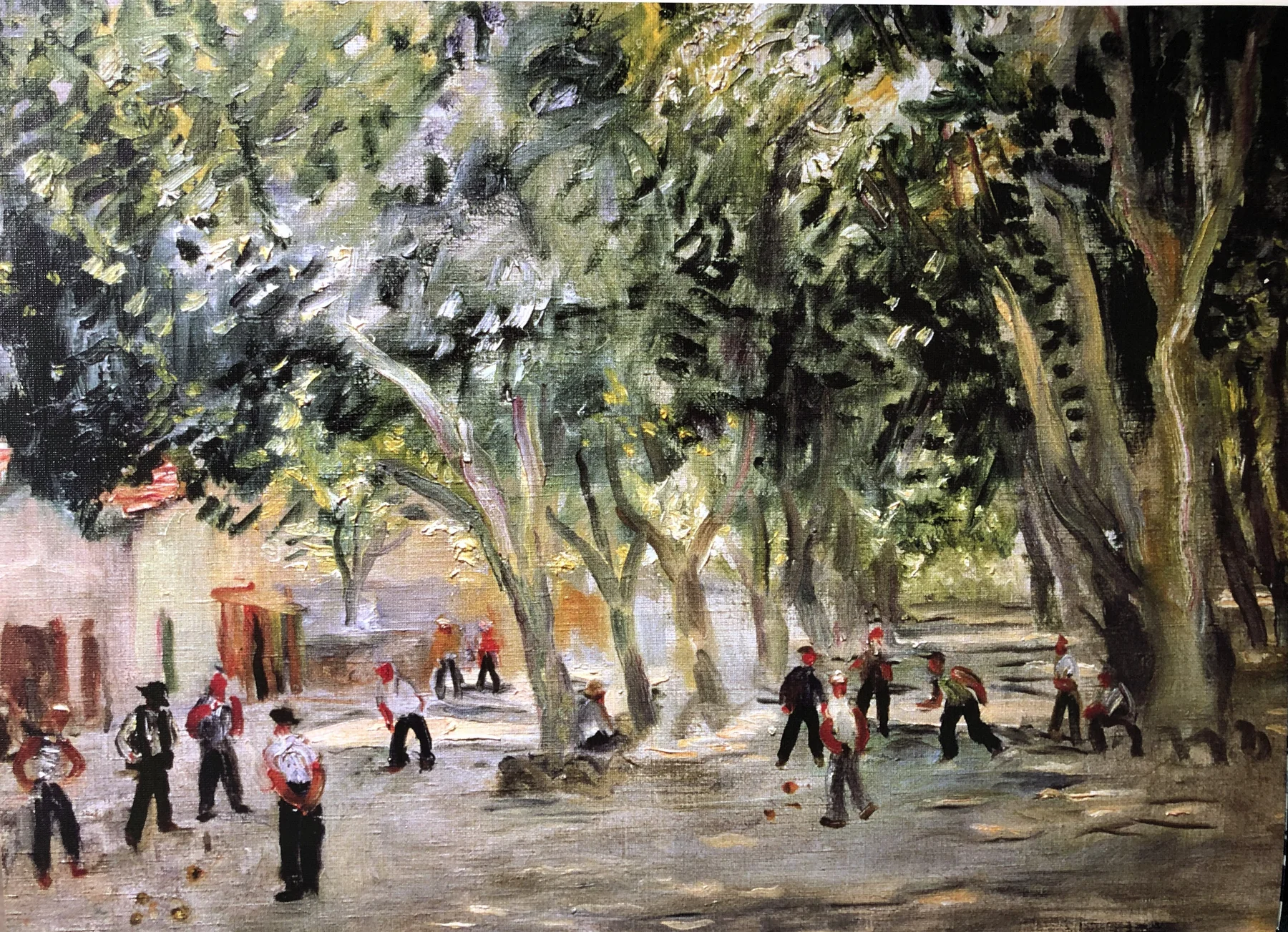
LA PLACE DES LICES
Charles Camoin
- Artist
- Charles Camoin (1879–1965)
- Date
- 1936
- Dimensions
- 60 x 75 cm
- Medium
- Oil on canvas
- Location
- Musée de l'Annonciade, St. Tropez, France
In the first half of the 20th century Charles Camoin was one of many French painters who flocked to the south of the country in search of inspiration in the golden light, tranquil mood and vivid colours the region had to offer. For Camoin the town of St. Tropez was indisputably the jewel in the Mediterranean crown and the focal point of his art, and he settled there in the 1920s. In all he painted more than a hundred pictures of the fairy-tale town and its charming harbour, of which La Place des Lices is one of the finest.
Fauvist Beginnings
The members of the Fauvist, or “Wild Beasts”, group of painters sought to express emotions in their works through the use of vivid, stronger-than-natural colours. These artists — Henri Matisse, Maurice de Vlaminck, Albert Marquet, Camoin and others — met in 1898 while attending Gustave Moreau’s classes at the École des Beaux-Arts in Paris. Although Moreau died that same year, Camoin soon became close friends with his fellow students and, despite his more moderate outlook, generally shared their attitude to exuberant colour and expression. In 1904 he exhibited with them at the Salon des Indépendants, then at the Salon d’Automne in 1905, and it was at the latter exhibition that the group received its somewhat disparaging name. Entering the room where their works were hung, the respected critic Louis Vauxcelles was so shocked by the wildly exaggerated, rebellious colours that he immediately branded the room the “cage of the Wild Beasts”. As a movement Fauvism lasted only a few years, from 1904 to 1908, but Camoin maintained close ties with Matisse and Marquet afterwards, both personally and artistically, and never lost his passion for colour.
A Love of Landscape Painting
From the beginning of his career Camoin was an enthusiastic still-life painter, but he also made excellent portraits, as his paintings of Marquet and Matisse testify. He fell in love with landscape painting only later. After Moreau’s death in 1898 Camoin and Marquet ventured out into the streets of Paris to paint open-air — plein-air — scenes of the city. Over the following years Camoin travelled with Matisse and Marquet to the south of France and on to Italy and Morocco, and in these sunny coastal places he discovered his natural attraction to the dazzling colours of his surroundings.
A Timeless Place
One of the tree-lined squares in the centre of sunny St. Tropez, the Place des Lices has changed little since Camoin’s time. The name “Lices” (meaning lists, a jousting ground) suggests that knightly tournaments were held here sometime around the 9th–10th century, but the square’s present appearance dates back to the early 1800s, when 12 plane trees were planted there. Today the twenty-metre-high trees divide the square into seven leafy arcades, and the sunlight filtering through the leaves offers an excellent setting for leisure activities such as boules, which has been played here for more than a century. Charles Camoin witnessed exactly this scene in 1936 and captured it in his superb picture. On a bright morning players gather in small groups under the shady trees of the square, keenly absorbed in boules and even more keenly in conversation, which goes on until late in the evening. The painting highlights Camoin’s subtle, Impressionist-like handling of light and creation of atmosphere, while the rich Mediterranean colours recall his early attachment to the “Wild Beasts” group.
A Change of Style
As La Place des Lices shows, Camoin’s style underwent a significant change after 1918. This turn came in the same November when Camoin and Matisse visited the grandfather of Impressionism, Pierre-Auguste Renoir. Enchanted and inspired by the old artist’s works, Camoin began to move away from Fauvist traditions towards the Impressionist style. In La Place des Lices this transition is most evident in the disappearance of the firm outlines characteristic of the artist, but it can also be seen in the unaffected spontaneous composition, the blurred image of the trees and the quick, broken brushstrokes with which he depicts the ground bathed in the play of patches of sunlight on his canvas.
A Special Appeal
When he painted La Place des Lices, Camoin was living in the south of France. In 1920 he married his fiancée, Charlotte Prost, and the following year the couple moved to St. Tropez. Although he kept a studio in the Montmartre district of Paris, Camoin lived and worked mostly in St. Tropez for the rest of his life, joining a long line of artists — Picasso, Van Gogh, Cézanne, Signac — seduced by the town’s special appeal. In his last years he painted portraits, interiors and still lifes, but above all wonderful, light-drenched pictures of the harbour as he saw it from his studio overlooking the sea.
Masterpiece Connection
During his military service in 1901 Camoin was posted to Aix-en-Provence, where he met and befriended the reclusive Paul Cézanne (pictured). For several months Camoin visited Cézanne daily, and during this time the older painter helped him rein in his extravagant use of colour. The two artists corresponded until Cézanne’s death in 1906, and Camoin went on to paint many pictures on subjects inspired by his mentor, including bathers and Cézanne’s most famous motif, Mont Sainte-Victoire.
- The Place des Lices today
- St. Tropez in the 1930s
- Gustave Moreau