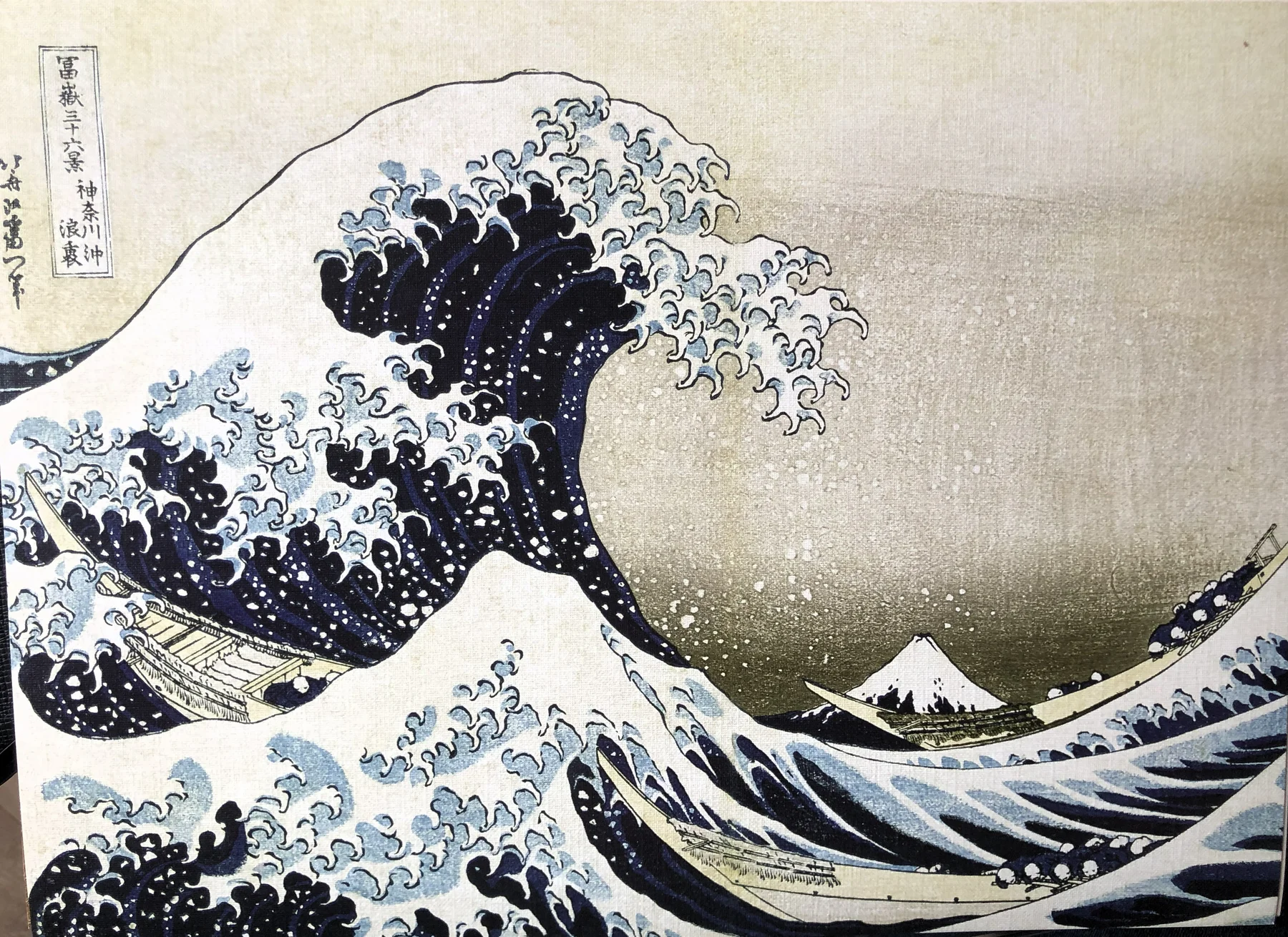
THE GREAT WAVE OFF KANAGAWA
Katsushika Hokusai
- Artist
- Katsushika Hokusai (1760–1849)
- Date
- Between 1830 and 1833
- Dimensions
- 25.8 x 37.9 cm
- Medium
- Colour woodblock print
- Location
- In various collections
Often referred to simply as The Great Wave, Katsushika Hokusai’s dramatic print of a giant wave towering over the snow-capped summit of Mount Fuji is the most iconic and recognisable Japanese image of all time. Made as part of Hokusai’s epoch-making 19th-century woodblock series, Thirty-Six Views of Mount Fuji, the work had a great influence on its own time, changed the face of Japanese art and even inspired artists in distant Paris, in an artistic era when the Impressionists in particular held the works of Japanese artists in very high esteem.
The Ukiyo-e Style
Hokusai was perhaps the most important printmaker of his time, and certainly the most popular. Fame, however, caught up with him only late in life, with his series Thirty-Six Views of Mount Fuji, which began to be published only in the early 1830s, when the artist was already in his seventies. Hokusai was a specialist in the genre known as ukiyo-e. The name, meaning “pictures of the floating world”, was originally used in connection with the Buddhist depiction of the transient nature of human life, but during the 17th century it was applied to the works of the leading artist of the age, Hishikawa Moronobu, who popularised the genre by capturing the similarly fleeting moments of city life and everyday existence.
Although in Moronobu’s time prints were made in black and white, by Hokusai’s time ukiyo-e had become colourful, and the complex printing process was the joint effort of many skilled craftsmen. After the artist (eshi) had painted the work, it went to the woodblock carvers (horishi), who carved the image into cherry-wood blocks, using a separate block for each colour. The printer (surishi) then made the prints: he inked the blocks and pressed the coloured image onto a clean sheet of paper. In all, seven different blocks were needed to make The Great Wave: three blue for the water, one yellow for the boats, one grey also for the boats and the sky, one black for the sky and one delicate pink for the clouds.
A Revolutionary Work
Although made by traditional methods, The Great Wave was a revolutionary work in almost every other respect. Ukiyo-e pictures usually focused on the activities of courtesans, actors and other ordinary people, but Hokusai’s prints of Mount Fuji changed this practice. When it appeared, Thirty-Six Views of Mount Fuji was the first ukiyo-e series to focus exclusively on landscape. Each of the pictures captured Japan’s famous volcano from different viewpoints and under different atmospheric conditions — in Red Fuji the mountain, glowing blood-red under a halo of clouds, sprawls like a giant in the morning sunshine, while in The Great Wave it is modest and retiring, serving merely as a backdrop to the scene. Although human figures also appear in The Great Wave in the form of fishermen crouching in their boats, these fragile figures are completely dominated by the mountain on the horizon and the menacing wall of water about to crash down. As in Hokusai’s other works, so in The Great Wave people serve merely to convey the greatness of nature. Hokusai was the first Japanese artist to put the natural world in the spotlight, showing its most majestic and most terrifying face.
An Optical Illusion
Despite the threat of the violent waves, the picture also exudes some of the humour that often characterises Hokusai’s works. Besides depicting Japan’s highest and most fearsome mountain dwarfed by a wave, he painted the wave’s spray as if it were falling on the mountain as snowflakes. The artist created this illusion through the use of perspective and a sense of depth. Hokusai showed great interest in other cultures all his life, and there was a period when he came under the influence of European art. Although contact with Western culture was forbidden in Japan, works of art were somehow smuggled into the country, and Hokusai looked at them in fascination. He was particularly impressed by prints of Dutch landscapes by Rembrandt and Van Ruisdael, from which he learned shading, colouring and perspective. He absorbed these techniques into his own art, and through him the change of the ukiyo-e style and the transformation of its visual world began.
Inspiration for the Impressionists
As the wear on the original woodblocks shows, Hokusai’s publisher in Edo (today’s Tokyo) made and sold prints of The Great Wave by the thousand. Copies of Hokusai’s works eventually found their way to many Western artists, above all the Impressionists and later Van Gogh. Monet was particularly inspired by Hokusai’s informal compositions, and he himself later painted several series of landscapes, some of which, such as the famous Water Lilies, bear characteristic Japanese features.
At home The Great Wave became so popular that the artist later added a further ten pictures to the series. Despite his success and growing influence, Hokusai remained modest and self-critical. On his deathbed he remarked: “If only heaven would give me another five years, I could become a real painter.”
- Reflection of Mount Fuji in Lake Misaka, from the series “Thirty-Six Views of Mount Fuji”
- A scene from Hishikawa’s work Japanese Popular Theatre in the Genroku Period
- Ruisdael