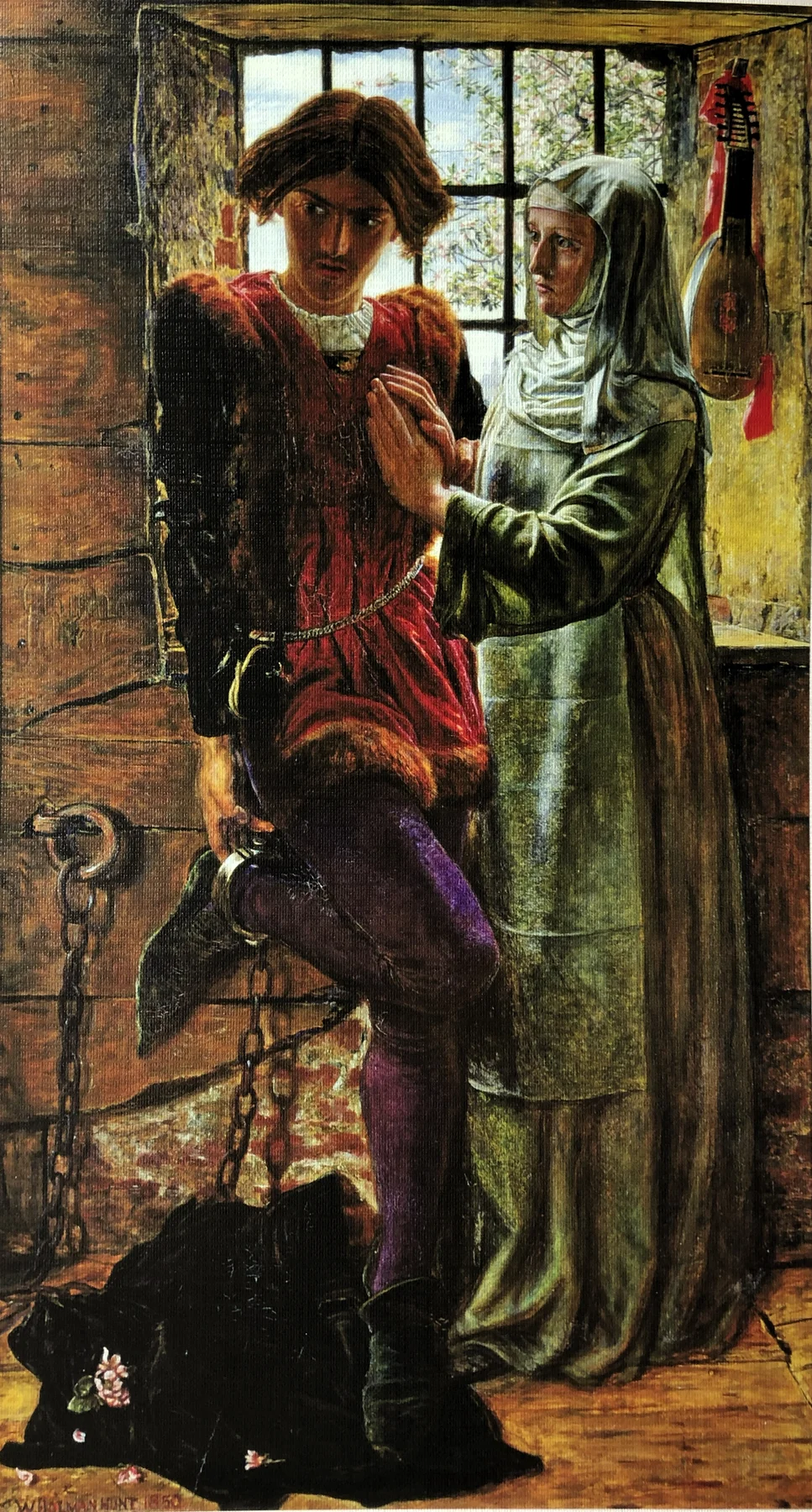
CLAUDIO AND ISABELLA
William Holman Hunt
- Artist
- William Holman Hunt (1827–1910)
- Date
- Between 1850 and 1853
- Dimensions
- 75.8 x 42.6 cm
- Medium
- Oil on panel
- Location
- Tate, London
Hunt’s emotionally charged, finely detailed picture Claudio and Isabella is one of the finest surviving examples of Pre-Raphaelite painting. William Holman Hunt was one of the founding members of the Pre-Raphaelite Brotherhood, alongside John Everett Millais and Dante Gabriel Rossetti, and throughout his career he remained the most faithful to the movement’s ideals. Founded in 1848, the movement championed the depiction of nature in its own reality, rejecting the idealistic rules and fashionable look of academic painting. No artist took these principles more seriously than Hunt, who painted with an unwavering realism and meticulous detail that few could rival.
Drama at Its Height
During his career Hunt painted many religious pictures, and his works usually carried deep moral messages. Like his Pre-Raphaelite brothers he had a keen sense of drama and often created more secular scenes centred on the theme of death or its shadow. For inspiration he turned to the writings of poets such as Lord Tennyson and William Shakespeare. Claudio and Isabella is based on Act III, Scene 1 of Shakespeare’s play Measure for Measure (1603), and the painter depicts the title characters at the climax of the drama. Claudio, who has made his fiancée Juliet pregnant outside marriage, is accused of fornication and condemned to death by the morally corrupt Angelo, the de facto ruler of Vienna. Claudio is visited in prison by his anxious sister Isabella, who reveals to him that Angelo is willing to release him in exchange for her virginity. At the end of their moral dialogue Claudio exclaims: “Death is a fearful thing,” to which Isabella replies: “And shamed life a hateful.” In his painting Hunt depicts precisely the moment when Claudio is about to utter the shocking words: “Sweet sister, let me live…” (The verse quotations are given in Shakespeare’s original; the Hungarian text used Dezső Mészöly’s translation.) The symbolic message of the scene, which Hunt himself professed, is: “We may not do evil that good may come of it.”
Visual References
Like Millais and Rossetti, Hunt had a comprehensive knowledge of visual symbolism and often depicted meaningful motifs in his pictures to help the story unfold smoothly. In Pre-Raphaelite art flowers had their own system of symbols, so the apple blossom lying at Claudio’s feet alludes to his desire for freedom at Isabella’s expense, while Isabella’s brilliant white dress symbolises virginal purity, which ultimately proves unshakeable. The central element of the painting is the two characters themselves, whom Hunt brings to life with extraordinary sensitivity through body language and facial expression. Isabella’s sincere concern for her brother’s fate contrasts with the discomfort of Claudio, who, full of guilt, averts his gaze and fiddles with his shackles; one can almost read his troubled thoughts.
An Ill-Fated Commission
Claudio and Isabella is now counted among Hunt’s most important works, but it might never have been completed without the kindly intervention of his friend and fellow artist Augustus Egg. The picture was originally commissioned by an English collector, Thomas Creswick, from the painter, who was then struggling with serious financial difficulties. According to Hunt, Creswick offered 50 guineas for a picture “depicting one or two figures from a work by Shakespeare, Tennyson or another well-known poet.” Hunt made preliminary sketch designs for Claudio and Isabella and for The Lady of Shalott (1905), but to his surprise Creswick claimed to know nothing of any commission and sent the bewildered artist away. This humiliating experience came as a complete shock to Hunt, who then turned to Egg. The well-to-do patron and generous friend immediately came to his aid, supporting the birth of the painting with an advance of 25 guineas.
Official Recognition
Although Claudio and Isabella is dated to 1850, that is in fact only when Hunt began the painting. Over the next few years he worked on it irregularly and finally managed to finish it in time for the Royal Academy exhibition of 1853. The painting was a resounding success; the enthusiastic collector Lord Grosvenor offered 300 guineas for it, but Hunt turned down the offer and insisted instead that Egg accept the picture as a reward for his generosity. Although Egg protested, Hunt was adamant: “If you had not come forward with your offer, the painting would never have been completed… The picture is yours and no one else’s.” It was a worthy gesture from an artist who proved as consistent in his own moral principles as in those expressed in his paintings.
Artistic Connection
Hunt and his fellow Pre-Raphaelite John Everett Millais (pictured) often discussed their views and ideas, so their subjects and figures frequently overlapped. Millais was working on A Huguenot (pictured) at roughly the same time as Hunt was painting Claudio and Isabella: the figures in both works face a grave moral dilemma.
- Augustus Egg