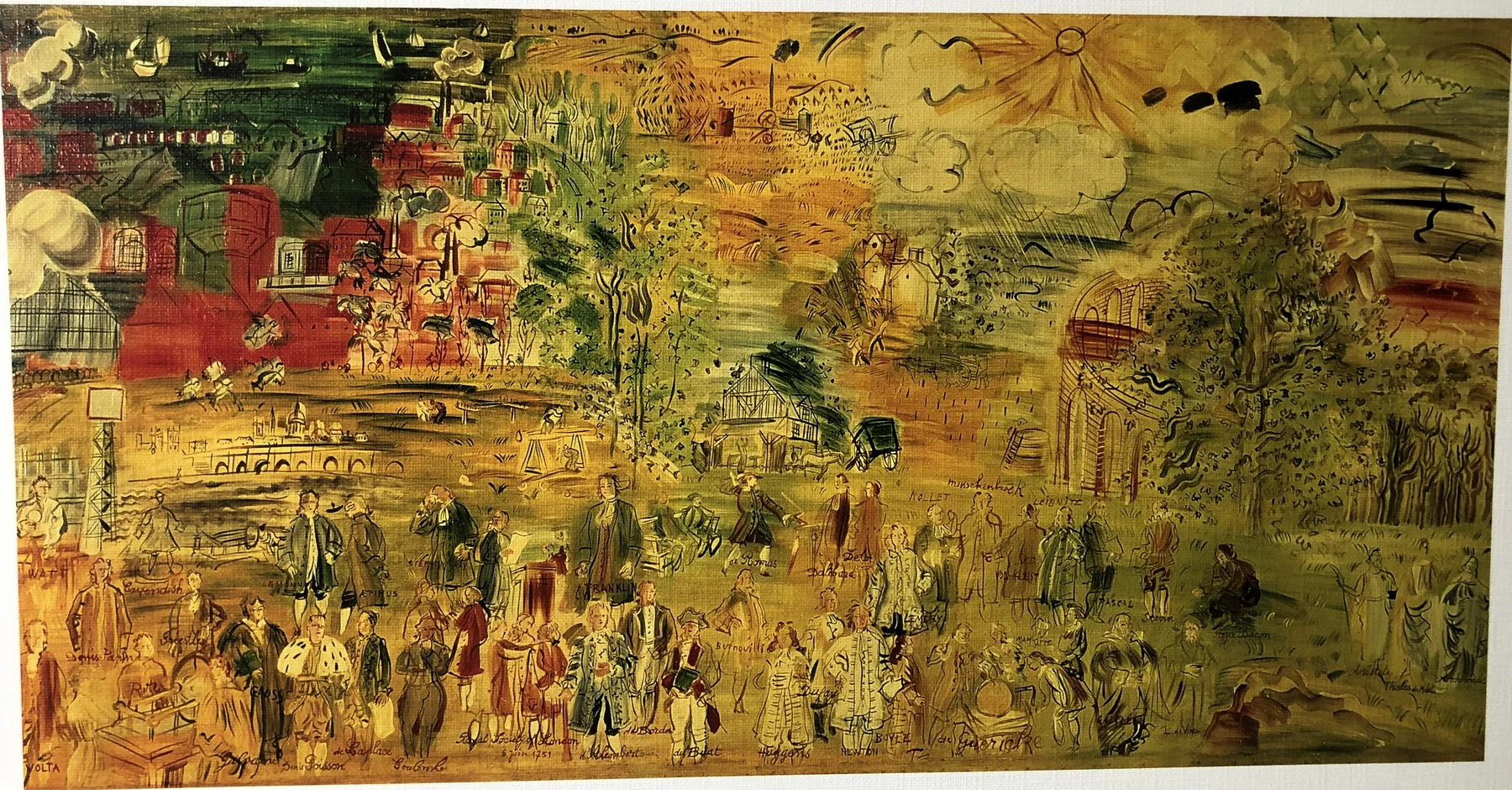
LA FÉE ELECTRICITÉ (DETAIL)
Raoul Dufy
- Artist
- Raoul Dufy (1877–1953)
- Date
- 1937
- Dimensions
- 10 x 62.4 m
- Medium
- Oil on canvas, with wooden panel backing
- Location
- Museum of Modern Art, Paris
La Fée Electricité was commissioned to decorate the wall of one of the pavilions of the 1937 Paris World’s Fair, the Palace of Light. At the time it was the largest oil painting in the world. Dufy painted the colossal mural single-handed over six months. In the form of a sweeping frieze, the work presents the main stages in the harnessing of natural energy from ancient times to the present day, together with a group of eminent scientists.
The Commission
The Paris electricity company first asked Dufy in March 1936 to make a painting to serve as a backdrop for four giant generators, and then in the July contract they ordered from him a further scale version measuring 2.5 x 15 metres (later reduced to 0.91 x 6 metres), together with 50 drawings or watercolours.
Preparations
Dufy visited the modern power station at Vitry, where he made carefully planned notes and sketches for the central element of the mural. He carefully estimated the quantity of paint needed and calculated the number (520) and size (1.83 x 1.22 m) of the wooden panels.
The composition was made in the form of a frieze, with spectacular scenes in the upper register and full-length portraits of scientists in the lower. For each scene he put together hundreds of sketch studies, and for the scientists he first made 30 nude poses, then “dressed” them one by one, depicting their postures in periodically repeating sections for convenience. He borrowed period costumes, and members of the Comédie-Française modelled for him.
He reconstructed the facial expressions of the scientists — chemists, physicists, mathematicians, philosophers, going back as far as Archimedes and Aristotle — on the basis of research, since none of them was still alive. (The only exceptions were Marconi and Rutherford, although they too died later that year.)
Execution
A studio was set up for Dufy in a disused electricity generating plant in Saint-Ouen, a northern suburb of Paris, where in November 1936 — even before the scale model was finished — he set to work in front of an “easel” 10 metres high and 18 metres long. The sketches were recorded on more than 300 slides, then projected onto the canvas and traced in methylene blue. In this phase of the work Dufy was helped by two assistants and his brother, but after that he continued alone.
Dufy, an artist always technically up to date, used Maroger Medium as his paint, a very thin, gouache-like oil paint that dried quickly. (Its inventor, Jacques Maroger, was technical director of the Louvre laboratory from 1930 to 1939 and was famous for rediscovering and popularising the durable paints used by the old masters. The paint used by Dufy contained special ingredients such as fish glue and lavender extract.)
The Deadline
Fitting out the French pavilions involved almost fatal delays, and Dufy’s painting was one of the few exhibits finished on time. His diary entry for 18 May reads: “Finished the Fée Electricité at ten this evening.” The World’s Fair opened six days later. The work’s presentation was spectacular: as one approached the base of the mural, the black floor tiles gradually gave way to white ones, lit from above by dazzling electric light.
The scale of the work does not allow it to be described in a few words; in any case the overall effect offers a pulsating symphony of colour as the viewer walks past the picture. The central section depicts the Vitry power station in steel blue, above which the gods of Olympus look down benevolently on the glorious creations of mankind, the cavalcade of factories, shipyards, neon-lit cities and a symphony orchestra shown in the wings.
A Gift to the State
After the World’s Fair La Fée Electricité was dismantled and put into storage. After the French energy sector was nationalised in 1946, there were plans to sell the picture in pieces, but Dufy insisted that it remain whole, so the work was donated to the state. It has been on display in the Museum of Modern Art in Paris since 1951. An examination carried out in 2001 showed that the wooden panels had been reinforced with asbestos, which could only be removed at a cost of several million francs.
Similar Commissions
Dufy was not the only well-known artist to make a mural for the 1937 World’s Fair: Robert Delaunay, for example, worked on the design of the railway and air transport pavilion, while Fernand Léger made a mural titled “Transmission of Energy” for the Palace of Discovery.
- Comédie-Française
- Ernest Rutherford
- Marconi