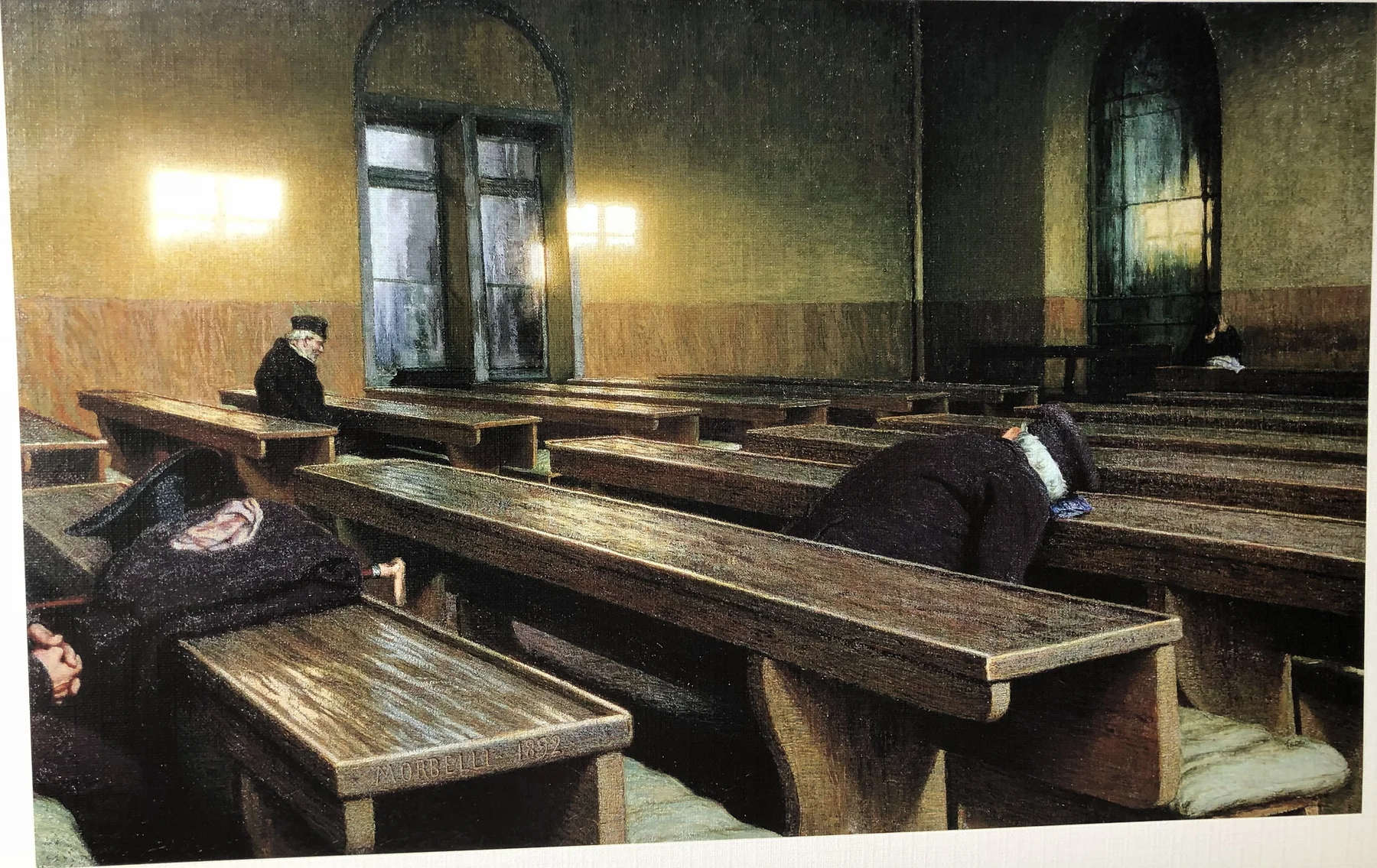
HOLIDAY AT THE PIO ALBERGO TRIVULZIO IN MILAN
Angelo Morbelli
- Artist
- Angelo Morbelli (1853–1919)
- Date
- 1892
- Dimensions
- 78 x 122 cm
- Medium
- Oil on canvas
- Location
- Musée d'Orsay, Paris
The plight of the elderly was a recurring subject of the Lombard painter Angelo Morbelli for nearly three decades. This painting, which won him a gold medal at the 1900 Paris World’s Fair, was bought by the French state and exhibited again at the 1903 Venice Biennale. Over the years it has lost none of its pathos or visual impact, thanks among other things to Morbelli’s use of good-quality materials.
Light, Colour and Truth
Angelo Morbelli was a Divisionist, a member of a group of northern Italian painters. The Divisionists developed a revolutionary new technique in the 1880s and 1890s. These artists sought to depict light and shadow by scientific means in order to achieve a purer, “truer”, yet emotionally powerful rendering of reality. Leading figures of the Divisionists included Emilio Longoni, Giuseppe Pellizza, Gaetano Previati and Giovanni Segantini.
Like the Impressionists, the Divisionists were inspired by the colour theory of the French chemist Michel-Eugène Chevreul (who published his red-yellow-blue colour wheel in 1855), and they also knew the work of the American physicist Ogden Rood on the optics of colour, Modern Chromatics (1879). Instead of mixing pigments on the palette, the Divisionists applied countless separate dots and lines of pure colour to the canvas straight from the pot in order to preserve the brilliant effect of the paint. The basic idea of Rood’s theory was that the colours should be “mixed” optically by the viewer’s eye.
The Perfectionist Painter
Divisionist painting was a painfully slow process, and Morbelli tried to shorten it by using a strange tool: he raked the paint across his canvases with a comb-like brush. At the same time the artist was obsessive about the quality and durability of his materials. At first he experimented with grounds, oils, pigments and varnishes of his own making, and finally settled on the good-quality, reliable products of the famous French brand Lefranc (Lefranc invented the practical paint tube with a screw-on cap in 1859).
In his early works, to achieve the best possible colour effect, Morbelli applied a thin layer of lead-white or zinc-white ground, which gave a perfectly smooth surface while retaining the weave of the canvas. As his confidence grew he later began to use coloured grounds that harmonised better with the desired tonal shade. After the ground he smoothed the surface of the picture for the preliminary sketch designs.
Age and Loss
In 1883 Morbelli began work on a cycle of six paintings entitled The Poem of Old Age. He returned to the series several times and finally managed to finish it in time to show it at the 1903 Venice Biennale. All six scenes are set in the Pio Albergo Trivulzio, a home for the elderly in Milan, and their common theme is the portrayal of the old and infirm.
While Morbelli evidently studied the light effects in the Pio’s cavernous rooms with interest, he turned with sincere understanding to Italy’s lower classes, and especially to the old, who had been left to fend for themselves during the Risorgimento, the movement for Italian unification, which was completed around 1871 but left social and economic upheaval in its wake.
Some of the six canvases — such as I Remember When I Was a Little Girl (1903) — have a great many figures, but Holiday at the Pio Albergo Trivulzio shows only four residents far apart in a huge hall. It is Christmas, and these people either have no family or have simply been forgotten. Since they have nothing more to expect from life, they spend this day like any other: in physical and spiritual isolation, lost in the past.
Morbelli combines two techniques on his canvas: he depicts the walls and windows bathed in sickly yellow light with broad brushstrokes, and paints the people and the furniture in the Divisionist style with a delicate application of pure colours (the lines of paint running along the grain of the bench tops reinforce the oblique perspective).
On the far left of the picture a well-dressed man stands ready to leave with his coat, hat and walking stick, but it seems his relatives have forgotten to come for him. The figure leaning forward in front of the back wall of the hall is praying to himself or grieving for a companion who has just passed away, or perhaps simply withdrawn into himself. On the right an old man slumps exhausted on the bench, his head resting on his handkerchief. Morbelli avoids mawkish sentimentality, partly by working out his figures in meticulous detail, thus preserving their human dignity.
In 1903 Morbelli returned to this subject in his picture Christmas of Those Left Behind. In this technically perfect work strong rays of sunlight divide the row of benches into vivid dark and light bands, which serve as symbols of life and death.
- Eugène Chevreul and his colour wheel
- Giuseppe Pellizza
- Christmas of Those Left Behind