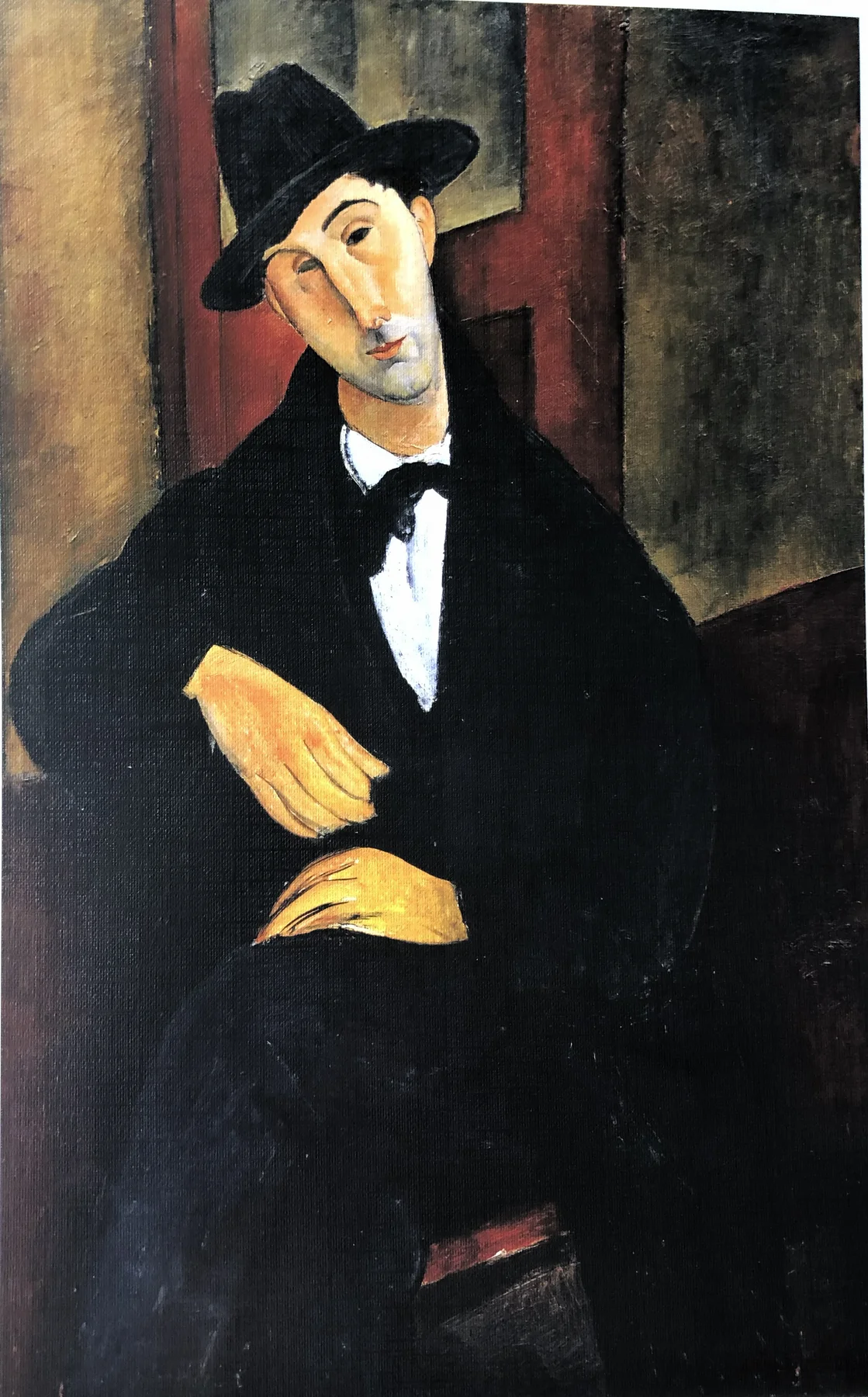
PORTRAIT OF MARIOS VARVOGLIS
Amedeo Modigliani
- Artist
- Amedeo Modigliani (1884–1920)
- Date
- 1920
- Dimensions
- 116 x 73 cm
- Medium
- Oil on canvas
- Location
- Private collection
The portrait of his New Year’s Eve drinking companion, the Greek composer Marios Varvoglis, was Modigliani’s last gift to the world. Bearing all the characteristics of his mature style, the picture reveals less about the sitter’s personality and more about the nightly revels that hastened the artist’s miserable death in Paris at the age of 35. Modigliani’s legendary addiction to wine and women long fed the romantic-sounding myth of the “ill-fated artist”, which in turn gave his works a value on the art market he could never have expected.
The Emerging Likeness
Apart from a good number of landscapes and a series of sensual nudes, Modigliani committed himself to portrait painting, and many of these pictures grew out of the countless sketches he made of fellow artists and writers in Parisian bars and cafés. In his first creative period, 1914–1916, he portrayed artists such as Pablo Picasso, Diego Rivera, Max Jacob, André Salmon, Moïse Kisling, Chaim Soutine and Jean Cocteau, and painted portraits of his lovers Beatrice Hastings and Jeanne Hébuterne. Many of these are unfinished works lacking artistic maturity but revealing a rich emotional world.
In the second phase of his portrait painting he concentrated on depicting stocky peasant figures, with whom he came into contact on the southern coast in 1918–19. He met these people in the street, and some were removal men; not surprisingly, these became not very personal, somewhat idealised depictions.
Besides these, he also made portraits of Parisian acquaintances, including several of Varvoglis, but in these last years of his life Modigliani moved towards a lighter treatment. His sitters’ personalities are almost always masked by formulae: a tilted head on a swan-like neck, expressionless, asymmetrical eyes, interlooping, gracefully curving lines, body shapes forming an S. All these features are present in the Portrait of Marios Varvoglis, as are the firm vertical and diagonal lines in the background characteristic of Modigliani’s period at the time, which counterbalance the organic forms of the body.
Who Was Marios?
Marios Varvoglis had a taste of painting at the school of fine arts in Athens, then moved to Paris in 1902 to study music at the conservatoire. During this period he lived in the city’s bohemian quarter, Montparnasse, where Modigliani lived with Jeanne. After one of Modigliani and Varvoglis’s drinking sessions together, the painter is said to have staggered home with a pencil sketch of the composer on which he had written: “From now on a new life begins…”. Three weeks later, however, Modigliani was dead.
Posthumous Esteem
When he painted Marios, Modigliani was already beginning to sell his works with the help of his new dealer, Leopold Zborowski, thanks to the successful exhibition of French art that opened in London in the summer of 1919. Despite his constant financial straits he did not care much about the money coming in. There is a story of an American lady who, having sat for Modigliani, insisted that the painter sign the picture, aware of the artist’s rising stock. Modigliani responded by scrawling his name in large letters across the portrait, ruining the picture.
Inexperienced in financial matters, Modigliani usually either gave his portraits to his sitters or charged a ridiculous sum, five francs, for them. Sometimes he even asked for a litre of red wine in payment, having concluded that he could only paint creatively when drunk.
After his death the prices of his paintings soared. His official dealers even hired a forger to add signatures to the original pictures to make them more saleable. Sales records fell one after another: the Portrait of Marios Varvoglis found a buyer for more than 12 million dollars in 1988. In June 2010 one of the African-style heads from Modigliani’s sculpture period changed hands for 52.8 million dollars.
Artistic Connection
With their restrained use of colour to heighten the sense of mass and depth and their distorted forms creating spatial harmony, Modigliani’s portraits recall the works of Paul Cézanne (1839–1906). Shortly after Cézanne’s death, in 1907, the Bernheim-Jeune gallery exhibited nearly 70 of the French painter’s watercolours, and later that year 56 more of his works were shown at the Paris Salon. Through these posthumous exhibitions Cézanne exerted a lasting influence on the avant-garde art of pre-war Paris. Modigliani carried a small reproduction of Cézanne’s Boy in a Red Waistcoat (1893–95, pictured) in his pocket, often taking it out and ceremoniously kissing it.
- Portrait of Picasso
- Modigliani: Leopold Zborowski