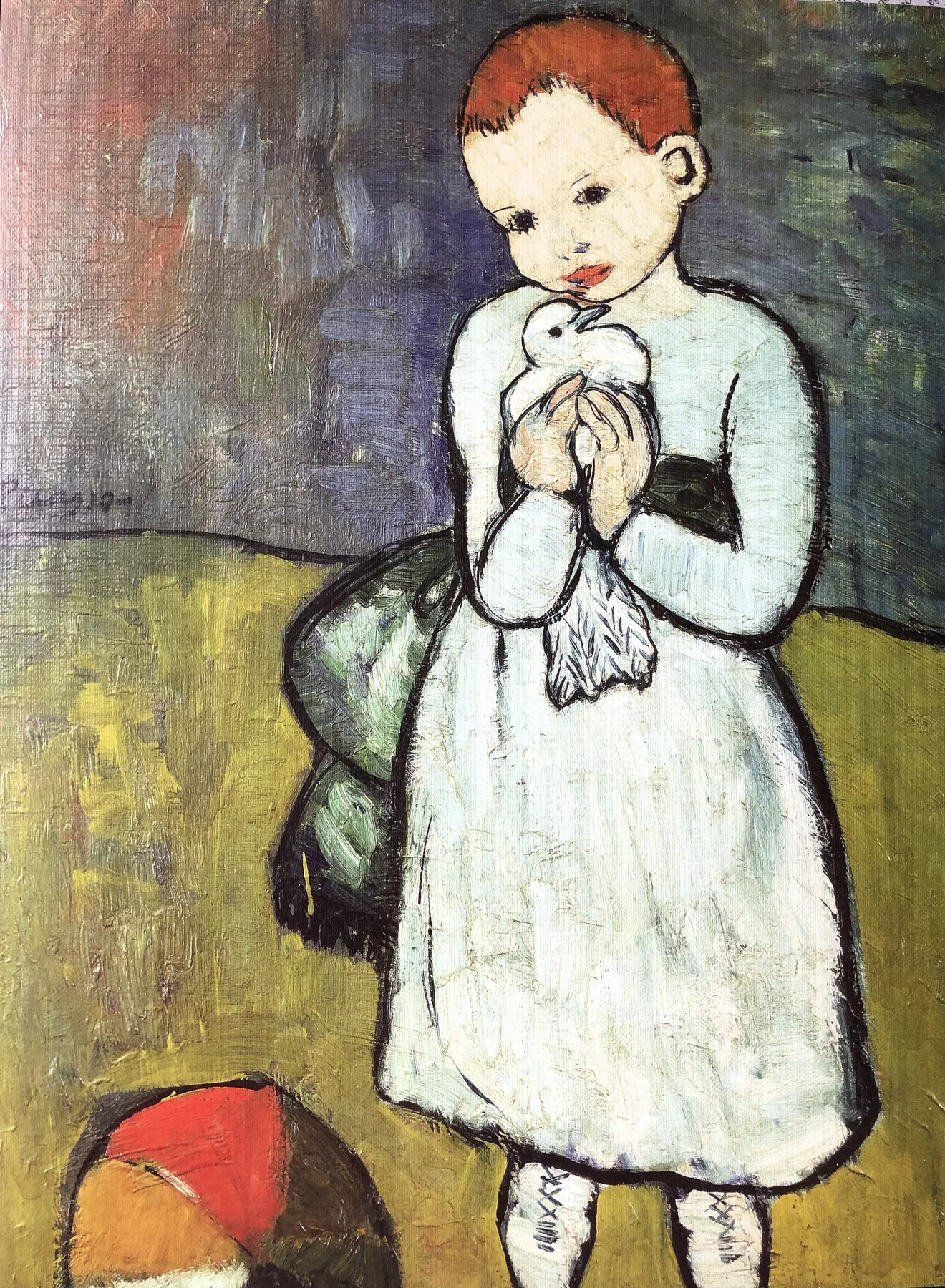
CHILD WITH A DOVE
Pablo Picasso
- Artist
- Pablo Picasso (1881–1973)
- Date
- 1901
- Dimensions
- 73 x 54 cm
- Medium
- Oil on canvas
- Location
- National Gallery, London (on loan from a private collection since 1974)
Picasso painted Child with a Dove in 1901, at only nineteen, in the days after his return from Madrid to Paris; it is one of the earliest works of his Blue Period, which lasted until 1904. Like most of the works made in this period, this painting is a captivating blend of melancholy and tenderness, a reflection of the artist’s gloomy state of mind at the time.
The Blue Period
By the time he painted Child with a Dove, the free-spirited Picasso had long since left behind the social and artistic conformism represented by his father and the Spanish art establishment, and was going his own way. During his stays in Paris in 1900 and 1901 he discovered the works of the Post-Impressionist painters — Cézanne, Gauguin, Van Gogh and Seurat — and other avant-garde artists, whose styles and new techniques he quickly adapted to.
Paris offered Picasso creative stimulation and a wide circle of artist friends, but he was often lonely and unhappy and lived in very modest financial circumstances. In early 1901 he suffered a huge blow when his close friend and fellow artist Carlos Casagemas took his own life because of an unhappy love affair. His suicide filled Picasso with guilt for not having helped his friend more. In the following months a noticeable change took place in his painting style, which we now call his Blue Period. The artist himself said: “It was thinking about Casagemas’s death that led me to paint in blue.”
The vivid, pure colours disappeared, replaced by melancholy blues that filled the entire surface of his canvases. His subjects changed too: lively café scenes gave way to depictions of lonely, mysterious figures and society’s outcasts, beggars and prostitutes, alongside pictures of the dead Casagemas. Picasso’s outlook also underwent a transformation: he no longer approached his figures with detachment or satire but began to portray them with compassion and tenderness.
A Lonely Figure
Child with a Dove is one of Picasso’s earliest “blue” paintings. He places the figure of the child, with only a coloured ball and a dove, against an empty background to emphasise the sense of loneliness. The picture lacks any indication of place or time. The simplified forms and distorted perspective give the composition a kind of unreal effect, reinforced by the dominant blue-green tones. The artist applied the paint thickly over the whole surface of the canvas, using the so-called impasto technique (a word of Italian origin meaning “dough” or “paste”), thereby heightening the expressive power of his work.
The Compassionate Picasso
Unlike Picasso’s earlier Paris paintings, this work shows a captivating tenderness. The child holds the bird in her hands with heart-wrenching care and gentleness. Picasso is able to convey a mood of innocence and purity without sentimentality. Some critics believe that Picasso’s newfound empathy for his sitters stemmed from childhood. He was only fourteen when his younger sister Conchita died suddenly of diphtheria in 1895, and this sad event had a lasting effect on him. During the little girl’s illness he even vowed to God that if his sister survived he would never draw or paint again.
A Symbol of Peace
Doves are recurring motifs in Picasso’s works. Besides being symbols of peace, they evoked fond childhood memories for the artist. Picasso’s father, Don José Ruiz Blasco, bred pigeons and made drawings of them, and as a child Picasso also captured the birds in his sketches.
In April 1949 Picasso’s lithograph Dove appeared on the poster of the first Peace Congress in Paris and became the symbol of the peace movement. In the same month Picasso named his fourth child, born then, Paloma, which means dove in Spanish. The following year he gave a speech at the second Peace Congress in which he recalled how his father had taught him to paint doves and declared his conviction: “I stand for life against death; I stand for peace against war.”
Artistic Connection
Picasso met the French painter Henri Matisse (below, top) in 1906, when the collector Gertrude Stein (below, bottom) introduced the two artists to each other in her Paris apartment. Their lifelong relationship was marked by mutual respect and healthy rivalry. Matisse greatly admired the sensual lines and brilliant colours of Picasso’s pictures. The two men were in constant contact, discussing their views and enjoying their differences of opinion, while regarding each other as their only worthy rival. As Picasso put it: “All things considered, there is only Matisse.” And in Matisse’s words: “Only one person has the right to criticise me… and that is Picasso.”
- The National Gallery, London
- Picasso’s lithograph Dove