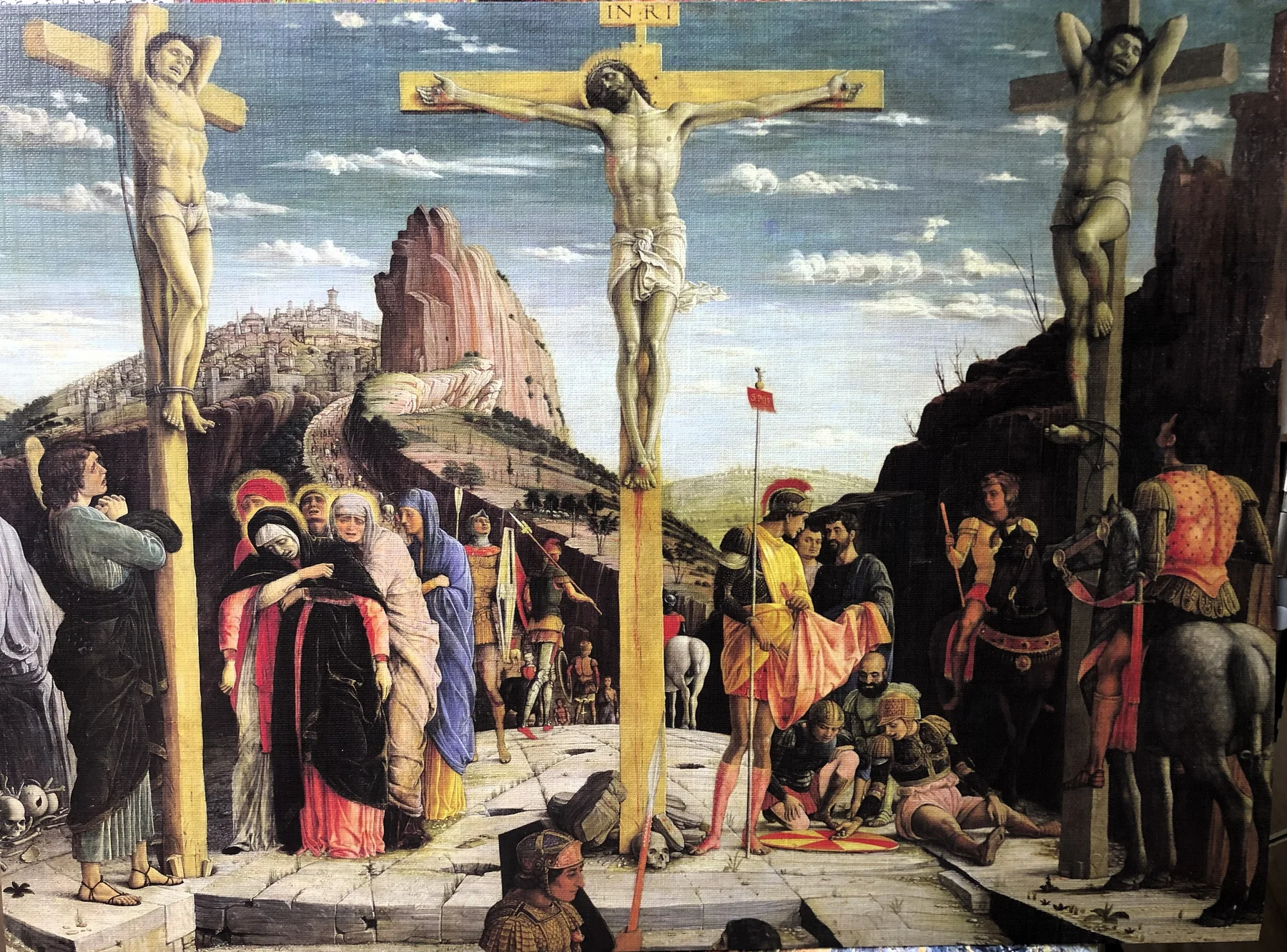
THE CRUCIFIXION
Andrea Mantegna
- Artist
- Andrea Mantegna (c. 1431–1506)
- Date
- c. 1457–60
- Dimensions
- 76 x 96 cm
- Medium
- Tempera on panel
- Location
- Musée du Louvre, Paris, France
Working in northern Italy in the second half of the 15th century, Andrea Mantegna was a passionate admirer of ancient Roman art and quickly became one of the finest painters of the early Renaissance. He made unique discoveries in perspective, often painting bold scenes seen from below to achieve a monumental effect. The Crucifixion was originally part of an altarpiece in his characteristically innovative style, designed for a church in Verona.
Part of an Altarpiece
In 1457 Giorgio Correr, abbot of the Benedictine monastery of San Zeno in Verona, commissioned Mantegna to create a large altarpiece, a so-called “sacra conversazione”, or “holy conversation”, depicting the Virgin and Child among saints. The artist was greatly influenced by Donatello’s work, the bronze altar of the Basilica of Sant’Antonio in Padua, on which two central columns separate Mary from the saints. He likewise used columns to frame his sacred image. By setting the three upper panels within this frame, Mantegna both unites and separates the three parts of the painting The Virgin and Child Enthroned, which thus form a triptych but are at the same time separate pictures.
Mantegna painted the small panel of the Crucifixion as the central element of three scenes from the Passion at the foot of the predella (altar step), directly beneath the three-panel Virgin and Child Enthroned. The Agony in the Garden, the Crucifixion and the Resurrection form the narrow, ornate base of the altarpiece.
Transport to France
In the 16th century the altarpiece was moved to the back of the apse of San Zeno, and at the end of the 18th century, on the orders of the French government commissioner, the work was dismantled and the panels shipped to France. In 1815 the city of Verona recovered the three upper panels. The three smaller scenes of the base, including the Crucifixion, were replaced by copies on canvas. The original panel of the Crucifixion remained in France together with the Agony in the Garden and the Resurrection. The Crucifixion, sometimes called Calvary, is now in the Louvre in Paris, and the other two predella pictures can be seen in the Musée des Beaux-Arts in Tours.
An Antique Sculptural Style
Mantegna can be recognised by his sculptural style with its relatively austere forms, greatly influenced by his passion for ancient Roman sculpture. His figures are slender, muscular and bursting with energy, their contours carefully outlined, the draperies stiffly folded, and everything painted in meticulous detail. According to the Italian painter and art historian Giorgio Vasari (1511–74), Mantegna painted in a “stony, severe style”, and like many of his other works the Crucifixion presents a stark, rocky landscape. With the stylised depiction of the rock monoliths the artist echoes the three crosses thrusting upwards.
Steps Leading Upwards
This tightly composed painting is dominated by Christ’s huge central cross, flanked symmetrically on either side by a further cross, slightly turned and facing inwards. On the grey, paved platform holes mark the sites of earlier executions on Calvary. At the bottom of the painting steps cut into the rock lead the viewer into the scene, at the very bottom of which the abruptly cut-off figures of two men can be seen. The spear of Longinus, wearing Roman armour, points upwards towards Christ’s cross. After he had pierced the side of the Son of God on the cross and Christ’s blood had run down his spear, Longinus converted to the Christian faith. Mantegna portrays the soldier with great empathy as he turns to his companion, recounting his conversion and revealing Christ’s divine nature. Mantegna creates a visual connection between the convert and the viewer — the artist encourages the Christian faithful to recognise the connection and identify with the witness to the Passion story.
- The San Zeno altarpiece in Verona
- Interior of San Zeno, Verona
- Mantegna’s studio in Mantua