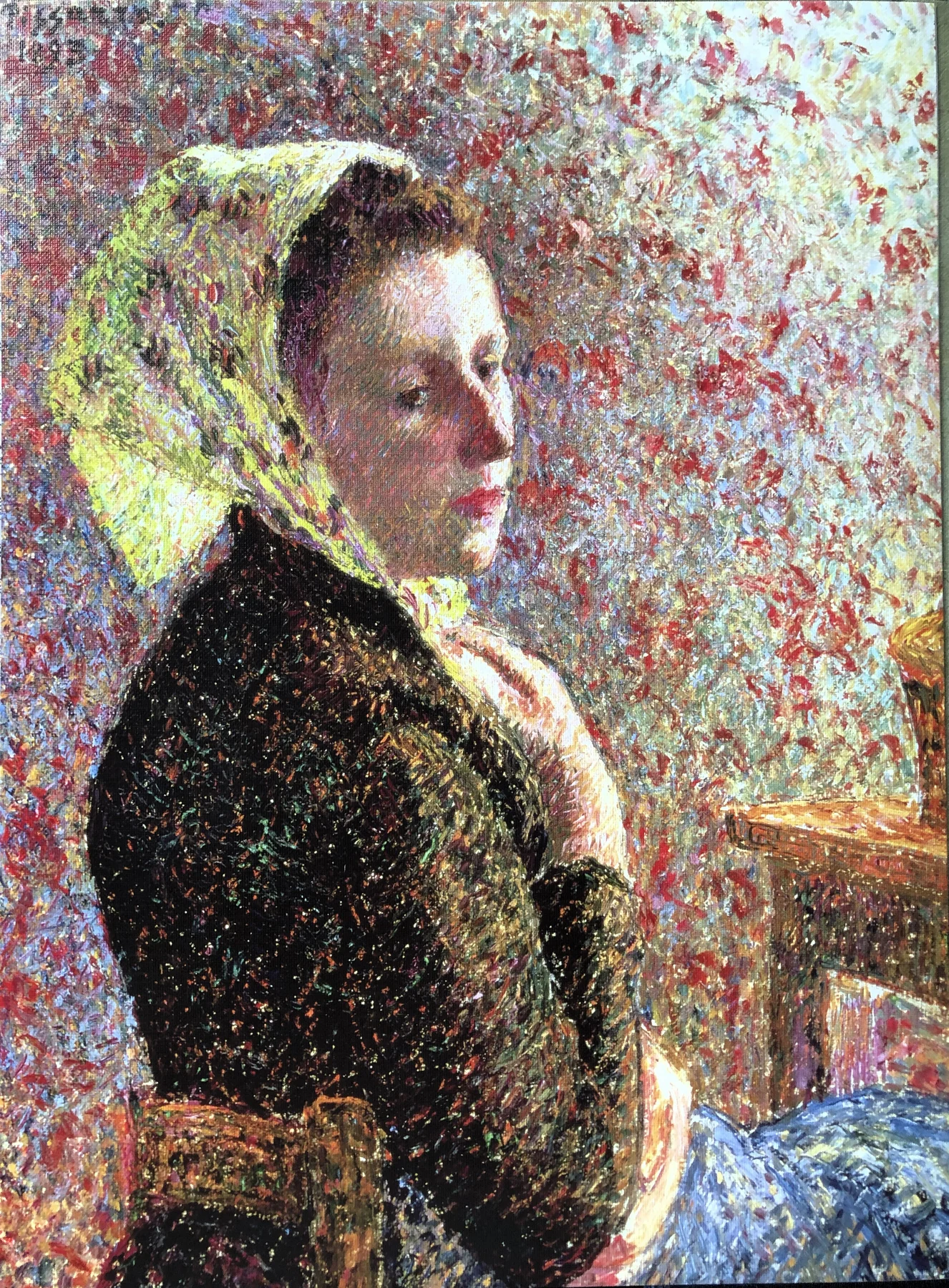
WOMAN IN A GREEN HEADSCARF
Camille Pissarro
- Artist
- Camille Pissarro (1830–1903)
- Date
- 1893
- Dimensions
- 65.9 x 54.5 cm
- Medium
- Oil on canvas
- Location
- Musée d'Orsay, Paris
Camille Pissarro was one of the key figures in the history of Impressionism. In his efforts to capture different effects of light and colour he was ready to change his methods and experimented with various painting techniques. In the late 1880s his brief flirtation with the new pointillist technique, also known as Neo-Impressionism or Divisionism, brought a kind of liberation to the last phase of his painting.
A Period of Transition
During the 1890s, the last decade of his life, Pissarro’s paintings fall into two main groups: landscapes of Éragny and townscapes showing mainly scenes of Paris and London, each with its own painting technique. In terms of subject, Woman in a Green Headscarf from 1893 is one of the less typical works, returning to his earlier pictures of female models such as Girl with a Stick (1881) and Peasant Girl Lighting a Fire, Frost (1888).
After being referred to for more than ten years solely as the father of Impressionism, Pissarro was ready to change his style and became a supporter of the cause of Neo-Impressionism, associated with the names of two young avant-garde artists, Georges Seurat (1859–1891) and Paul Signac (1863–1935). Pissarro was interested in the dot technique, that is, applying pure colours to the canvas in tiny dots (which merge when seen from a sufficient distance). Pissarro’s experiment with pointillism, however, ended by 1890, as he wanted to avoid the fragmentation of his pictures “while obeying the laws of colour as far as possible.”
In the early 1890s Pissarro reached a decisive stage in his artistic development. He felt that he had by then reached a certain level of enlightenment and had found in his painting the harmony he had sought for so long. He wrote about it to his niece, Esther Isaacson: “I began to understand my feelings and to realise what I had been striving for at the age of 40 (in the early 1870s) — but only vaguely.” This transitional period was a prelude to his scenes of Paris and Rouen, which reveal far greater artistic freedom in his paintings.
A Gift to the State
Woman in a Green Headscarf was once part of the collection of Mary Cassatt (1844–1926). The Impressionist painter from Pittsburgh, Pennsylvania, is credited with launching Impressionism in North America. From 1939 the picture enriched the collection of Dr Eduardo Mollard, and in 1972 it passed by bequest to the French state. The painting was kept in the Louvre in Paris until 1986, from where it moved to its present home, the Musée d'Orsay.
A Fusion of Styles
Having applied the coloured-dot technique of pointillism in his own paintings in the late 1880s, Pissarro began to marry different painting methods in the first years of the following decade. Woman in a Green Headscarf shows a mixture of decorative elements and different styles, from Impressionism to pointillism. Built up with broken brushstrokes, the picture unusually looks both sketchy and yet finished. The face of the woman, lit from the upper right corner of the composition, appears more real and better related to space than the wooden table in front of her, while the flood of dots in the ornate background recalls falling autumn leaves.
A Young Farm Worker
During his career Pissarro drew and painted many kinds of female portraits, made five self-portraits, and portrayed his own children and his artist friend Paul Cézanne. Pissarro turned to workers and peasants with empathy; his 1893 picture Woman in a Green Headscarf, for example, depicts an unknown young peasant woman. The woman sits at a table, her head turned as if she had suddenly heard a noise behind her, so that the viewer catches her off guard, daydreaming, her raised right hand resting softly on the knot of her simple headscarf. The gesture seems unconscious, so its meaning remains obscure.
- View from My Window (Éragny)
- Hyde Park, one of Pissarro’s London scenes
- Peasant Girl Lighting a Fire, Frost
- Pissarro: The Artist’s Son