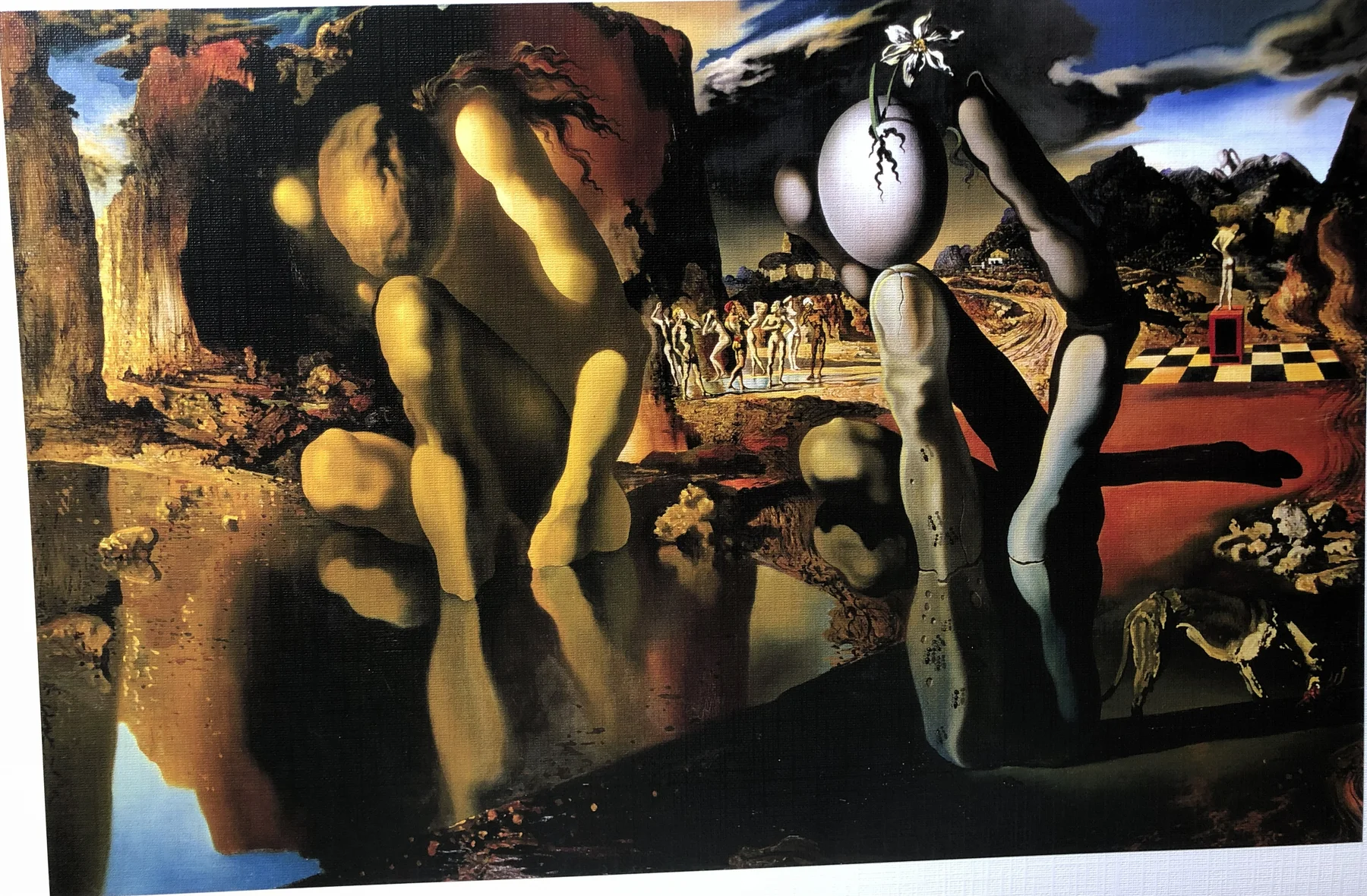
METAMORPHOSIS OF NARCISSUS
Salvador Dalí
- Artist
- Salvador Dalí (1904–1989)
- Date
- 1937
- Dimensions
- 50.8 x 78.3 cm
- Medium
- Oil on canvas
- Location
- Tate Modern, London
One of the many intellectual experiences awaiting the viewer who studies Dalí’s Metamorphosis of Narcissus is the almost endless number of layers of interpretation of the work. A Freud-inspired self-portrait by a Surrealist artist never gives up its secrets easily. The painting was made in the decade of Dalí’s most important creative period, at the height of his international fame, when he was moving away from the closed circle of the Surrealists towards a modern mythology of his own imagining.
A Mythical Source
At first glance the painting depicts a Roman myth based on Ovid’s Metamorphoses. Narcissus, a captivatingly beautiful but proud youth, drives away everyone who tries to approach him. The nymph Echo falls in love with the young man, and when he rudely rejects her she pines away with longing until only her voice remains. As punishment the gods condemn Narcissus to adore his own reflection, and since he cannot tear himself away from gazing at his beauty, he too is consumed by grief, and in place of his body narcissi spring from the ground.
Ode to a Painting
Dalí wrote a poem to accompany the picture, which was recorded and played back to viewers. The poem was accompanied by some helpful notes. Dalí explains, for example, that the basic idea came to him when he overheard some fishermen talking on the Spanish coast where he lived with his wife, Gala. One fisherman asked: “What’s wrong with that fellow [Dalí], looking at himself in his mirror all day?” The other replied: “If you really want to know, he has a bulb in his head.” Dalí then explains that this Catalan expression corresponds exactly to the psychoanalytic concept of a complex. If someone has a bulb in their head, it may flower at any moment — into a narcissus!
A Double Reflection
In the left foreground, painted in warm colours, the ghostly figure of Narcissus, depicted with soft contours, is already lost in contemplation of his reflection, and the carved limestone sculpture to his left, in cold blue-green tones, mirrors his form. The cracked, dead stone symbolises decay, from which new life arises: a narcissus hatched from an egg. But death is already approaching again (in the form of scurrying ants), alluding to the endless cycle of life.
Meanwhile naked people gather in the background — whom Dalí called the “heterosexual group” in his poem — forming a counterpoint to the hermaphroditic, self-absorbed Narcissus (whose figure is also echoed by the statue on the red pedestal). The group perhaps represents the lovers rejected by the proud Narcissus.
We would like to know exactly why Dalí painted this picture and what it meant to him. The answer goes back in part to the intellectual legacy of Sigmund Freud.
The Connection with Freud
Dalí had admired Freud since his student-residence years in Madrid, and after reading The Interpretation of Dreams (1900) he added visual symbols embodying dream elements to his artistic repertoire. Dalí devised his “paranoiac-critical” method for the processes by which the brain makes connections between images that have no rational relationship. In short, this means that when we look at a Dalí painting and try to interpret it, our subconscious fits the elements together, much as Freud interpreted dreams.
Of the many complex motifs linking Freud to this picture, narcissism is one such concept. According to Freud, self-love is a natural stage on the way to a healthy, selfless sexual identity, causing problems for development only when someone becomes completely absorbed in it.
Gala
In his poem Dalí evokes Gala, whom he met in 1929 and married in 1934. Gala was the artist’s muse, his constant source of inspiration, and from the mid-1930s Dalí began to sign his paintings with Gala’s name alongside his own. The lofty poem ends like this:
When the bud bursts open,
it will become a flower, the new Narcissus, Gala – my narcissus.
While these lines seem a touching tribute to the wife who saved him from his fate, it is no less likely — given the artist’s legendary narcissism — that he continued to adore himself but projected this feeling onto Gala. The answer is left to our imagination.
- Another version of Narcissus, by Caravaggio
- Salvador Dalí
- Dalí and Gala aboard the steamship Normandie
- Sigmund Freud