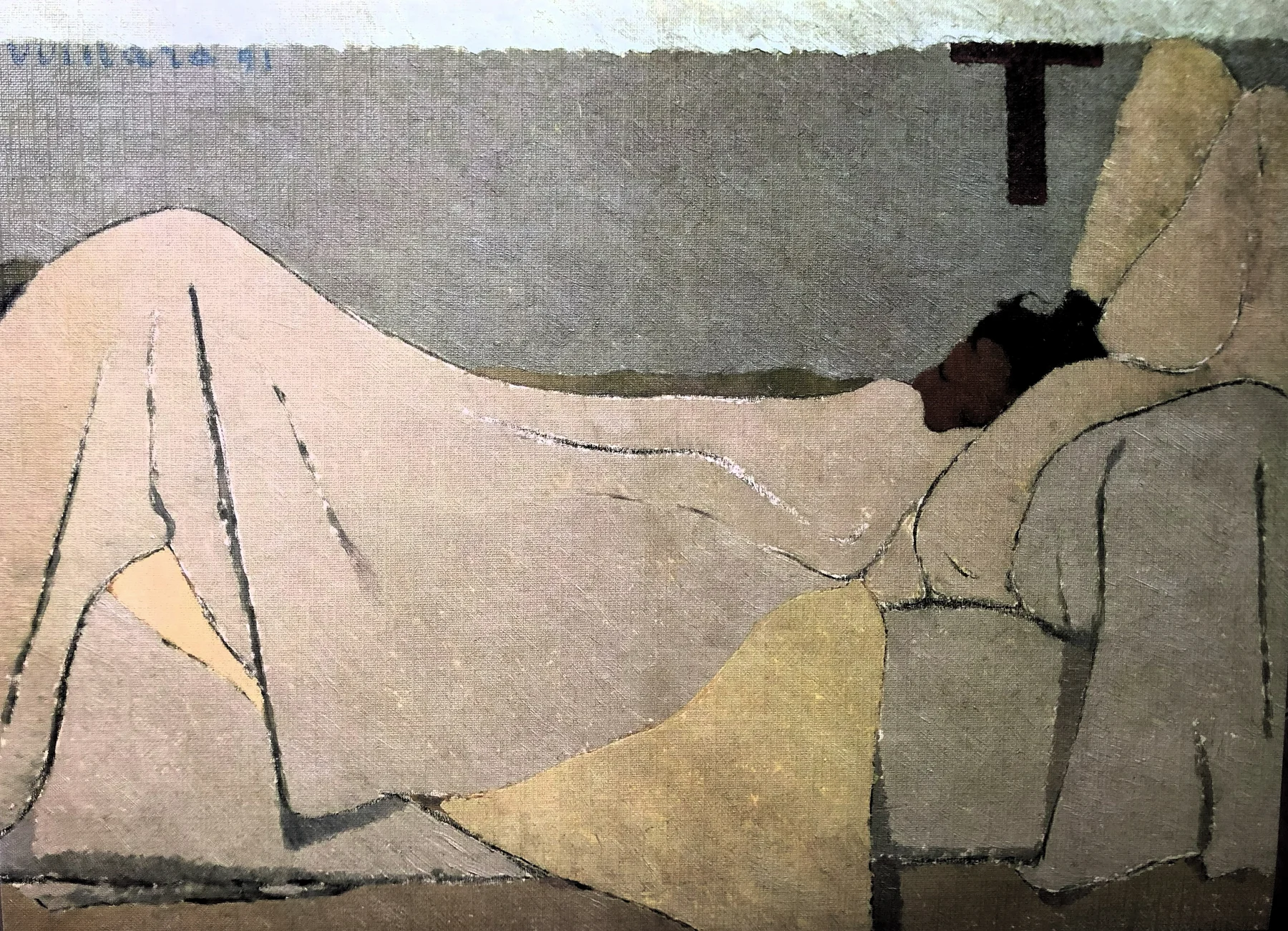
IN BED
Édouard Vuillard
- Artist
- Édouard Vuillard (1868–1940)
- Date
- 1891
- Dimensions
- 73 x 92.5 cm
- Medium
- Oil on canvas
- Location
- Musée d'Orsay, Paris
The quiet, famously modest French painter Édouard Vuillard once said: “I have never been anything but a spectator.” Vuillard was a great observer of everyday life, and he endowed his characteristic, intimate domestic interiors with extraordinary subtlety and a unique charm. The artist also painted large decorative pictures, and later in his career he was commissioned to make a number of portraits. In Bed is an early work from 1891, presenting the refreshing pleasures of an afternoon nap.
The Nabis – Post-Impressionists
In the spring of 1891 Édouard Vuillard moved to 28 rue Pigalle in Paris, a cramped studio apartment that he shared with his friends Pierre Bonnard, Aurélien Lugné-Poe and Maurice Denis. Lugné-Poe, the actor-manager of the avant-garde Théâtre de l’Oeuvre and an intermediary who helped sell the three friends’ works, later recalled: “This was when the Nabis were born — pure-hearted prophets of painting, who formed a new branch on the trunk of the proud tree associated with the names of Signac, Seurat and Pissarro.”
Muted Colours
Vuillard had in fact joined this group of artists in 1889; it was strongly influenced by the Synthetist views of Paul Gauguin (1848–1903) and Émile Bernard (1868–1941), who sought to use the simplest possible lines and colours in their pictures. Vuillard experimented with using muted colours in broad fields, and Gauguin’s influence is immediately apparent in two of his paintings from 1890, The Seamstresses and Lilacs, famous for its loud colours and strong contrasts of light and shadow. In In Bed, made the following year, the artist adapted his more restrained colours to the theme of sleep. Vuillard made many pictures connected with sleep in this period, such as Woman in Bed (1891), Sleeping Girl and Sleep (both 1892).
Master of Oil Paint
Vuillard loved working with a particular kind of distemper, which took a long time to prepare and was not easy to use, but which dried relatively quickly and allowed the surface to be reworked at will. For In Bed, however, Vuillard used oil paint, which meant working on the canvas without retouching. In his masterly use of paint Vuillard depicted the pale brown blankets, sheets and pillows in soft tones with infinite simplicity and ease, separating broad areas from one another by alternating straight and sensuously curving lines. Despite the flat surface of the painting, the artist creates an illusion of space and depth with subtle greyish shading.
Daytime Slumber
A young girl is asleep in her bed. The pretty mound formed by her drawn-up knees slopes gently towards her half-covered face. The light in the painting suggests that we are looking at a daytime nap. Vuillard depicts the bedroom scene with light strokes, so that in the viewer’s imagination the young girl sinks into the mysterious world of a happy dream rather than a restless nightmare. The handling of form is surprising but extremely economical: the closed eyes are indicated by just two dark arcs; that is all Vuillard shows of the girl’s face. Her olive skin and dark brown hair with a few unruly strands contrast with the lighter shades of her pillows.
The Cross
The strange T-shaped geometric form above the girl’s head is a cross, cut off by the horizontal line of a canopy or veil; on the left, directly below this line, are the artist’s signature and the date. The symbolism of the cross lends the picture a religious dimension — Vuillard was educated by the Marist Brothers, a Catholic religious community founded in France by Marcellin Champagnat. While the cross may allude to the transience of life, the bold vertical line both directs attention to the girl’s head and gives the impression that a loving being is watching over her sleep from above.
A Dream as a Gift
In accordance with Édouard Vuillard’s oral will, In Bed was donated to the French state in 1941 by M. and Mme Ker-Xavier Roussel (Vuillard’s brother-in-law and sister). It was first placed in the collection of the Museum of Modern Art in Paris and moved in 1986 to the Musée d'Orsay, where it can still be seen today together with five panels of the decorative series Public Gardens.
Artistic Connection
For Édouard Vuillard and his friends’ group of artists, the Nabis, the French painter Paul Gauguin provided the initial inspiration. Paul Sérusier, having met Gauguin in Brittany, returned to the Académie Julian with a small scene painted on the lid of a cigar box, which became known as The Talisman. Gauguin had encouraged Sérusier to paint a forest landscape according to Synthetist methods with vivid colours applied straight from the tube without mixing. The picture had a catalysing effect on all members of the Nabis group, and Maurice Denis (pictured) later declared: “Gauguin set us free.”
- Aurélien Lugné-Poe
- Émile Bernard
- Interior of the Musée d'Orsay
- Marcellin Champagnat