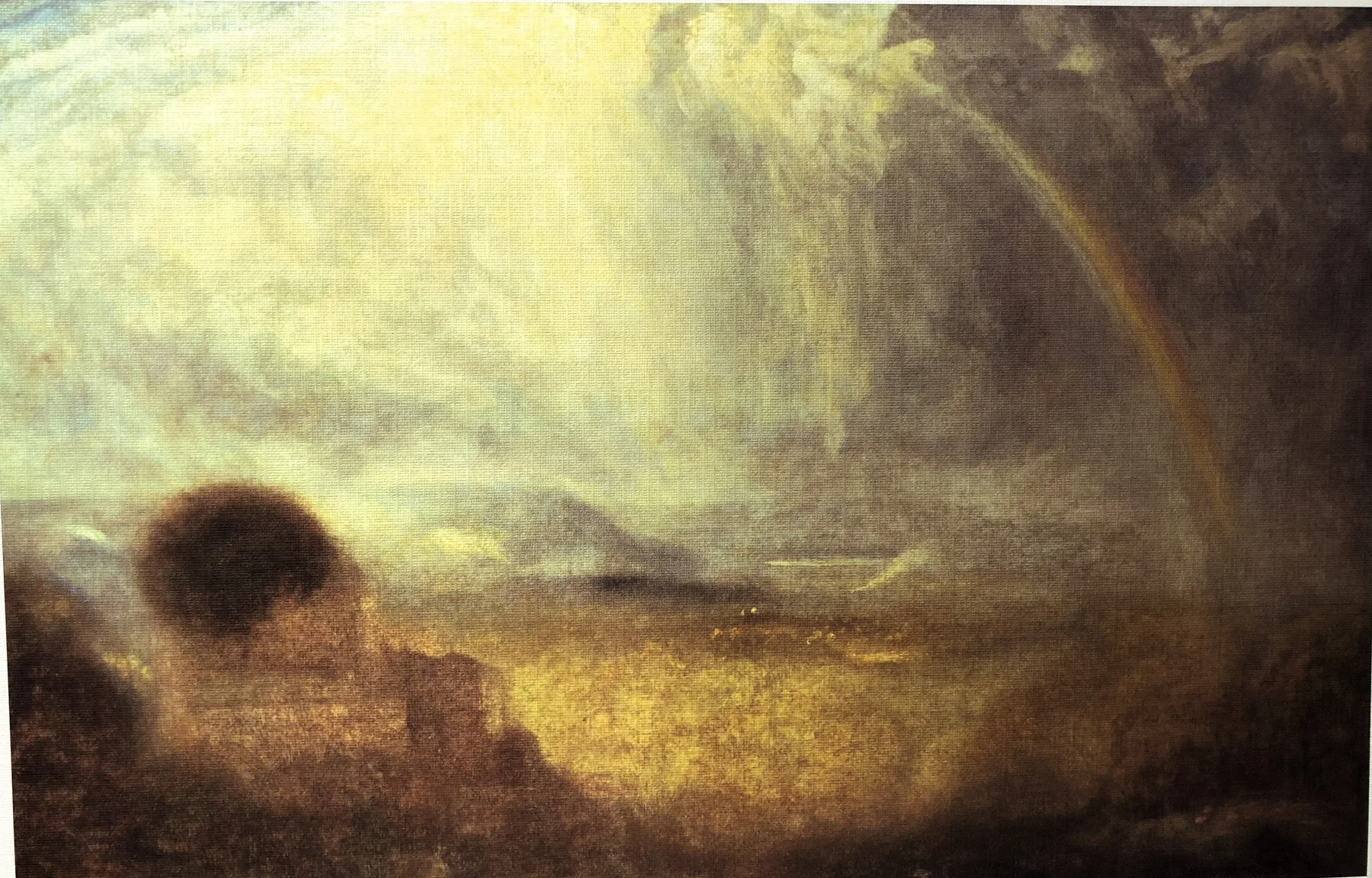
LANDSCAPE WITH A RAINBOW
J. M. W. Turner
- Artist
- Joseph Mallord William Turner (1775–1851)
- Date
- Unknown
- Dimensions
- 91.4 x 137 cm
- Medium
- Oil on canvas
- Location
- Private collection
“When I was a child,” J. M. W. Turner once recalled in later life, “I often lay on my back for hours, looking at the sky, and then went home and painted it.” This youthful attraction to depicting natural light led to a lifelong vocation. In this airy landscape almost every topographical detail recedes in favour of capturing the dramatic scene, as sunlight dances around a ruined church in wild country while storm clouds sweep across the darkening sky. This painting is one of Turner’s least-known works and was discovered only recently, in rather unusual circumstances.
Picturesque Romanticism
With its ruined stone church, naturalistic landscape and stormy sky, Landscape with a Rainbow is a model example of the picturesque scene. In Turner’s time the term “picturesque” applied to landscapes that offered an attractive mixture of architectural elements and natural scenery, or combined a sense of tranquil beauty with the presence of the threatening power of the elements.
The picturesque was one manifestation of the Romantic movement that swept through European art, music and literature in the late 18th and early 19th centuries. Turner, one of the leading exponents of Romanticism, often raised his evocative landscapes into otherworldly spheres with stunning inventiveness and bold handling of colour.
A Humanist Vision of the World
Turner’s immense, almost universal humanism is always present in his landscapes, often in the form of fragile man facing the deadly power of nature. His paintings frequently feature ships battered by wild seas (for example The Shipwreck of 1805) or raging storms falling on defenceless travellers (Snow Storm: Hannibal and His Army Crossing the Alps, 1812).
In this picture the human motif is evoked mainly by the ruined church, but it is also indirectly alluded to by the distant, wind-blown column of smoke and by the group of domestic animals seeking shelter in the thicket in the right foreground. If the painting were not in such poor condition, one or two figures might well be discernible hurrying into the church to escape the heavy rain.
Light Above All
Like his contemporary John Constable, Turner was captivated by the physical properties of sunlight; in 1804 and 1824, for example, he made sketches of solar eclipses. In the 1840s he studied in depth the theory of the German writer Johann Wolfgang von Goethe, who attempted to refute Isaac Newton’s theory of colour. (It was Newton who in the 1660s split white light into the seven colours of the rainbow by passing it through a glass prism.)
Rainbows often appear in Turner’s works, for example in Arundel Castle with Rainbow (1824). In Buttermere Lake (1798), however, we see a fogbow, an essentially white natural phenomenon in which the water droplets are too small to produce distinct colours.
A Genuine Work of Art
The rediscovery of Landscape with a Rainbow caused one of the biggest press sensations of recent years. In 1985 the owner of a worn, heavily soiled canvas, who had no money to restore the picture, sold it cheaply to the Montreal restoration firm of the Hungarian-born brothers Peter Paul Biro and Laszlo Biro. After the Biro brothers had carefully removed the accumulated layers of dirt, to their great surprise an unknown Turner landscape with a wonderful rainbow was revealed. They then travelled to England in the hope of finding the probable location of the landscape in the painting; they most suspected the village of Millom in Cumbria, which now lies in the Lake District National Park.
In 1987 Peter Paul took Landscape with a Rainbow to the experts at the Tate Gallery in London for authentication, who judged it a fake. As he studied Turner’s other works at the Tate, Peter Paul noticed faint fingerprints on the pictures. The artist was famous for smearing the paint on the canvas with his fingers, so that their marks remained on the paintings. The question occurred to Biro: if he took “fingerprints” from his own picture, could he prove its authenticity with modern means?
The following years were spent on this work, until in 1994 a police expert confirmed that the fingerprints found on Landscape with a Rainbow matched Turner’s. (This was the first such proof procedure concerning the authenticity of a painting.) Opinion in the art world was divided at first, but the new evidence convinced even the previously sceptical experts, who now also came down in favour of the painting’s authenticity. On 12 December 1995 Landscape with a Rainbow sold at auction for more than 150,000 dollars. (The price might have been higher had it not been for the careless storage and soiling, still visible today as large brown stains in the lower left part of the picture.)
Artistic Connections
Turner’s art was shaped by two main influences. One was the Dutch school, whose traces are clearly evident in his lifelong attachment to seascapes and in his more realistic landscapes, such as Frosty Morning (1813). The other influence came from the French painter Claude Lorrain (1600–1682), who together with Nicolas Poussin (1594–1665) founded the tradition of classical landscape painting in the 17th century. Turner was amazed by Claude’s masterly handling of light and paid his debt in works such as Dido Building Carthage (1815, pictured).
- Snow Storm: Hannibal and His Army Crossing the Alps
- J. W. Goethe
- Millom, Cumbria today