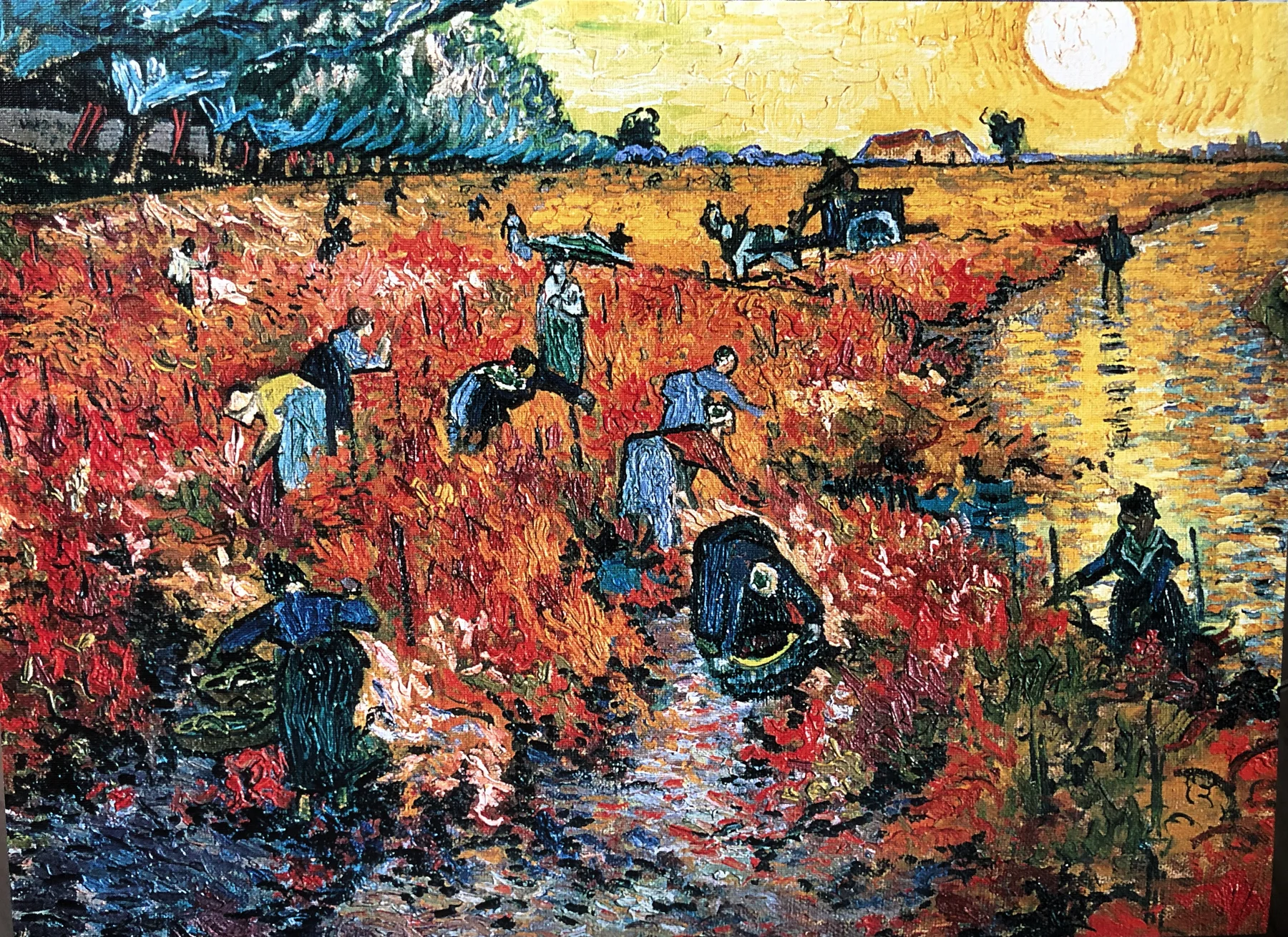
THE RED VINEYARD AT ARLES
Vincent van Gogh
- Artist
- Vincent van Gogh (1853–1890)
- Date
- 1888
- Dimensions
- 73 x 91 cm
- Medium
- Oil on canvas
- Location
- Pushkin Museum, Moscow
The Red Vineyard at Arles dates from the autumn of 1888, when Van Gogh was living in the so-called “Yellow House” in Arles in the south of France. Working in a heightened state, almost to the point of exhaustion, the artist downed one coffee after another and smoked and drank to excess. A few weeks before painting The Red Vineyard at Arles, Paul Gauguin moved in with Van Gogh in the Yellow House, beginning a period of initially fruitful artistic collaboration.
Like Red Wine
In early November 1888 Van Gogh wrote to his brother Theo that he had at last managed to paint the portrait of the café owner Madame Ginoux, titled The Arlésienne, as well as the “falling leaves” of the poplars. It was autumn, and after a walk with Gauguin he painted The Red Vineyard at Arles outdoors. In his letter he described the landscape to Theo: “if you had been with us on Sunday, you would have seen a red vineyard, all red like red wine.”
Van Gogh’s description need not be taken literally, but the rays of the setting autumn sun did turn the vineyards a reddish hue, and the parallel with the juice of the grape suited the landscape. As a colourist painter Van Gogh liked to use garish colours. Despite his break with natural hues, and despite the greater freedom and looser style offered by oil paint, Van Gogh wanted to create a lifelike picture.
Complementary Colours
In early October 1888 Van Gogh finished The Green Vineyard, depicting a similar scene mainly in greenish shades. Based on an idea the artist had worked out in early summer, the picture was the first in the vineyard series, which was followed by a number of lively wheatfield landscapes. After completing The Red Vineyard at Arles in the autumn of 1888, Van Gogh began to refer to the two paintings together. He liked to think of his pictures in terms of the relationship created by opposing colours, just as the colours of The Red Vineyard at Arles are complementary to those of The Green Vineyard.
The Only Sale
In 1889 the art critic Octave Maus invited Van Gogh to send pictures to the exhibition of the group Les XX (the Twenty) in Brussels. Van Gogh submitted six works, including The Red Vineyard at Arles, to the exhibition that opened in January 1890. The painting was bought for 400 francs by Anna Boch, a member of Les XX and sister of the Belgian painter Eugène Boch (whom Van Gogh had portrayed in 1888). The Red Vineyard at Arles is said to be the only painting Van Gogh ever sold. The picture remained part of the Anna Boch Collection until the artist’s death and is now on display in the Pushkin Museum in Moscow.
A Raised Surface
Paul Gauguin did not like Van Gogh’s impasto technique (in which a thick layer of paint stands out from the surface of the canvas) and remarked: “[Van Gogh] relies on his thickly applied paint.” Van Gogh admired the late style of the French painter Adolphe Monticelli (1824–1886), who applied his freely used rich colours to the canvas in a vivid impasto style, giving texture to his pictures, and Van Gogh too began to experiment with this distinctive painting technique.
Colour Composition
Van Gogh did not leave his colours to chance and always approached his compositions from the point of view of pure colour. Alongside the dominant red hues of The Red Vineyard at Arles Van Gogh added the following note: “In the distance it turns yellow, the sunny sky takes on a greenish tone, the rain-soaked earth becomes violet, with brilliant yellows here and there where it reflects the rays of the setting sun.”
Fruit Season
The harvesters in the vineyard scene put the autumn fruit into baskets. Their postures recall the North Brabant peasants depicted in the artist’s early drawings, such as Peasant Woman Stooping or Peasant Woman Digging. Among the harvesters, in the middle background, a woman with a parasol walks across the fields, similar to the figures with red umbrellas in The Green Vineyard. That painting lacks the source of light and warmth, the sun, which on the other hand shines strongly in The Red Vineyard at Arles. Although summer is over and the sun is setting, the rich red hues of the painting speak not only of the autumn landscape and mood the painter loved but also of an abundant harvest.
- Vincent van Gogh
- The Green Vineyard
- Paul Gauguin
- Peasant Woman Digging
- Interior of the Pushkin Museum