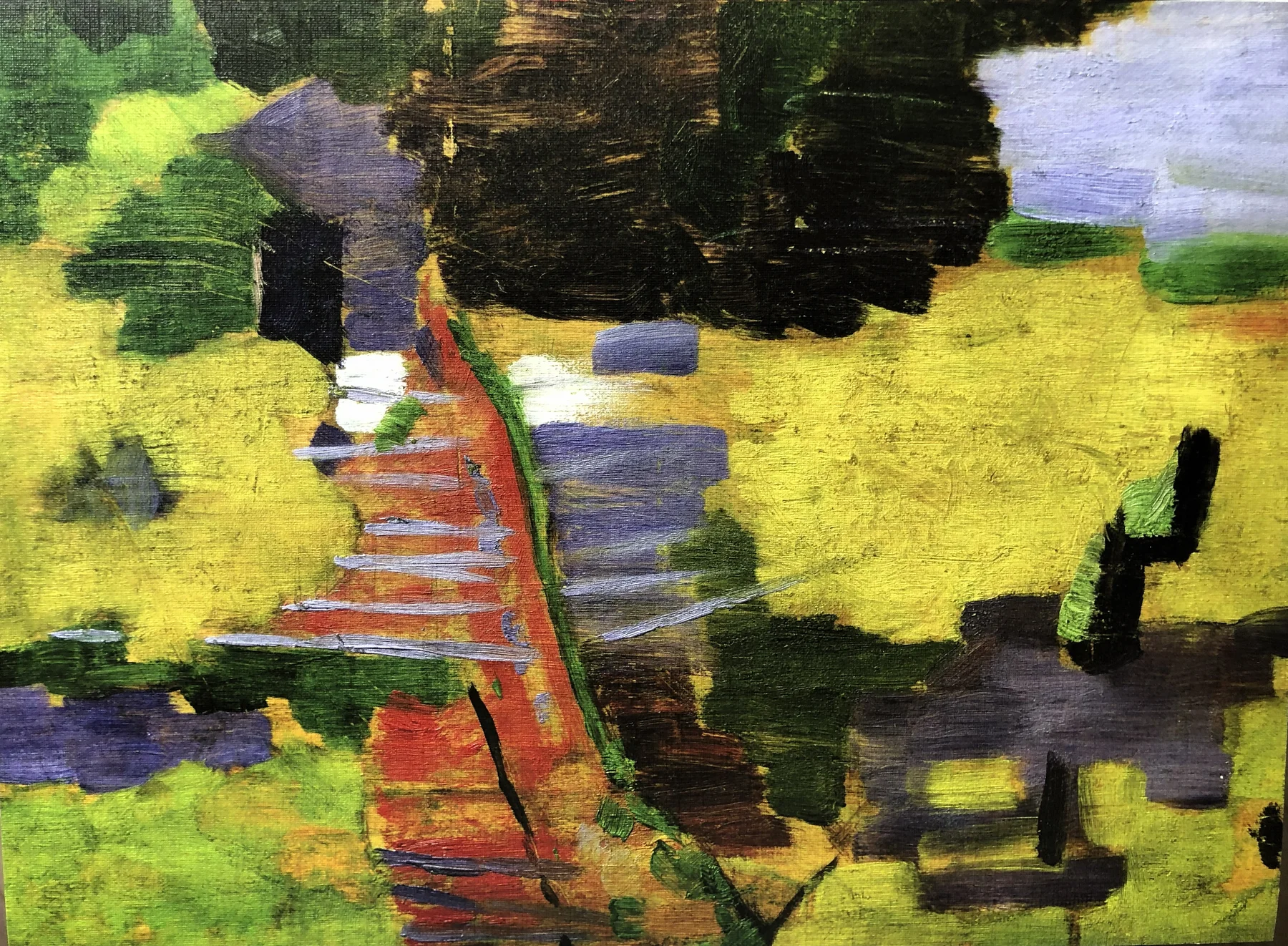
THE TALISMAN
Paul Sérusier
- Artist
- Paul Sérusier (1863–1927)
- Date
- 1888
- Dimensions
- 27 x 21.5 cm
- Medium
- Oil on panel
- Location
- Musée d'Orsay, Paris
The Nabis group, associated with the name of its charismatic leader Paul Sérusier, represented one of the most popular art movements in France at the end of the 19th century. Passionate admirers of Paul Gauguin and Paul Cézanne, the movement raised its banner against Impressionism. The captivating story of the birth of the Nabis began with the creation of their sacred “talisman”: this sunny riverside scene of Pont-Aven in Brittany was painted by the young Paul Sérusier on the lid of a cigar box in 1888 under the guidance of his mentor, Gauguin.
Gauguin, the Source
In the late 1880s Gauguin and his followers, including Emile Bernard, Emile Schuffenecker and Charles Laval, established a rural artists’ colony at Pont-Aven in Brittany, loved for its tranquillity and ancient Celtic charm, where they began working in a style they called Synthetism. Drawing on Cézanne’s pioneering example, through the use of flat perspectives, pure colours and simplified forms with strong outlines, they created strikingly austere and expressive landscapes, several of which depicted local peasants in Breton dress.
Revelation in the Woods
Sérusier, a student at the Académie Julian in Paris, first came to Pont-Aven and met Gauguin during a school holiday. Towards the end of Sérusier’s visit Gauguin took him for a walk in the Bois d’Amour wood beside the River Aven, where he expounded his views on art and then gave the young artist advice on this quickly sketched landscape. When Sérusier returned to the Julian, he showed the sketch to his classmates, including Pierre Bonnard, Maurice Denis, Gabriel Ibels and Paul Ranson. Denis later recalled: “The lid of a cigar box on which a landscape emerges, free of all form, built up in a Synthetist manner, speckled with patches of violet, crimson, Veronese green and other colours, applied straight from the tube… ‘How does this tree look to you?’ Gauguin had asked him… ‘Bright green, doesn’t it? Then take some green, the best green on your palette. And this shadow is really blue, isn’t it? Don’t be afraid — paint it as blue as you can.’”
Sérusier’s friends regarded this painting as a kind of magical icon or amulet, The Talisman, as they christened the movement’s first work.
Another Reality
What was so revolutionary about The Talisman? The students of the Julian were trained in a conservative, academic spirit, and hardly any of them had seen an Impressionist painting. They looked at the riverside sketch in amazement. The picture had no focus, and the lines were covered by colours applied with a flat, square brush. And what colours! Yellow trees… mauve beech trunks lining a crimson path… the only “real” object was the little mill building.
The picture depicted a new kind of reality. The Talisman offered a freedom never seen before, a departure from slavish copying. Painting was now much more about the canvas — expressive marks, decorative effects — than about the content of the view or illusionistic effects. This work was an influential step towards modernism and abstraction.
Seers and Thinkers
This small group of artists, soon joined by René Piot, Ker-Xavier Roussel and Édouard Vuillard, came together in a common movement. Through distorted lines, compositions and colours the Nabis sought to express the essence hidden in a painting, as opposed to merely copying what was seen, marking a shift from the optical world to the realm of the spirit. Their leader was naturally Sérusier, who introduced them to the works of Gauguin, the Impressionists and Cézanne. “Art,” he argued, “is a means of communication between souls.” He gave the group the name Nabis, derived from the Hebrew word nebiim, meaning seers or prophets, and the painters did everything to live up to the spirit of the name: they took nicknames, wore cultish clothes and even communicated with one another in a secret code. Over the next ten years they regularly organised joint exhibitions, before each Nabi went his own way.
Artistic Connections
Sérusier and Gauguin were close friends from 1888, painting together at Pont-Aven and from 1891 at Le Pouldu. Thanks to his intelligence, erudition and articulacy, Sérusier was able to convey Gauguin’s profound ideas to the members of the group. Although Gauguin had an enormous influence on him, especially with his ultra-modern picture Vision after the Sermon: Jacob Wrestling with the Angel (1888), Sérusier gradually developed his own, more contemplative style. The two painters later drifted apart; this was especially true of 1893, when in his quest for the exotic Gauguin headed for the tropical South Seas, while Sérusier found inspiration in Brittany.
- Landscape at Le Pouldu, one of Sérusier’s Breton paintings
- Pierre Bonnard
- Gauguin: Washerwomen at Pont-Aven