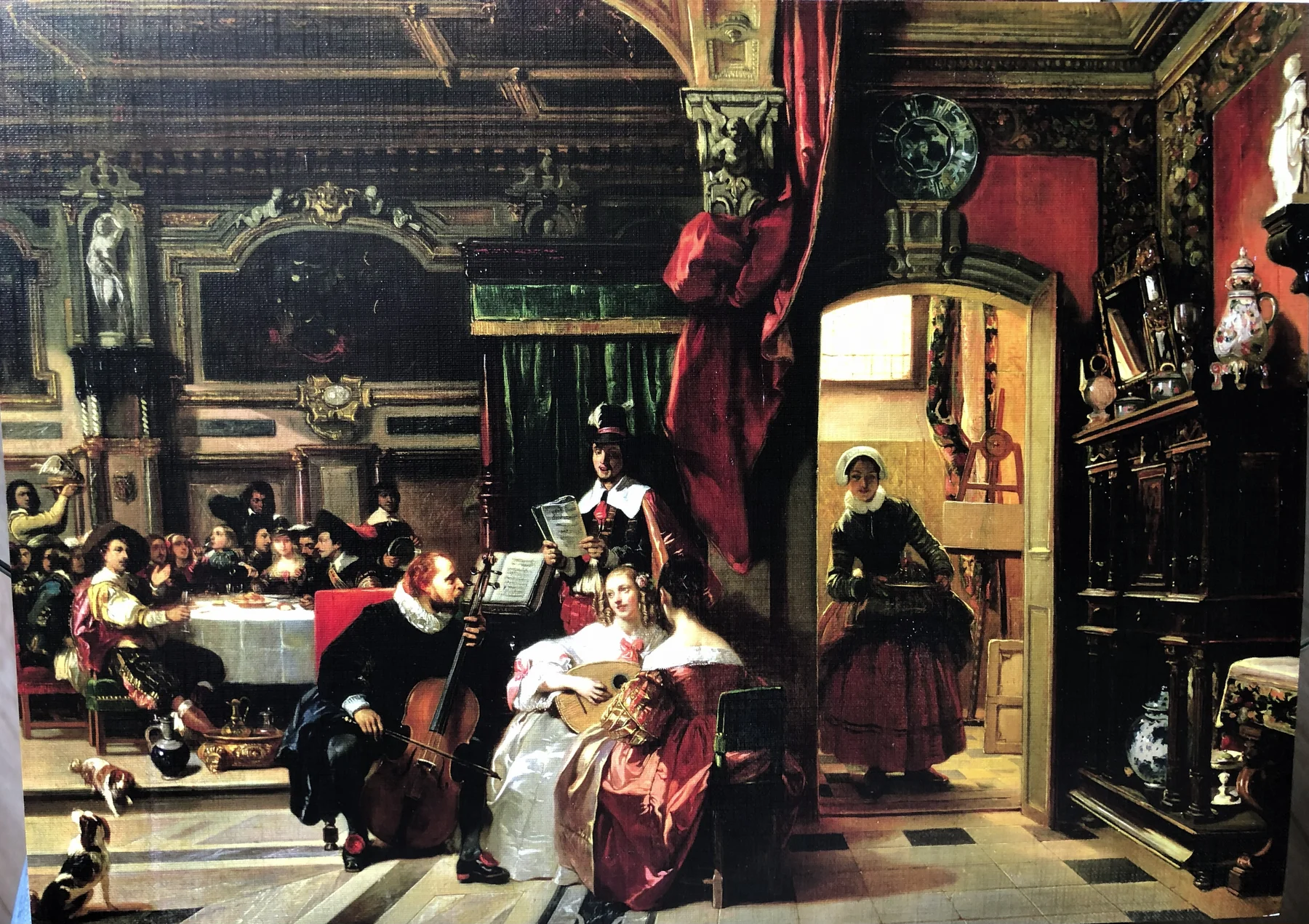
SIR ANTHONY VAN DYCK IN LONDON
Camille Roqueplan
- Artist
- Camille Roqueplan (1800–1855)
- Date
- 1837
- Dimensions
- 89.5 x 116.5 cm
- Medium
- Oil on canvas
- Location
- Petit Palais, Musée de la Ville de Paris, France
The French painter Camille Roqueplan lived and studied in Paris in the first half of the 19th century, when the French capital, famous for its culture, was the artistic centre of Europe. Working mainly in oil and watercolour, Roqueplan painted landscapes, sea scenes, works depicting historical events and genre pictures. Although Roqueplan’s name is little known today, the French artist enjoyed great recognition in his own time and also played a leading role as a lithographer. At the height of his fame he painted Sir Anthony van Dyck in London, which was exhibited at the Paris Salon the following year, 1838.
Starting Small
Camille Roqueplan’s small early landscapes, such as Italian Landscape, Evening (1832), were influenced by the freely applied watercolour technique of the English painter and lithographer R. P. Bonington and by the works of the painter and graphic artist Eugène Isabey. By the mid-1830s, however, Roqueplan was already painting larger, anecdotal pictures, and he gained considerable fame with The Lion in Love (1836), made as an illustration to one of the fables of the French writer Jean de La Fontaine. The following year, 1837, in the style of his former master Antoine-Jean Gros, he painted a war scene from the Napoleonic era, The Battle of Elchingen, for the Museum of History in the Palace of Versailles. In the same year he finished Sir Anthony van Dyck in London, an original work harking back to an earlier age, in which he presents Van Dyck at the centre of London social life in the first half of the 17th century.
A Famous Personality
The protagonist of Roqueplan’s painting is the Flemish painter Anthony van Dyck (1599–1641), who was appointed principal court and portrait painter to King Charles I of England in 1632, although he had already visited and worked in the country in 1620–21 at the court of the previous Stuart monarch, James I. Trained in Peter Paul Rubens’ workshop in Antwerp, Van Dyck was by then already a well-known artist in Flanders. The scene in the genre picture Sir Anthony van Dyck in London probably takes place after 1632, after Charles I had knighted his favourite painter. Many of the legends circulating about Van Dyck have proved false, but we know that during his stay in London the painter liked to move in higher circles. The memorial erected in his honour by Charles I in St Paul’s Cathedral recalls him thus: “he lived sumptuously, more like a prince than a painter.”
Eclectic Influences
Roqueplan worked in an eclectic style; his art was influenced especially by the 16th-century Venetian painters, the 17th-century Dutch and Flemish masters and the representatives of French Rococo. His works were also significantly influenced by the works of contemporary English painters, including Bonington and Constable. Roqueplan was highly regarded for the colour harmony and light effects of his pictures.
A Musical Gathering
Roqueplan’s painting Sir Anthony van Dyck in London depicts an interior scene showing the famous court painter at the centre of social life rather than in a direct portrait. Set two centuries before Roqueplan’s time, the scene takes place in a luxurious, richly decorated town house in the English capital. In the genre picture three seated musicians and a male singer entertain the finely dressed gathering, the cream of London society. Based on numerous self-portraits of the Flemish painter, the painting shows the bearded Van Dyck playing a bass viol.
Roqueplan conveys a sense of spontaneity through the skilful use of an open doorway — a favourite device of the Dutch painter Pieter de Hooch (1629–1684), as can be seen in his work Musical Party in a Courtyard (1677) — and in this way he can show two different scenes in one interior, dividing the canvas into two picture areas of different sizes. The viewer’s eye focuses on the brightly lit doorway, where a maidservant — invisible to the figures in the painting — cranes her neck to hear better the music filtering out of the reception room. Behind her leaning figure we get a glimpse of Van Dyck’s temporary studio: the large easel and canvases stand ready for the famous artist’s brushstrokes, to capture the merry company.
Artistic Connection
The works of the British painter Richard Parkes Bonington (1802–1828), usually known as R. P. Bonington, influenced Camille Roqueplan’s early art. Like Roqueplan, Bonington attended the École des Beaux-Arts, studied under Antoine-Jean Gros (his studio pictured), and later, during the development of Romanticism, made a lasting impression on many French and British painters. Bonington was one of the first artists in France to make his watercolours outdoors rather than in the studio, and his work is regarded today as a link between the English landscape painters, including Constable, and the French Barbizon painters.
- Anthony van Dyck
- Richard Parkes Bonington
- The Lion in Love