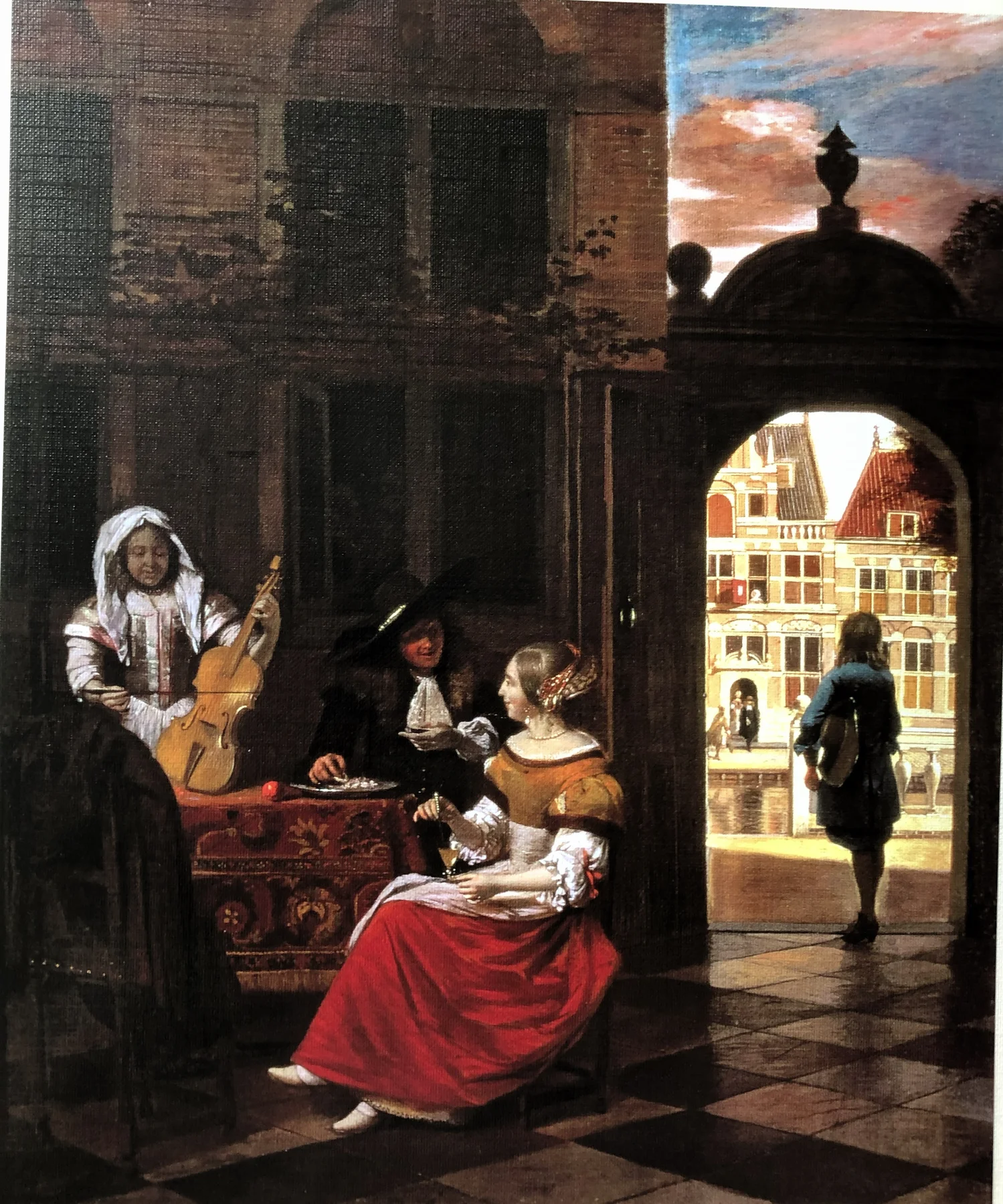
MUSICAL PARTY IN A COURTYARD
Pieter de Hooch
- Artist
- Pieter de Hooch (1629–1684)
- Date
- 1677
- Dimensions
- 83.5 x 68.5 cm
- Medium
- Oil on canvas
- Location
- National Gallery, London
Pieter de Hooch was one of the many excellent painters of the 17th-century Dutch Golden Age, a time when most of Europe’s artists worked here. De Hooch liked best to paint well-lit interiors with views into adjoining rooms or corridors and courtyards. He depicted the intimate scenes set there with perfect perspective. His balanced, geometric compositions present the simple events of everyday life.
Elegant Subjects
Pieter de Hooch painted Musical Party in a Courtyard in 1677. He had moved to Amsterdam more than fifteen years earlier, perhaps as early as 1660 or 1661. After his depictions of simple interiors and bright courtyards in Delft, such as The Courtyard of a House in Delft (1658), this painting shows a development in style. In his Amsterdam paintings of the 1660s and 1670s de Hooch turned to more elegant and refined subjects than in his Delft pictures; his colours became darker and his palette more colourful. His colour scheme recalls Vermeer’s, but his favourite subjects are distinctly different. Although the quality of his late works is uneven, Musical Party in a Courtyard clearly illustrates the Dutch artist’s professional skill and refined compositional ability.
A Dutch Master in London
Careful examination of the dark arch above the gateway reveals de Hooch’s signature and the date 1677, the year the picture was made. After that no record mentions the painting for more than a century, until 1833, when it was bought in The Hague by Jonkheer Johan Steengracht van Oostkappelle. By order of the executors of the Steengracht estate, the picture was sold in 1913 for 84,000 francs. Three years later, in 1916, the painting was acquired by the National Gallery in London, where it is still on display together with other pictures by the artist, including perhaps his most famous work, The Courtyard of a House in Delft.
Texture and Light
De Hooch masterfully depicted light and various textures in his pictures. In the dark foreground of Musical Party in a Courtyard a woman playing a viola entertains a seated couple. At first glance the half-light suggests a darkened room interior, but the title makes it clear that the setting is a courtyard, which the artist makes intimate through his skilled depiction of natural light and shadow. In the brightly lit area beyond the open arch the afternoon sun casts its rays on the canal, while the foreground scene takes place in darkness. De Hooch also delights in depicting the pattern of the floor tiles, the red dress and the texture of the patterned Persian rug covering the table.
A Secret Rendezvous
The protagonists of de Hooch’s Musical Party in a Courtyard are a lady and her suitor, enjoying each other’s company over a glass of wine and a plate of oysters. The couple, absorbed in each other, seem oblivious to the woman standing beside them, who heightens the romantic mood with the soft melodies of the viola. De Hooch often depicted Dutch women and men drinking together, for example in Two Soldiers and a Woman Drinking in a Courtyard (c. 1658–1660) and A Seated Couple and a Woman in a Garden (c. 1663–1665).
The painting can be divided into two picture areas of different sizes. The bright, narrower strip on the right creates a sense of timelessness with the silhouette of a young man in a fashionable blue suit standing under the arch, his back to the courtyard, watching the life of the sunlit canal before him. The artist painted the tall gabled houses typical of the architecture of Amsterdam’s concentric canals on the model of the buildings of the Keizersgracht. (On the plaque of the building on the left, above the woman in a white cap standing at the window, the year 1620 can be seen.) Despite the two adjoining scenes, the people painted in each area seem to live in separate worlds, ignoring one another, lending the courtyard rendezvous a mysterious and dramatic mood.
Artistic Connection
De Hooch’s art influenced his fellow Dutch painter Johannes Vermeer (1632–1675). No document is available to prove a connection between the two painters, but they both lived in Delft at the same time and almost certainly knew each other. Judging by the similarity of their style and subjects, they may have been in close contact in the period 1655–1660. Vermeer further refined de Hooch’s artistic toolkit and eventually became the more famous and acclaimed painter.
- The Courtyard of a House in Delft
- National Gallery, London
- Two Soldiers and a Woman Drinking in a Courtyard
- Gabled houses today