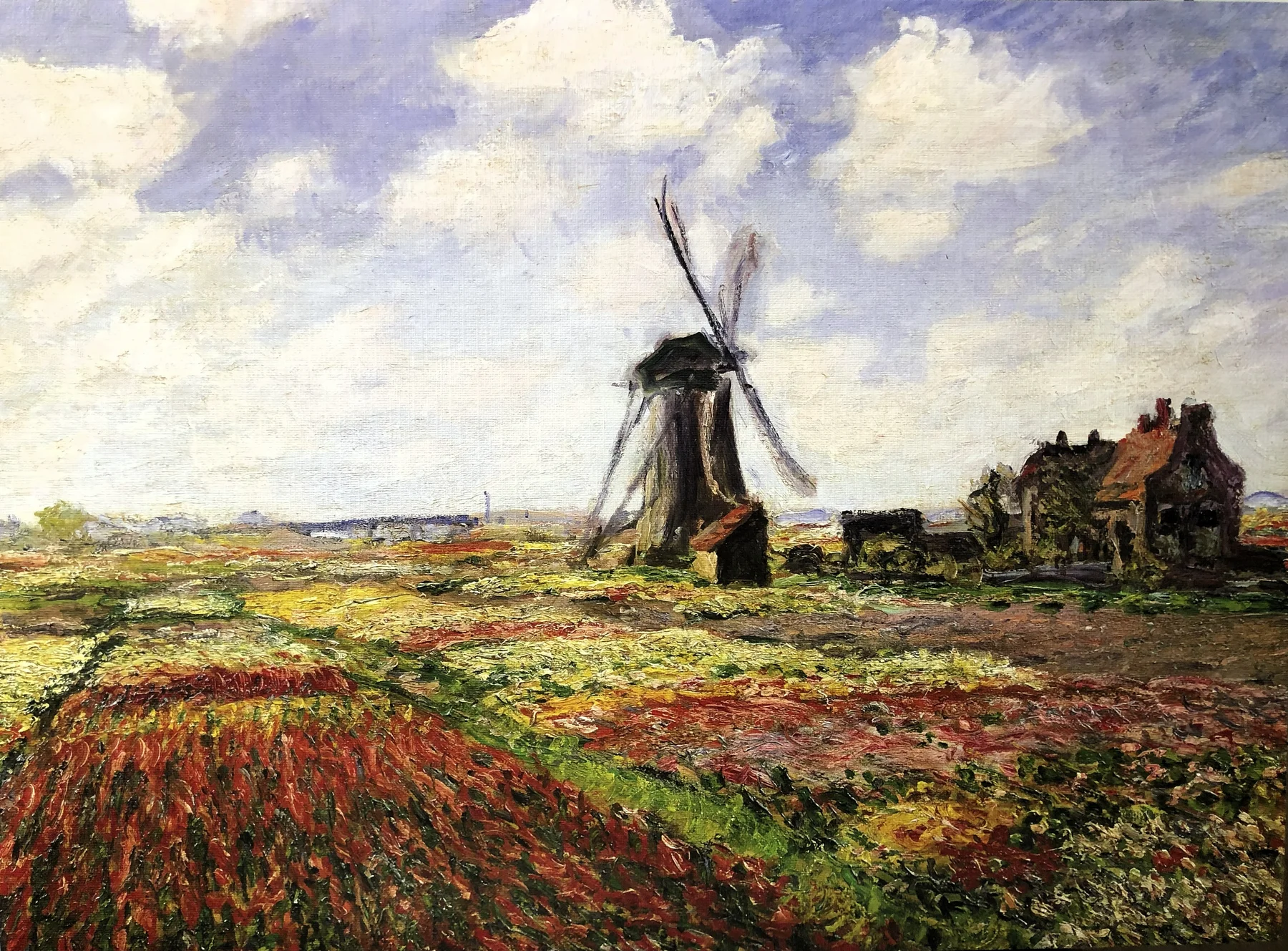
TULIP FIELDS WITH THE RIJNSBURG WINDMILL
Claude Monet
- Artist
- Claude Monet (1840–1926)
- Date
- 1886
- Dimensions
- 65.5 x 81.3 cm
- Medium
- Oil on canvas
- Location
- Musée d'Orsay, Paris, France
In the 1880s Monet travelled through much of France and also went abroad to find new subjects. In the course of this he reached the country famous for its tulips, the Netherlands. Despite all its artificiality, the colourful landscape was an irresistible challenge for the artist, known for his love of flowers.
First Trip to Holland
Monet visited the Netherlands twice. His first, longer trip fell between June and October–November 1871. He arrived in the country by boat from London and spent almost all his time painting in a beautiful little village called Zaan, north of Amsterdam, where he made some 24 pictures. The artist wrote happily to Camille Pissarro: “an excellent place for painting, with houses of every colour, hundreds of windmills, charming boats and extremely friendly Dutch people, almost all of whom speak French”. A fine souvenir of his visit to Holland is the set of blue earthenware he also portrayed in his garden scenes at Argenteuil and Vétheuil in the 1870s and 1880s.
The Land of Tulip Bulbs
Monet returned to Holland in 1886 at the invitation of one of his patrons to paint the tulip fields near Rijnsburg and Sassenheim. The two small villages lie between Haarlem and Leiden, close to the flat coastline of the North Sea. However much he liked the Dutch — and of course flowers (by then he had begun laying out his famous flower garden at Giverny) — Monet was somewhat apprehensive about the task. “The tulip fields,” he wrote to a friend, “are quite wonderful, but they drive the poor painter mad, since it is impossible to render them with our own limited palette.”
The second, much shorter trip began with fierce spring gales, but the weather soon improved, and Monet painted five pictures, three of which captured the tulip fields and the mills of Rijnsburg.
A Region That Draws Tourists
Monet timed his trip to coincide with the tulip season. Haarlem had been the centre of the international tulip-bulb trade for more than two centuries, a trade so profitable that the cultivated fields stretched as far north as the Leiden area, and the colourful spectacle attracted tourists from far away. At certain times tulips were grown not for their flowers but mainly for their bulbs, which stored up their energy for the next flowering. In later years Monet recalled how spellbound he was when “around the little canals a riot of colour suddenly appeared, reflected as a yellow patch in the blue of the sky.” Above all, however, his eye was drawn to the endless, glittering flowerbeds of the fields.
Surprisingly few Dutch or other artists tried to paint the tulip fields. One exception was Vincent van Gogh, who in his picture Flower Beds in Holland (1883) combines the perspective of plantations set in regular rows with a contrast of bold colours.
Perspective and Space
Monet’s painting depicts the fields beside the “De Vlinder” mill and the mill’s outbuildings, which stood on the bank of the Oegstgeest Canal, which gave access to the coast a few miles to the north-west. (Sadly the windmill was demolished in the 1930s, and today a motorway runs alongside the canal.)
Monet began painting the canvas outdoors, en plein air, and finished the work in his studio. While he worked the sky thinly and translucently, he applied the paint thickly to the fields with an impasto technique, in a manner reminiscent of Van Gogh’s extravagant brushwork. Like Van Gogh’s painting, Monet also exploits the perspective of the bed edges running towards the horizon on the left. The racing clouds also direct our attention to the same point, but on a different scale. The overall effect is created by light and space: in the characteristically flat Dutch countryside the buildings reach so high that their outlines almost graze the sky.
“The Best Monet”
Monet showed his work that same summer at the fifth annual exhibition in Paris and then sold it to Winaretta Singer, daughter of the sewing-machine millionaire. After a visit to Winaretta’s family in 1903 Marcel Proust wrote enthusiastically about the painting, calling it “the best Monet he knew”.
- Zaan today
- Camille Pissarro
- The garden at Giverny
- Monet: Flower Fields and Windmills near Leiden (1886)
- Tulip fields near Haarlem today
- Marcel Proust