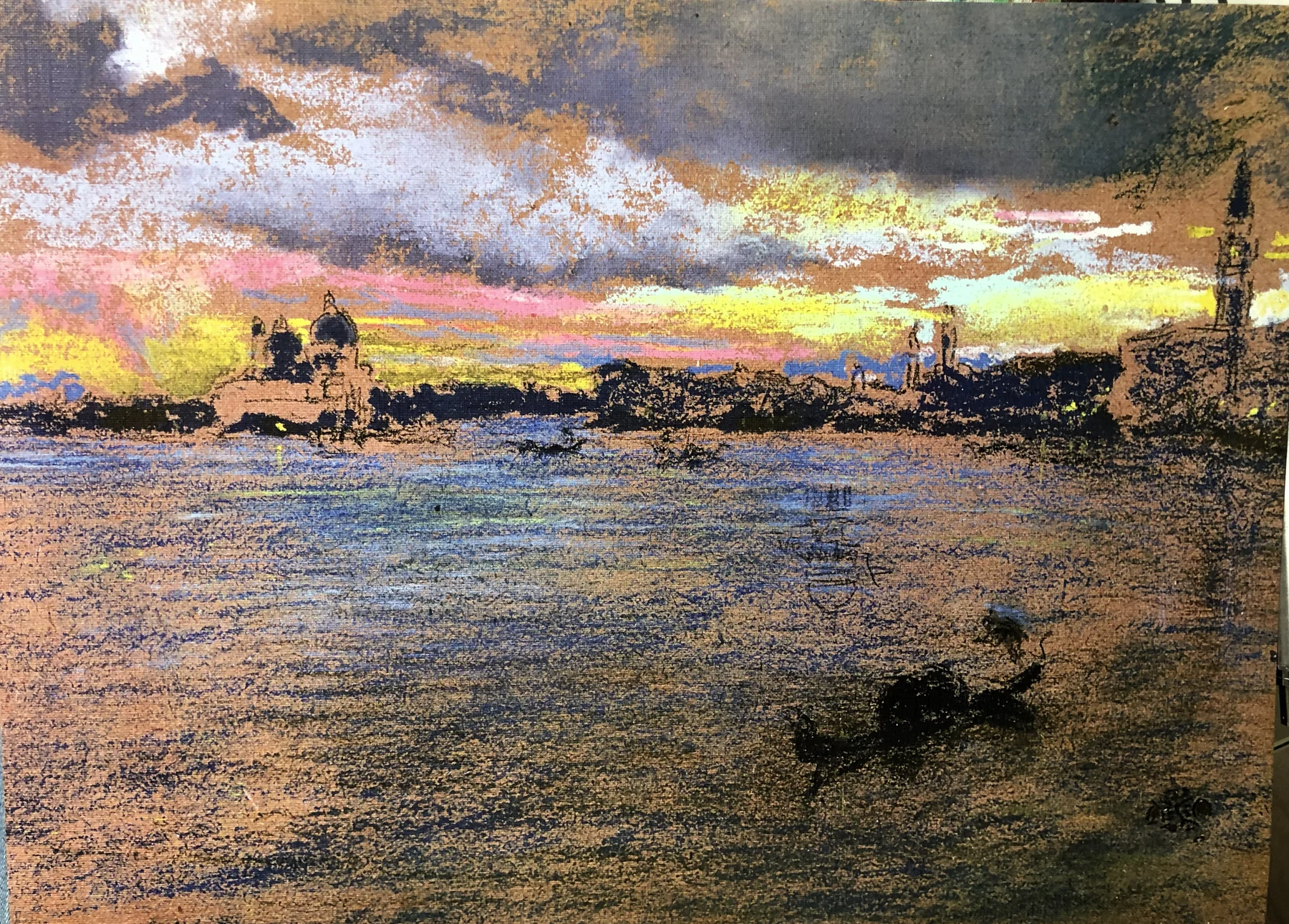
STORMY SUNSET
James McNeill Whistler
- Artist
- James McNeill Whistler (1834–1903)
- Date
- 1880
- Dimensions
- 18.6 x 29 cm
- Medium
- Pastel on paper
- Location
- Fogg Art Museum, Harvard University, Cambridge, Massachusetts, USA
Stormy Sunset is one of Whistler’s finest works among the famous pastels he made in Venice in the winter of 1879–1880. This was a turbulent period in the artist’s life; by then his once brilliant career was overshadowed by dark storm clouds, largely through his own fault. In 1879 Whistler rashly sued the highly respected critic John Ruskin, who had spoken disparagingly of an earlier, near-abstract series of night pictures, the Nocturnes. Although Whistler won the case, the huge costs set against the paltry damages left him not only penniless but also out of favour. The Venice commission seemed perhaps the best opportunity for the struggling artist to turn his fortunes around and, more importantly, to restore his battered reputation.
A New Beginning
Whistler’s pastels eventually proved a great success, but that was not why he visited Italy. His trip was financed by the Fine Art Society of London, which had commissioned a dozen etchings of the canal-laced city from him. He could not resist the offer of £1,200 for the commission, and in September 1879, with his sweetheart Maud Franklin at his side and an advance of £150 in his pocket, he set off for Venice.
Despite his enthusiasm, the venture did not start well. With limited means, Whistler could not be choosy about accommodation and finally had to make do with cheap rooms on the Riva degli Schiavoni in the city’s eastern Castello district. To make matters worse, one of the harshest winters in recent years lay ahead. Etching is a lengthy activity requiring a steady hand, but the biting cold made outdoor work impossible. At first he worked doggedly: “I stand in the snow with a copper plate in my hand and an icicle on the end of my nose”, but he was soon forced to retreat: “I am freezing… Fine work cannot be produced amid bodily suffering.”
A Change of Medium
There were several reasons why Whistler turned to pastel. He could work faster and, unlike etching, use colour. The versatile technique required only a handful of chalks and a few sheets of paper, without brushes, paint, water or solvents. And more importantly, Whistler realised that it allowed more than just sitting and watching the city’s beauties, its vivid colours, its distinctive atmosphere and, into the bargain, its glorious sunsets appear before him. His change of direction, however, sprang more from inner motivation. In 1875 he had made a series of pastels for the Society of French Artists, but they were rejected as “unfit for publication for lack of quality”. At that time Whistler was regarded as little more than an amateur in the medium.
Growing Confidence
Although his inexperience showed in some early attempts, by the time he painted Stormy Sunset Whistler had developed a great deal in skill and confidence. The picture, made from his room window, is full of life and offers a stunning view of the city. One of the few advantages of Whistler’s lodgings was that they were beside the lagoon and offered a dazzlingly wide panorama across the water to the picturesque Dorsoduro district to the west. The picture therefore features several landmarks, including the church of Santa Maria della Salute, whose domes dominate the left of the picture, and the elegant spire of the Campanile bell tower, rising above the rooftops on the right. The title, however, suggests that the subject of Stormy Sunset is the capture of atmospheric effects, centred on the vibrant sunset that so fascinated Whistler. The sky, rendered in pink and gold, seems to glow with heat, competing with the oppressive rain clouds, which he made heavier and more menacing on the paper by rubbing them with his fingers.
As a sign of Whistler’s growing expertise in the medium, Stormy Sunset also reveals techniques that were then unusual for him. One example is that Whistler used the paper not merely as a support but made it an integral element of the picture. Unlike other artists, he left large areas completely untouched, creating a sense of infinite space. He let the colour of the paper show through the pastel, giving the work a unified ground tone. He used only as much pastel as was necessary to create the impression, and given such an economical approach it is all the more remarkable how finished certain details of the picture, such as the Campanile, appear.
A Triumphant Return
Whistler stayed in Venice for 14 months, during which he made some 100 pastels, a few oil paintings and 50 etchings, far exceeding his commission. He was particularly enthusiastic about his pastels, writing to his client: “They will sell, no doubt about it”. Fortunately for Whistler his prediction came true. At an exhibition in January 1881 he showed 53 highly prized pastels in gold-toned frames, hung on red, gold and green walls to bring out the vivid colours. Stormy Sunset, together with Fishing Boats, was bought by one of the artist’s old patrons, Louis Huth. The exhibition eventually earned Whistler £1,800, consolidating his financial position and restoring his reputation as one of the most talented and innovative artists of the 19th century.
- Whistler and Maud Franklin in a gondola
- Whistler: Corte del Paradiso
- Whistler: A Venetian Courtyard