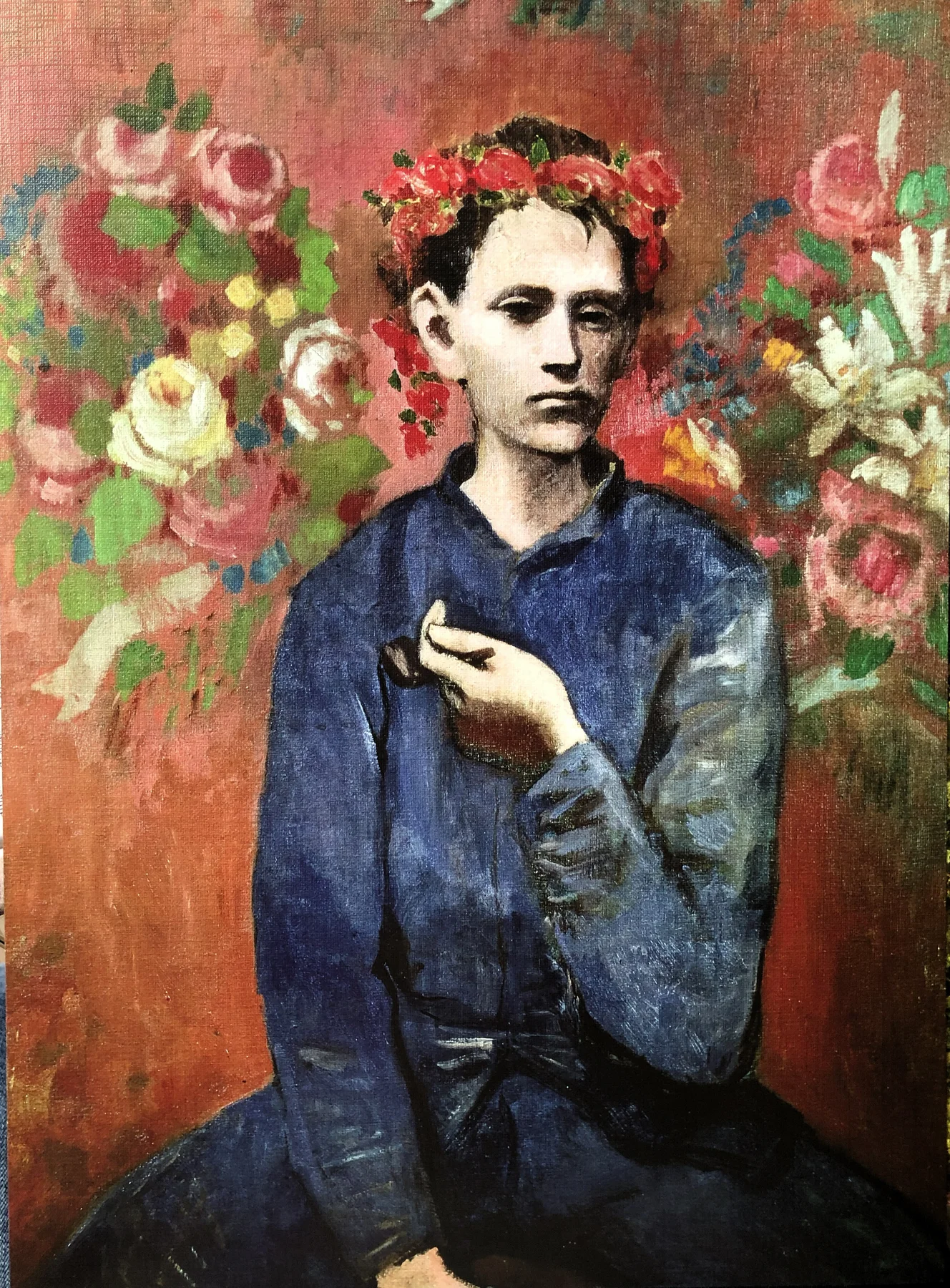
BOY WITH A PIPE
Pablo Picasso
- Artist
- Pablo Picasso (1881–1973)
- Date
- 1905
- Dimensions
- 99.7 x 81.3 cm
- Medium
- Oil on canvas
- Location
- Private collection
Painted in 1905 at the height of Picasso’s so-called Rose Period, Boy with a Pipe has always been in the spotlight as one of the artist’s most enigmatic works. Nearly a century after its creation, however, it made the headlines for an entirely different reason. In May 2004, in Sotheby’s New York saleroom, an unknown collector bought the painting for the incredible sum of 104.2 million dollars, setting a record for the highest price ever paid for a work of art up to then.
A Modern Mona Lisa
One of the most attractive features of the painting is the mystery surrounding the sitter. The enigmatic expression and the inexplicable presence of the garland of roses exude the mystery of a modern Mona Lisa. The latter detail was in fact the result of an afterthought by the artist. He had spent an evening with friends in Parisian cafés and bars. The then 24-year-old artist, who had recently settled in the French capital, returned to his studio in Montmartre, and his eye fell on a canvas he had abandoned a month before. On a sudden impulse Picasso put the picture back on the easel and with quick brushstrokes painted a garland of roses on the boy’s head, transforming a hitherto ordinary figure study into a painting that has captivated viewers ever since.
A Poetic Work
Boy with a Pipe is a poetic, almost yearning painting in delicately applied pinks, greys and light blues from Picasso’s short-lived Rose Period. Between 1904 and 1905, in just six months, the artist made a multitude of pictures of actors, clowns, dancers and acrobats whom he had seen performing that winter in the colourful shows of the Cirque Médrano, which amazed Montmartre.
These paintings, including Boy with a Pipe, marked Picasso’s escape from his “Blue” Period, which had been an artistic response to the devastating effect of the suicide of a close friend, Carlos Casagemas, in 1901. Dark days had then befallen Picasso, and his works depicted prostitutes, beggars and drunks in sombre, mournful bluish tones.
From Blue to Rose
Picasso disliked the division of his works into different periods. He always insisted that his successive pictures did not represent some development in his style but were merely responses to a current subject. “When I wanted to express something, I depicted it without thinking of the past or the future… If the subject called for a different means of expression, I adopted it without hesitation.” Although his use of colour became lighter and his mood more cheerful during the Rose Period, he remained consistent in his subjects — the portrayal of society’s outcasts — and in how he presented them. The circus performers in one of the outstanding works of Picasso’s Rose Period, Family of Saltimbanques (1905), are as introverted and marginal as the most destitute figures of his Blue Period. Boy with a Pipe also shows the same persistent melancholy.
Famous Owners
Thanks to its unique, poetic charm, Boy with a Pipe soon left Picasso’s studio. Today it is one of three pictures from the Rose Period in private hands. Around 1910 it was bought by a wealthy German banker, Paul von Mendelssohn-Bartholdy, son of the composer Felix Mendelssohn’s nephew. From him the work passed to his widow, who sold it to a famous German art dealer, Walter Feilchenfeldt. The picture first crossed the Atlantic in 1950: it was acquired for a “mere” 30,000 dollars by John Hay Whitney, a former intelligence agent who later became American ambassador and then owner of the New York Herald Tribune. The name of the buyer who offered the record price at the 2004 auction was never made public, and his identity has been the subject of speculation ever since.
An Enigmatic Model
The identity of the picture’s model is also shrouded in mystery. The pipe, its stem pointing towards the viewer, lends the boy an adult air that contradicts his youthful appearance. His blue overalls resemble Picasso’s, suggesting that he may be the artist’s young assistant, but the significance of the garland of roses arbitrarily placed on his head is called into question. Some have seen a Montmartre actor in the model, but there is a more plausible explanation, according to which he was probably a local boy known as “Petit Louis”, one of the many “delinquents” who regularly frequented the studios of Picasso and other artists in the Bateau-Lavoir. Picasso certainly knew the boy, once remarking that Louis sometimes hung around his studio for a whole day. “He watched me work. He liked to watch.” It is very likely that Picasso, who often chose his models from his immediate surroundings, painted the boy because he happened to be at hand. Whether Louis felt any sense of honour remains a mystery, hidden behind one of the most enigmatic expressions ever painted.
Masterpiece Connection
The floral motifs appearing on either side of the figure in Boy with a Pipe were probably inspired by the works of Odilon Redon (1840–1916). The French painter used this visual element in many of his portraits, such as Madame Arthur Fontaine (Marie Escudier) of 1901, in which Redon’s flowers seem to float in the air, drifting between foreground and background and in places overlapping the figure, as can also be seen in Picasso’s painting.
- Cirque Médrano
- John Hay Whitney