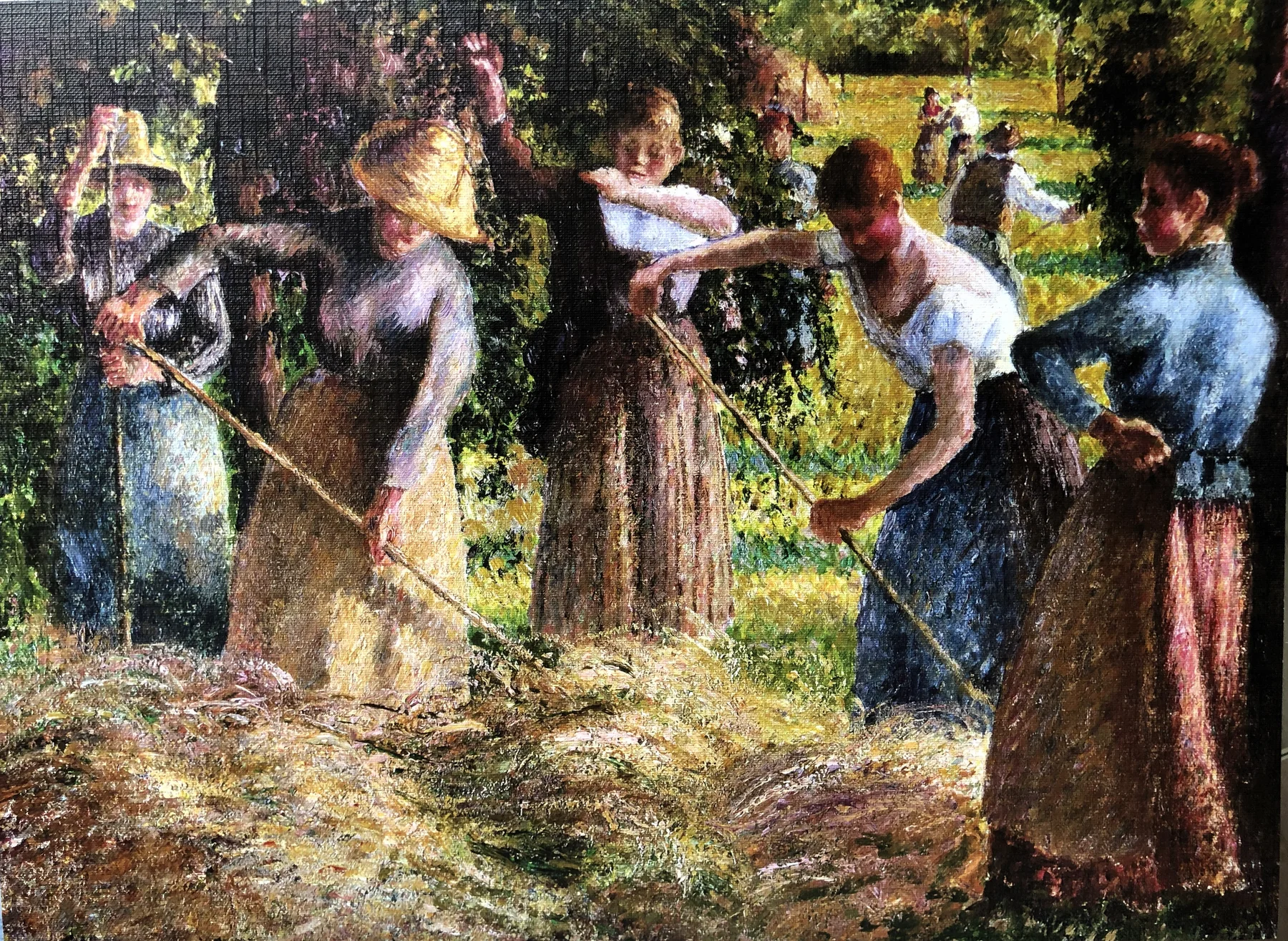
HAYMAKING AT ÉRAGNY
Camille Pissarro
- Artist
- Camille Pissarro (1830–1903)
- Date
- 1901
- Dimensions
- 53.9 x 64.7 cm
- Medium
- Oil on canvas
- Location
- National Gallery of Canada
We know Camille Pissarro as the father of Impressionism. Through his unique handling of colour and light he had a major influence on the emerging art movement, and he was one of the first advocates of painting scenes from everyday life outdoors. Haymaking at Éragny is a classic example of his technique. By placing the figures diagonally on the canvas the artist created rhythm and harmony. When this masterpiece was made, Pissarro already had more than fifty years of painting behind him. Haymaking at Éragny shows the artist in full maturity: his colours and tones are sublime, and a kind of idyllic calm radiates from the picture.
Social Harmony
Some believe that Pissarro so often depicted agricultural workers because of his left-wing political sympathies. He wanted to show how well people could work in small village communities, far from the harsh reality of industry and the demands of capitalism. Pissarro’s figures represent social harmony.
The Story of the Work
In the late 1880s Pissarro made an excursion into the world of the pointillist technique of the Neo-Impressionist movement, that is, instead of mixing colours on the palette he applied dots to the canvas, which produced the desired effect when seen from a little further away, but he soon gave this up. From 1889, however, because of an eye disease he could no longer work in the open air, and for the rest of his life he painted his town and village scenes, including Haymaking at Éragny, in the studio. The National Gallery of Canada bought the picture in 1946, and it can still be seen there today.
Early Years
Camille Pissarro was born in 1830 on the island of St. Thomas in the Virgin Islands. He was sent to a boarding school in Paris, from which he returned to St. Thomas five years later to take over his father’s grocery business. His heart, however, drew him to France, and in 1855 his parents finally agreed to let him study art in Paris.
Ahead of His Time
Before going to Paris, Pissarro had already been painting in an Impressionist manner for years on St. Thomas: he worked in the open air, which was practically unprecedented at the time. His first ten years in France were spent studying, and there he came into contact with now well-known exponents of the movement such as Monet, Renoir and Cézanne. His earliest pictures in the Impressionist style depicted French rural life, a subject that recurred many times in his art.
An Impressionist Neighbour
In 1884 Pissarro and his family moved to the area painted in Haymaking at Éragny, on the banks of the Epte; this is the same river that Monet diverted to create his famous water-lily pond at Giverny. The region was the perfect choice for capturing idyllic village scenes, and Pissarro settled there for good.
The Patriarch of Impressionism
Many of the original ideas of Impressionist style and composition came from Pissarro, not from Monet or Degas as is usually claimed, even if the movement took its name from Monet’s picture Impression, Sunrise. As the oldest member of the group, he often smoothed the way for his younger colleagues and was able to keep all the big egos and complicated personalities in his own camp.
Pissarro did not win undivided recognition in critical circles until his comprehensive retrospective exhibition in 1892. The oldest standard-bearer of Impressionism finally received the respect and esteem he so deserved. Pissarro died in Paris two years after completing Haymaking at Éragny in 1901.
- The National Gallery of Canada
- St. Thomas, Pissarro’s birthplace
- Pissarro (right) with Cézanne (seated)
- Pissarro: Dulwich College, London