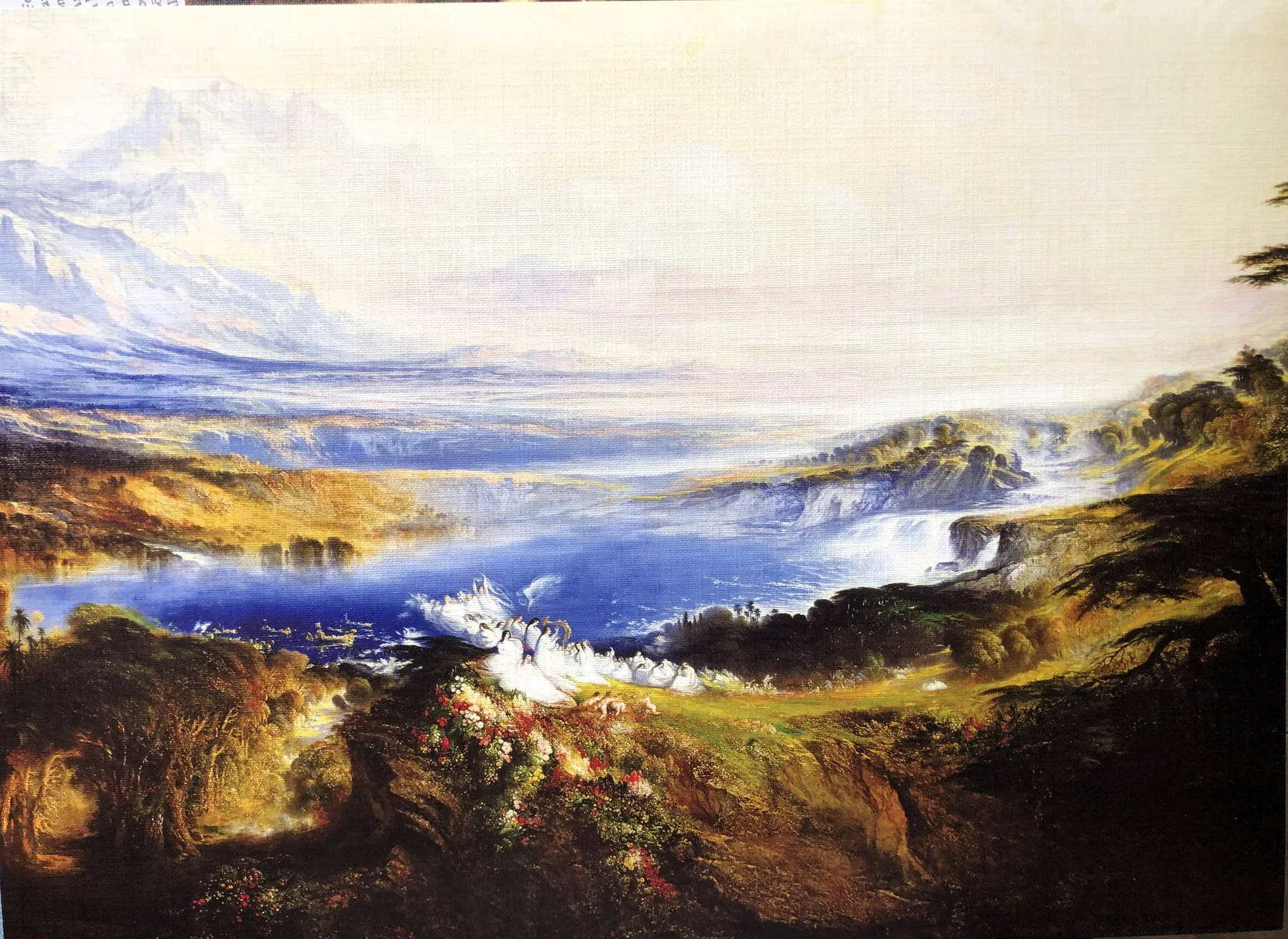
THE PLAINS OF HEAVEN
John Martin
- Artist
- John Martin (1789–1854)
- Date
- Between 1851 and 1853
- Dimensions
- 198.8 x 306.7 cm
- Medium
- Oil on canvas
- Location
- Tate Britain, London
The Plains of Heaven is a stunning painting; both its size and the biblical landscape it depicts are truly sublime. John Martin was perhaps the most popular painter of his time; in many of his pictures man is dwarfed by the grandeur of an awe-inspiring landscape, a reminder of God’s absolute power over mankind. This painting is one of a three-part series based on the Book of Revelation. The righteous arrive in exalted white robes and gather on the plains of heaven as a dazzling vision unfolds before them. This is truly Paradise itself; the picture radiates an Edenic mood. When the paintings reached London after a highly successful and popular tour of England, they were called “the grandest and most astonishing pictures in the world”.
A Short History
John Martin made many paintings and engravings on biblical subjects during his career, including a commission in 1823 to illustrate Milton’s Paradise Lost.
The Plains of Heaven was part of the series of paintings “The Last Judgement”, based on the Book of Revelation. The Plains of Heaven itself is based on Revelation chapter 21: “And I saw a new heaven and a new earth…”. The other two pieces in the series are The Last Judgement and The Great Day of His Wrath.
Martin devoted the last three years of his life to the three paintings of “The Last Judgement” series. The pictures were first exhibited at the Victoria Rooms in Newcastle in 1854, just seven days before Martin’s death. They made a great impression on the local press and public. The paintings then toured the country, finally arriving in London the following year.
The owner stipulated that the pictures could not be exhibited in towns of fewer than 30,000 inhabitants, but in 1872 he made an exception. The Plains of Heaven and its two enchanting companions were put on public display with enormous pride in Hexham, Northumberland, England, John Martin’s home town.
The three paintings of “The Last Judgement” series were bequeathed by a private collector to Tate Britain in London in 1974, where they still are today.
A Popular Series
Not all art critics liked Martin’s works. Some did not care for his style and use of colour. They felt that he broke the rules of “history painting” (the painting of past events), the most respected art form, by making man secondary to nature in his pictures. The public, however, celebrated him unswervingly and enthusiastically received his paintings, including their depiction of man and mortality. For twenty years after his death the three paintings of “The Last Judgement” series toured Great Britain and America.
Intricate Engravings
Martin was also a master of engraving. He earned more money from his engravings than from his paintings, and The Plains of Heaven was no exception: the engravings made from the painting were a huge success, and within a few years he had sold every last one.
Masterpiece Connection
The greatest influence on Martin was J. M. W. Turner. Both artists were concerned with the dramatic depiction of heightened emotion and intensity, focusing on the natural environment in its primeval state.
- Illustration for John Milton’s epic poem Paradise Lost
- Two pictures from “The Last Judgement” series: The Last Judgement (above) and The Great Day of His Wrath (below)