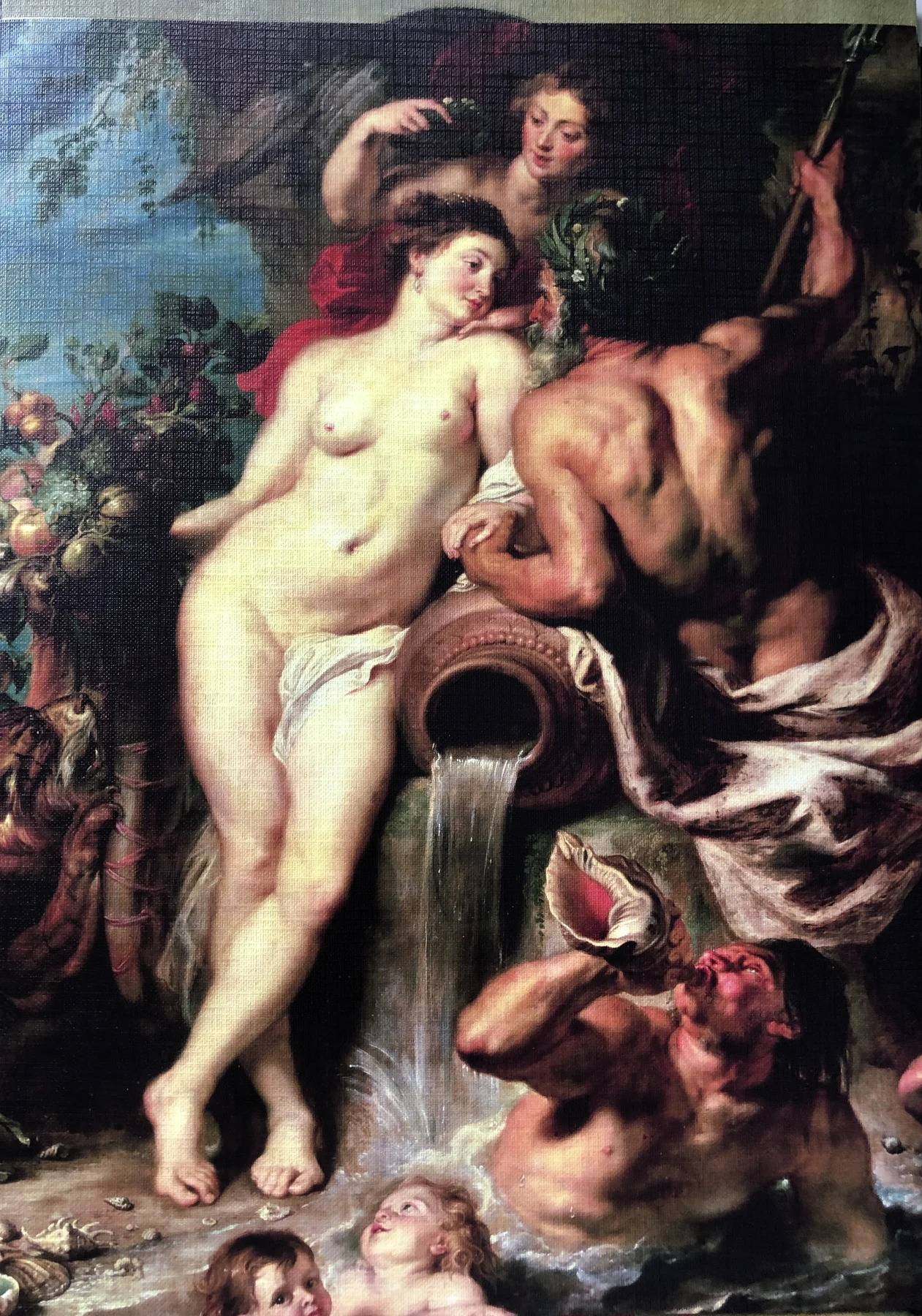
THE UNION OF EARTH AND WATER
Peter Paul Rubens
- Artist
- Peter Paul Rubens (1577–1640)
- Date
- 1618
- Dimensions
- 222.5 x 180.5 cm
- Medium
- Oil on canvas
- Location
- Hermitage, St Petersburg
Peter Paul Rubens was the finest painter of his time, showered with commissions by the crowned heads of European countries. He is perhaps best known for his pictures of nude women, whose full figures have gone out of fashion today but are key to appreciating Rubens’ art. His figures are plump, sensual and radiate enormous energy. Rubens wanted to paint what he saw every day, and despite his humanist education he paid little attention to the classical ideal of beauty, which seemed remote and improbable to him. His most famous works, including this masterpiece, present vividness, movement and an overflowing abundance of colour. His freely swirling brushstrokes are extremely expressive, and his incredible ability to render texture — whether human flesh or fabric — is unique even by today’s standards. The Union of Earth and Water is a classic example of his art: the wonderfully composed and painted picture is visual splendour and richness itself.
Troubled Times
The 17th century was a turbulent period for Rubens’ homeland, Flanders, and for all Europe because of the wars between Catholic and Protestant nations. Flanders was Catholic and remained loyal to the Spanish Crown that had formerly ruled the country. The Spanish wanted the territory to remain a Catholic region, so they did everything to make Flanders the leading artistic centre of northern Europe. On the other hand the northern part of the Netherlands was militantly Protestant and kept Flanders under constant pressure.
The Union of Earth and Water is a direct allegory of the political situation of the time. Cybele, goddess of the Earth, personifies Antwerp, the most important city in Flanders, while Neptune, god of the sea, symbolises Antwerp’s river, the Scheldt, which provides the city’s outlet to the sea. The Dutch had blockaded the waterway, and without this corridor Flanders’ trade was paralysed, condemning the country to stagnation. A few years earlier the parties had concluded a truce, and the painting expresses the hope that Flanders might once again set out on the road to prosperity.
The History of the Union
We do not know who commissioned the picture, but the painting was not made for the Catholic Church. There is evidence that the picture was sold at auction in Paris in 1775 for a relatively low price and that there were disputes about its authenticity. We do know for certain, however, how it reached its present location. The Hermitage in St Petersburg, founded in 1746 [actually in 1764], was built by Empress Catherine the Great of Russia with the intention of creating one of the most wonderful art collections in the world. Her son, Paul I, succeeded her on the throne in 1796 and reigned until 1801. Although he was reputed to be a great connoisseur, he bought only two paintings for the collection, one of which is The Union of Earth and Water.
A Genius at Work
Rubens was born in 1577 in Westphalia, Germany. His Protestant family had fled there from Antwerp to escape religious persecution, but returned to the Flemish city in 1587. Rubens became a devout Catholic. He trained with three local painters and then spent eight years in Italy. After hearing that his mother was seriously ill, he returned to Antwerp in 1608 but did not find her alive. He loved Italy so much that he signed many of his pictures “Pietro Paulo” — but his success kept him in Flanders.
In Italy he became a court painter, in the service of the Duke of Mantua. From then on Rubens was regarded as the most famous court painter of his time; in the following decades he worked for almost all the Catholic rulers of Europe, above all in France and Spain, but his clients also included King Charles I of England, who sympathised with the Catholics and later knighted the artist. He enjoyed such popularity in the highest state circles and had such intellectual abilities that he was also asked to serve as a diplomat. This is how he came to the court of Charles I, after mediating in peace negotiations between England and Spain.
A Fruitful Alliance
It was common practice to depict mythological scenes as political or religious allegories, as we see in this masterpiece. A kind of love scene unfolds before us, as the hands of Neptune and Cybele clasp each other in an open allusion to the relationship between the city and the sea. The bodies of the two gods radiate perfect symmetry, turning towards each other in complete harmony. Their intertwined bodies give the painting a swirling momentum. The happiness-filled scene is crowned by the goddess of Victory. The message is clear: peace brings happiness.
- Rubens’ picture Bacchanal: an example of his nude figures
- Dmitry Grigoryevich Levitsky: Catherine the Great in the Temple of Justice
- 17th-century Antwerp