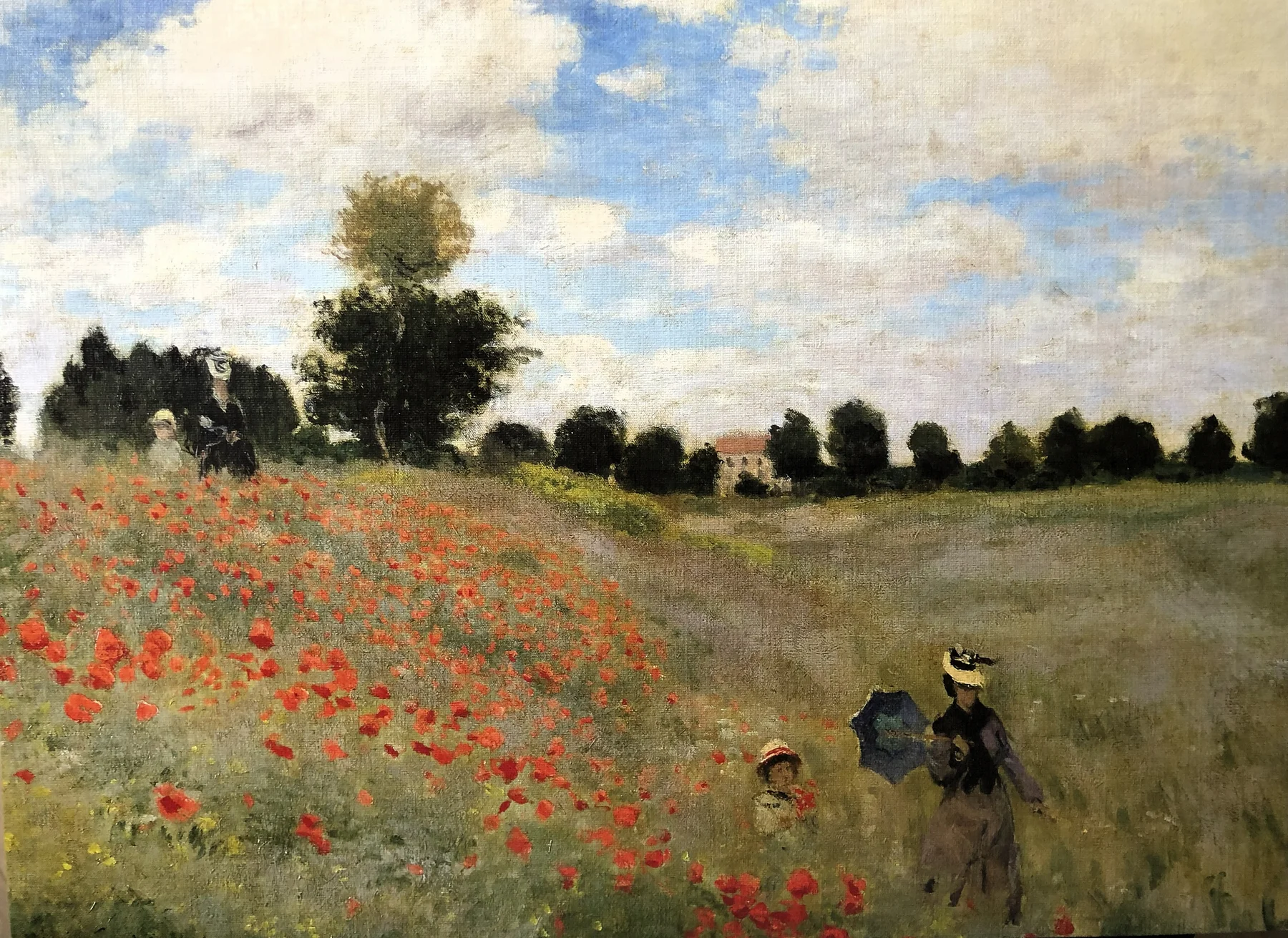
POPPY FIELD AT ARGENTEUIL
Claude Monet
- Artist
- Claude Monet (1840–1926)
- Date
- 1873
- Dimensions
- 50 x 65.3 cm
- Medium
- Oil on canvas
- Location
- Currently Musée d'Orsay, Paris
Impressionism is probably the most popular art movement in the world. The appeal of pictures painted in vivid colours in their natural state lies in their simplicity and cheerful mood. Poppy Field at Argenteuil, originally titled Coquelicots, is one of Monet’s most famous works and one of the first pictures that brings Impressionism to mind. The painting captures everything the art movement stood for — on a beautiful summer day a mother walks with her little son through a poppy field, in complete harmony with nature. As one of his contemporaries observed, Monet faithfully depicted the “French Sunday”, a moment of peace and quiet before the working week.
Safe in Argenteuil
In 1870 war broke out between France and Prussia, lasting until early 1871. France suffered a severe defeat, the government was overthrown by revolution, and the Prussians kept the country under occupation until 1873. In 1872 Monet moved with his wife and small child from war-torn Paris to a picturesque little town on the Seine, Argenteuil, west of the capital. This was the happiest period of Monet’s life. At last he found peace at home, and in 1873 the long-deprived family also came into some money through an inheritance. His paintings from this period reflect his happiness, but above all Poppy Field at Argenteuil, in which he portrays his beloved wife, Camille, and his son, Jean.
Bringing an Impression to Life
Monet painted for years without much success, at times so poor that he could not afford paint or canvas. Later he formed a group of artists — they did not yet call themselves Impressionists — whose members experimented with creating a new mode of artistic expression using vivid colours and broken brushstrokes, outdoors rather than in the studio. Breaking with the past, they wanted to paint what they saw around them.
Poppy Field at Argenteuil was shown at the first Impressionist exhibition in 1874. When the French art critic Louis Leroy saw another picture by Monet, titled Impression, Sunrise, he remarked disparagingly that instead of a real depiction the painter had put his own impressions on canvas. The exhibition ended in miserable failure, but afterwards the label stuck to the artists. What we now regard as a conventional style was then considered revolutionary. The exhibition had few visitors, and only a few paintings were sold.
The Monet Family
Monet met Camille in the 1860s, and their son, Jean, was born in 1867. They married in 1870, the year war broke out. To avoid the fighting, Monet and his family fled to England. When they returned to the continent in 1871, they spent a short time in Holland before settling in Argenteuil. Monet portrayed his family, especially Camille, in many pictures. Camille and Jean in fact appear twice in Poppy Field at Argenteuil, lending the painting a sense of space. After the first Impressionist exhibition failed and their debts began to mount again around 1876, the idyllic Argenteuil years came to an end. In 1878 their second son was born, but the following year Camille died of the consumption that had been tormenting her for some time. Monet, ever the artist, painted his wife on her deathbed too.
Plein Air and Modern Life
Monet began painting in the open air in the 1860s, when he lived on the coast. This was a new phenomenon in the world of painting, made easier by the spread of paint in tubes and portable canvases. The spirit of the age dictated that the artist should capture “modern life”. Instead of historical and mythological scenes, painters wanted to depict everyday people going about their activities. This aim was completely unconventional, as was their method. Poppy Field at Argenteuil was a truly revolutionary work in its time.
- The Franco-Prussian War (1870)
- Monet: Impression, Sunrise (1872)
- Monet: Camille and Jean Monet in the Garden at Argenteuil
- The Musée d'Orsay in Paris, the present home of Poppy Field at Argenteuil