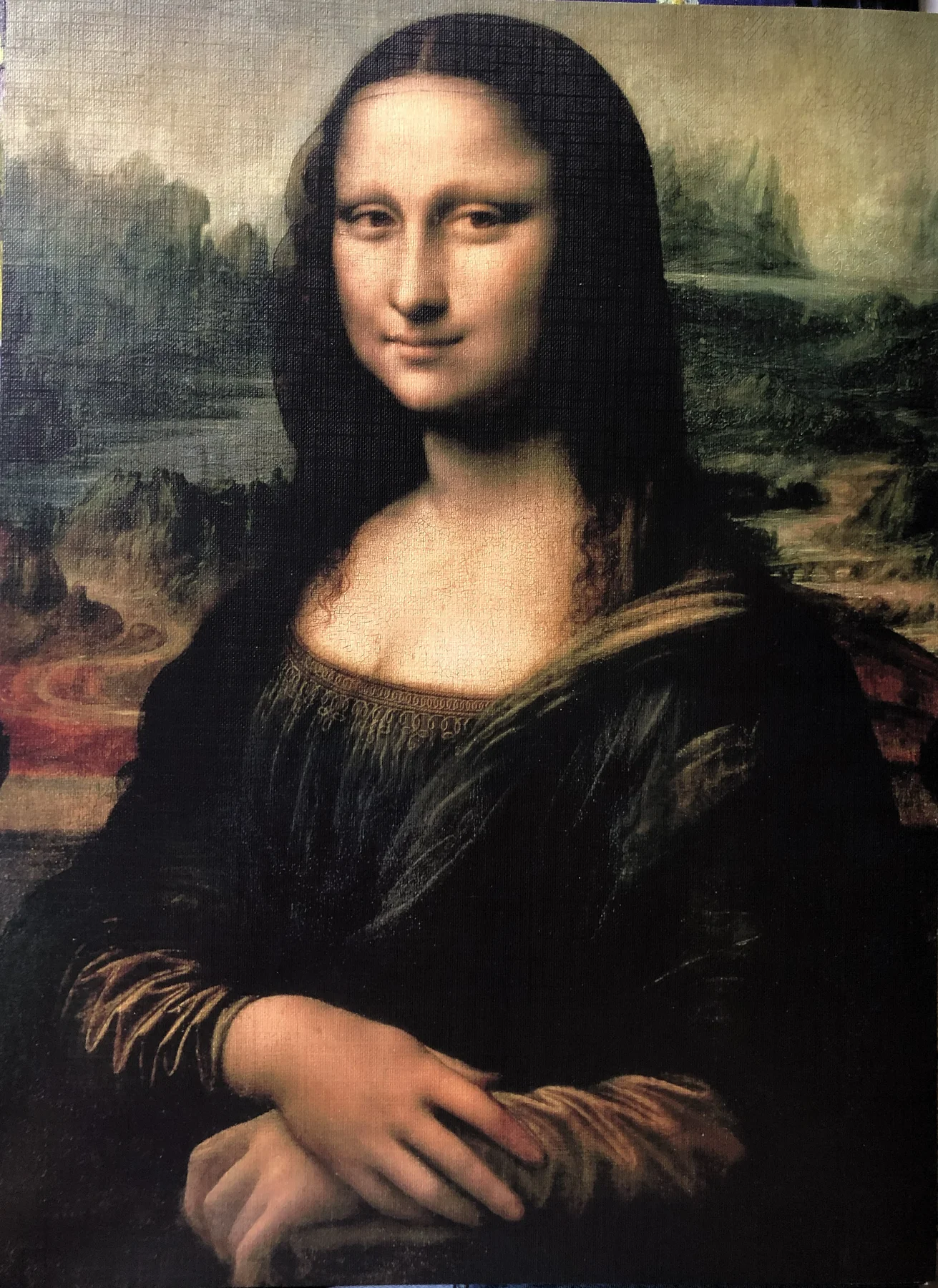
MONA LISA
Leonardo da Vinci
- Artist
- Leonardo da Vinci (1452–1519)
- Date
- Between 1502 and 1506
- Dimensions
- 77 x 53 cm
- Medium
- Oil on poplar panel
- Location
- Louvre, Salle des États, Paris, France
The Mona Lisa (also known as La Gioconda), Leonardo da Vinci’s 16th-century oil painting, is perhaps the most famous picture in the world. It has found its home in the Louvre in Paris, and its value is incalculable. This female figure, dressed in the Florentine fashion of her time and set in an imaginary mountainous landscape, is a fine example of Leonardo’s technique, sfumato, with which he softly dissolves outlines and creates a hazy effect. The Mona Lisa’s mysterious expression, at once seductive and reserved, has made the picture world-famous and has continually attracted millions of admirers for five hundred years.
The Woman Made Immortal
Until the 19th century paintings everywhere were mostly commissioned by wealthy patrons. The Florentine silk merchant Francesco del Giocondo, a friend of Leonardo’s father, commissioned the artist to paint a portrait of his wife, Lisa Gherardini, apparently to celebrate the birth of their third child. The name Mona was a common abbreviation of the Italian word madonna.
After many sketches Leonardo began painting the portrait around 1502 or 1503. Although the work was practically finished within four years, he kept it with him until the end of his life, continually changing minor details. This was typical of Leonardo — he was a restless man, always excited by new tasks, so he rarely managed to finish a work.
The Story of a Masterpiece
Leonardo spent his last years in France, working for King Francis I. Leonardo kept the Mona Lisa until his death; it then passed to the French court, accompanying the monarch everywhere, until the French Revolution, when it was moved from the Palace of Versailles to the Louvre. Apart from a few brief periods — when Napoleon kept it with him for his pleasure, when it was stolen, and when it was taken to safety during the Second World War — it has been in the museum ever since.
Brushstrokes
Leonardo’s method has long baffled art historians. Examination shows that the artist worked with very tiny brushstrokes, sometimes smaller than a pinhead, and then reinforced them with cross-hatching or zigzag strokes. Experts claim that Leonardo must have used a magnifying glass when working on the details. There are thirty layers of paint on the Mona Lisa’s face. The result shows even brushwork that visibly lends the picture movement and liveliness. Through the blending of colours and nuances of light, a real woman of flesh and blood was born on Leonardo’s canvas. This is the magic of the Mona Lisa.
The Pose
The Mona Lisa’s lifelike gaze and mysterious smile have intrigued viewers for centuries. Some art historians claim that the Mona Lisa is wearing mourning dress, suggested by the famous smile tinged with a hint of sadness.
The Theft of the Century
Although the painting was well known, the Mona Lisa only became world-famous in 1911, when an Italian employee of the Louvre dissatisfied with his pay, Vincenzo Peruggia, took it off the wall, hid it in a cleaning cupboard and then calmly walked out with it under his coat after the museum had closed. The theft was discovered only when a visitor asked where the painting was. It caused a sensation around the world, and museum visitors came to see the empty space on the wall as if mourning a lost friend.
After a forger had made several copies of it, Peruggia hid the painting in his attic room for two years. In the end, however, the thief was caught when he tried to sell the picture in Italy. He said he had wanted to return the Mona Lisa to where she came from. The picture was ceremonially returned to France in 1913.
World Fame
The modernists, rebelling against traditional art forms, had no regard for the Mona Lisa’s fame and made distorted, irreverent copies. Andy Warhol created his well-known doubled screen-print image, drawing a parallel with Marilyn Monroe. In 1956 acid was thrown on the painting, and later that year it was damaged by a stone. Both senseless acts caused great damage. Today it is kept safe behind bulletproof glass on the wall of the Salle des États. Its vulnerability, however, also comes from within, as Louvre staff say that the picture, painted on a poplar panel, is deteriorating faster than expected.
- In the Mona Lisa’s place in the Louvre
- Distorted – Marcel Duchamp’s work (left), Andy Warhol’s doubled screen-print image (below)