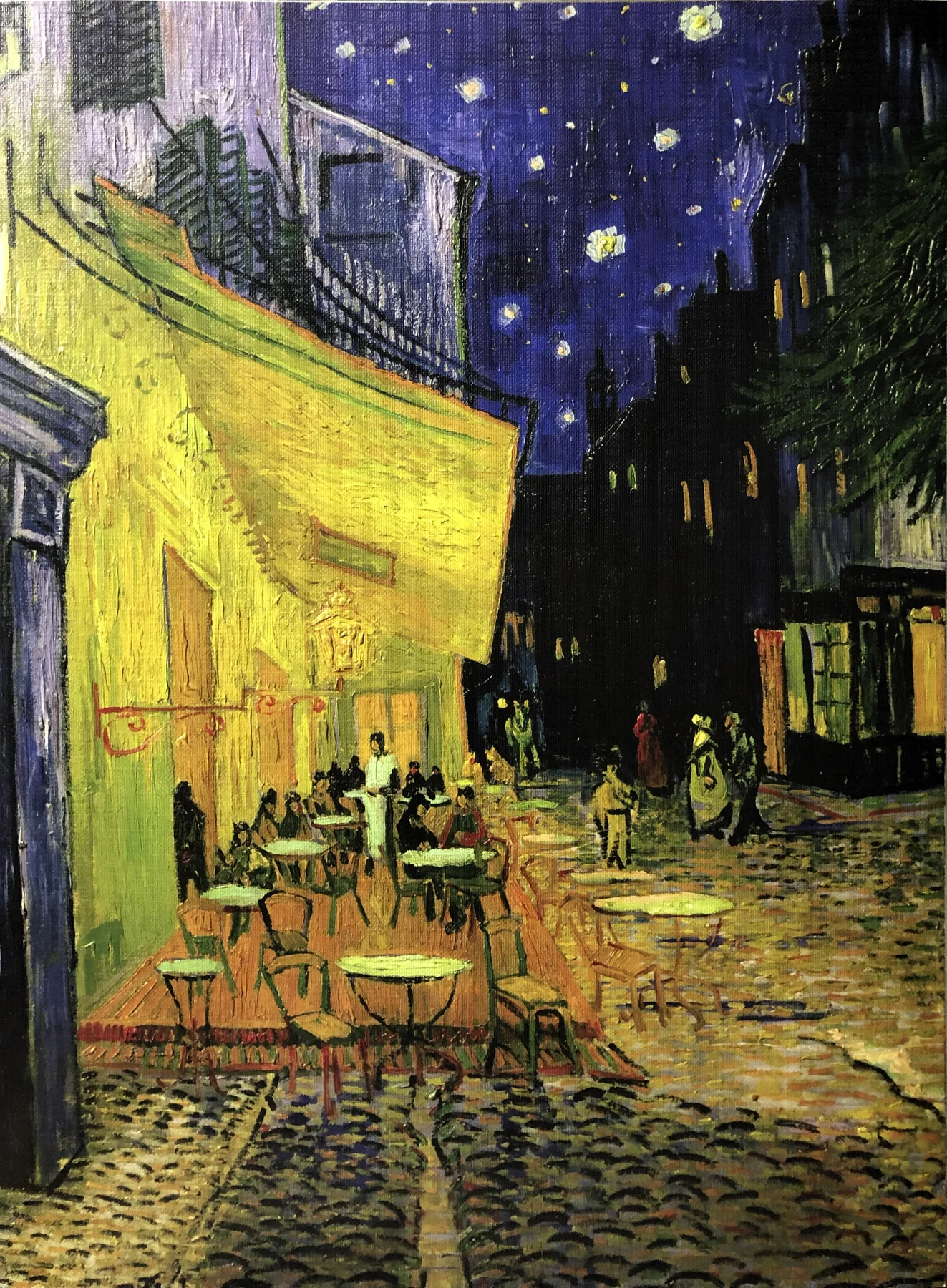
CAFÉ TERRACE AT NIGHT
Vincent van Gogh
- Artist
- Vincent van Gogh (1853–1890)
- Date
- c. 16 September 1888
- Dimensions
- 81 x 65.5 cm
- Medium
- Oil on canvas
- Location
- Kröller-Müller Museum, Otterlo, Netherlands
Vincent van Gogh was at first a zealous preacher, and began painting at the age of twenty-seven. Since he found it hard to complete any formal art course, he was largely self-taught. Being of a volatile, highly unpredictable nature, he managed to alienate most people. Van Gogh is the embodiment of the tormented artist — he paid for his art with poverty, hunger and mental illness. He knew that his mental illness would be his undoing and declared that the more his illness took hold, the more brilliant and dazzling the colours he wanted to paint with, to bring beauty into the world. Café Terrace at Night is an Expressionist masterpiece that shows the world through exaggerated emphasis on form and colour. It is a wonderful, improbably vibrant, colourful painting, and tells the viewer more about what Van Gogh felt than what he saw.
Work Made on the Spot
In a letter to one of his sisters Van Gogh describes why he chose this location: “Right now I would most like to paint a starry sky… Here is a night picture without any black, painted with beautiful blue and violet and green, and in these surroundings the lit-up square takes on a pale sulphur and greenish lemon yellow. It amuses me enormously to paint the night on the spot.” That he created this painting on the spot, without sketches, vividly demonstrates his impulsive nature and spontaneity. Together with Starry Night over the Rhône and The Starry Night, this painting is one of three pictures on the theme of night.
A Well-Travelled Painting
In 1888 Van Gogh moved to Arles in the south of France, near Montpellier. The region inspired him, and here he painted some of his most famous pictures, including Café Terrace at Night.
This painting was bought in 1890, the year of Van Gogh’s death, by Albert Aurier, and it remained in the family’s possession until it was bought around 1917 by the Kröller-Müller Museum in the Netherlands. It is a well-known painting, often given pride of place in exhibitions around the world. It was first put on public display in 1927 in Basel, Switzerland.
A Volatile Nature
Van Gogh was born on 30 March 1853 in Groot Zundert, a small town in the Netherlands, the son of a pastor. He was the eldest of six children. He proved a rather withdrawn child and spent a lot of time on solitary walks in the area. His mother encouraged her son to paint, since she herself had painted watercolours before her marriage.
Van Gogh first worked for his uncle, an art dealer, which went well until he moved to London and fell hopelessly in love with his landlady’s daughter. There he got his next job: he was sent to one of the poorest districts to collect overdue school fees. He was upset by what he experienced there and did not have the heart to carry out his duties. He resigned and decided to follow his father’s example and become a chaplain.
At twenty-five he moved to a mining region in Belgium as a preacher. His unparalleled religious zeal and conduct — he even gave away his clothes and did not eat — offended and shocked the church, and he was dismissed. He disappeared from public view for two years. During this time it became clear to him that he wanted to devote himself to painting. His first work, The Potato Eaters (1885), showing peasants eating their supper in gloomy surroundings, focuses on depicting the suffering around him.
Arles
In Arles the inspired Van Gogh created some of his best works. He was very prolific, painting more than 200 pictures here. He felt prompted to establish an artists’ colony in the mild southern climate with his friend and fellow painter Paul Gauguin.
It was at this time that Van Gogh first went into a mental asylum, at St. Rémy, hoping they could help with his mental illness. He managed to persuade Gauguin to move to Arles, but within two months they quarrelled and Gauguin returned to Paris.
Around this time the citizens of Arles petitioned for the “mad” Van Gogh to be removed, so the artist soon moved to the town of Auvers, north-west of Paris, and stayed there until his early death on 27 July 1890. Sadly, 1890 was also the year when, with the sale of his picture of a vineyard at Arles, Van Gogh’s paintings began to become known.
- Kröller-Müller Museum, Otterlo
- Van Gogh’s father
- His mother
- The Café Van Gogh today
- Van Gogh’s first painting, The Potato Eaters