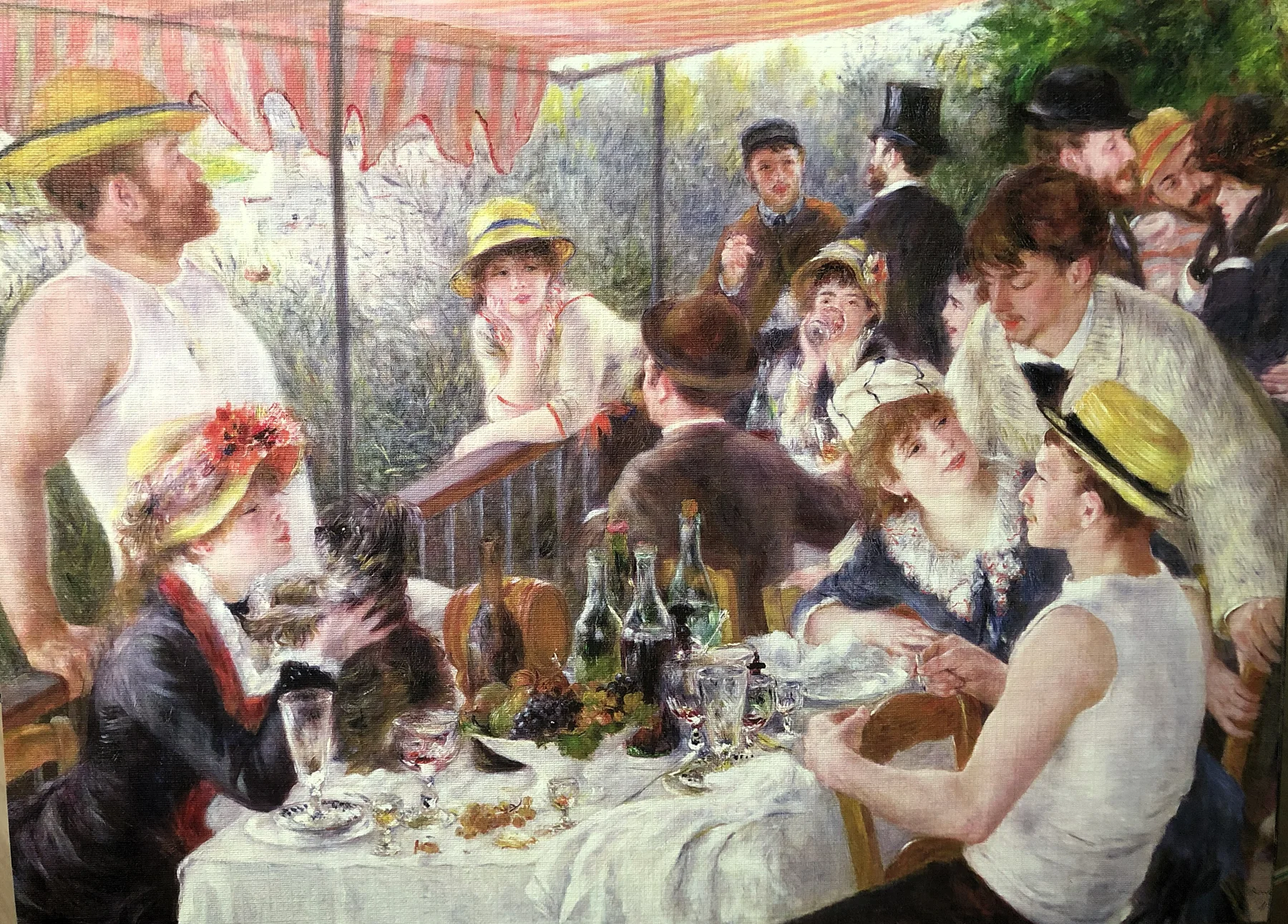
LUNCHEON OF THE BOATING PARTY
Pierre-Auguste Renoir
- Artist
- Pierre-Auguste Renoir (1841–1919)
- Date
- 1880–81
- Dimensions
- 130 x 173 cm
- Medium
- Oil on canvas
- Location
- Phillips Collection, Washington D.C.
If we had to choose one painting by the Impressionists that most vividly expresses the feeling of joie de vivre (joy of living), it would be Luncheon of the Boating Party. This masterpiece depicts a charming scene of day-trippers enjoying their day off and each other’s company over fine food and glasses of wine. The painting conjures up elements of the new Parisian lifestyle: the light-hearted mood of summer Sundays and people from different social classes enjoying themselves together. In the foreground sits a seamstress with her dog; in the middle of the composition, with his back to the scene, a baron is in conversation. On his right an actress drinks from her glass, and in the background we can see a newspaper editor and collector in a top hat. The figures seem to embody the French ideals of liberty, equality and fraternity.
A Change of Direction
Luncheon of the Boating Party is a kind of “sequel” to Renoir’s masterpiece made two years earlier, Dance at the Moulin de la Galette. The earlier work was made in true Impressionist style: painted outdoors with quick, sweeping brushstrokes. Following criticism of the picture’s style and his own disillusionment with open-air painting, Renoir changed his working method somewhat.
Different Lighting
Unlike the earlier Dance at the Moulin de la Galette, Luncheon of the Boating Party was made almost entirely in the studio, and its figures are more model-like, with clearly discernible features. Renoir’s turning away from sunlit subjects is clearly perceptible in this picture, in which he depicts the company under an awning, so that the light becomes more diffuse and less dappled. The vivid colours of the scene nevertheless radiate joy under the sun-warmed canvas. Renoir had no intention of telling a story with the picture; instead he evokes a mood through colour that speaks for itself.
An Ideal Setting
From the late 1870s Renoir often visited the Fournaise family’s restaurant on the island of Chatou on the Seine, known as a boating venue, an ideal place for a short excursion. In Luncheon of the Boating Party the two figures in white vests in the foreground wear traditional boating dress, and the boats appearing in the background were arranged by one of Renoir’s friends during the careful staging of the scene.
The Jewel in the Crown
Renoir began painting the picture in late summer 1880. It was a lengthy and complicated work, which he finished in early 1881. The painting was bought by the legendary Paris art dealer and great champion of the Impressionists, Paul Durand-Ruel. The following year Durand-Ruel sold the picture to a collector, who, however, was slow to pay, so the dealer took the work back. The picture was put on public display at the seventh Impressionist exhibition in 1882 and was a huge success. Over the next 40 years Durand-Ruel made sure it was shown around the world, and the painting’s fame grew and grew. In 1923 Luncheon of the Boating Party passed to the American Duncan Phillips, who paid 125,000 dollars for it, at that time the highest sum ever paid for a Renoir. Phillips had opened his gallery, the Phillips Collection, in Washington back in 1921 and was extremely proud to be able to add this painting to his collection. He wrote of the picture: “Luncheon of the Boating Party is one of the greatest paintings in the world.” The picture is still owned by the Phillips Collection and is undoubtedly the finest jewel of the collection.
- Renoir: The Bridge at Chatou
- Paul Durand-Ruel in Renoir’s painting
- Renoir: Alphonsine Fournaise on the Island of Chatou