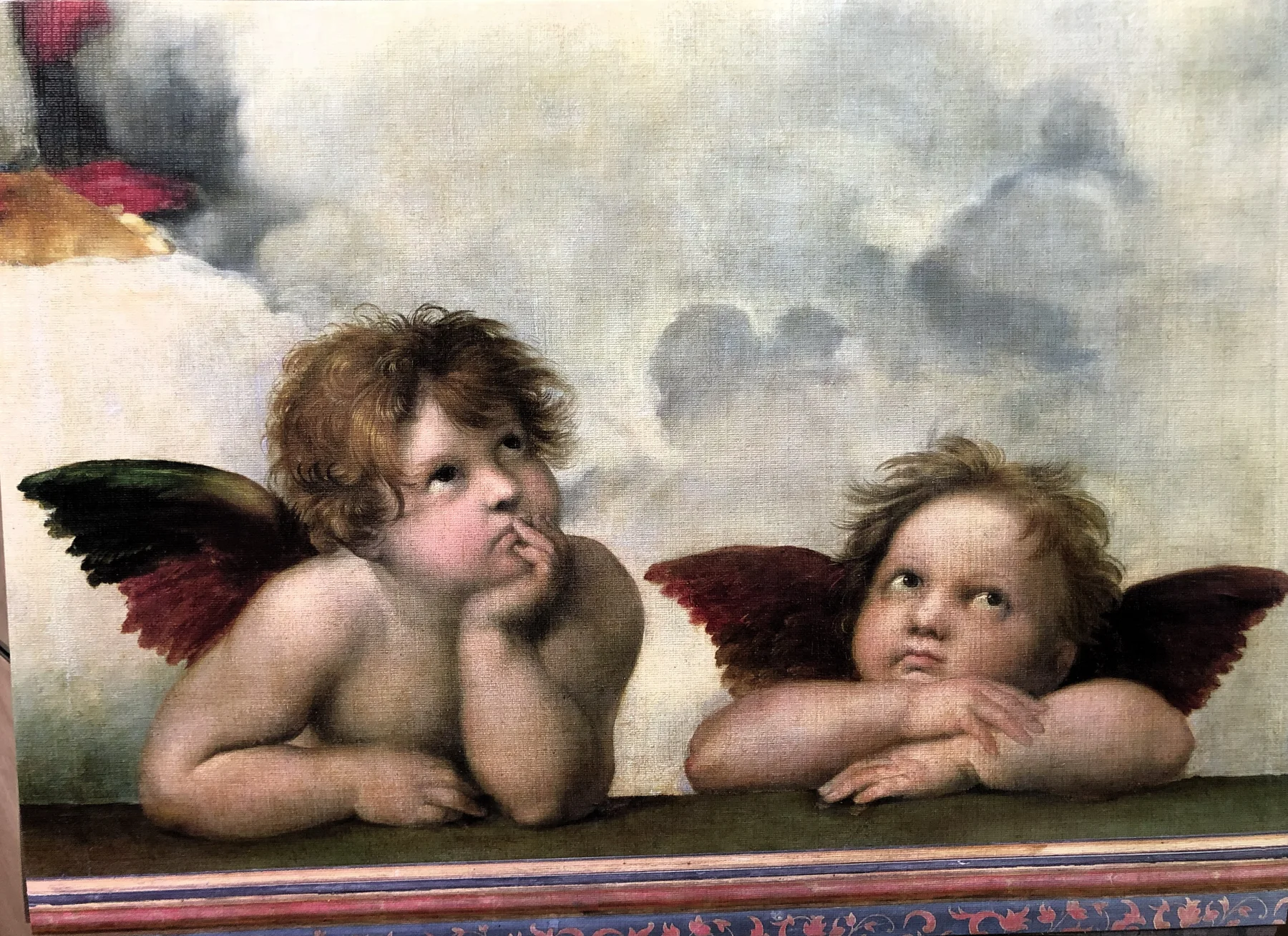
PUTTI, DETAIL FROM THE SISTINE MADONNA
Raphael (Raffaello Sanzio)
- Artist
- Raphael (Raffaello Sanzio) (1483–1520)
- Date
- 1512–13
- Dimensions
- 269.5 x 201 cm
- Medium
- Oil on canvas
- Location
- Gemäldegalerie Alte Meister, Dresden, Germany
Two little angels lean on their elbows in the foreground of the picture, as if waiting for something. Instead of angelic smiles their faces wear an unusual expression, accompanied by a strange pose. The putti, or angels, enormously popular as reproductions in their own right, are in fact a detail of Raphael’s most famous depiction of the “Virgin and Child”, the Sistine Madonna. The angels’ peculiar expression and the mystery of the painting’s origin have aroused the curiosity of scholars and art historians alike.
The Patronage of Two Popes
The Sistine Madonna was made around 1513. Raphael had many influential patrons, including Pope Julius II (Giuliano della Rovere) and his successor, Pope Leo X. In 1508 Julius II summoned Raphael to Rome with an important commission: he was to paint huge frescoes on the walls of the new papal reception rooms in the Vatican, the so-called stanze. One wall of the Stanza della Segnatura (Room of the Signature) is decorated with perhaps his most famous fresco, The School of Athens.
According to one researcher of the Sistine Madonna, it adorned the tomb of Pope Julius II. He painted the ledge or parapet on which the angels lean as a continuation of the horizontal line of the original coffin, so that the angels appear to rest on the tomb itself. The two winged cherubs symbolise the funeral rite. They are at once of this world and of the next. According to this theory, then, through the putti’s hazy expression Raphael may have been trying to depict the moment of death.
Waiting
The little angel boys are deep in thought, yet their attention wanders. Raphael painted their childish bodies softly, in warm tones, but their faces bear several adult features, as if they were daydreaming and waiting for something to happen. If we follow the direction of their dark, sad eyes, the focus of their gaze falls beyond the detail (and the original picture). The angel on the left seems more pensive, holding the fingers of his left hand to his mouth; his body language reveals that he is bored with waiting. The younger, or just smaller, angel on the right rests his chin on his arms. He too is clearly tired of waiting. His expression is extremely human, almost wondering. We may be witnessing the moment the angels are waiting for, though still anxiously and timidly.
Return to Dresden
Despite the appealing theory, it is more likely that the Sistine Madonna was made as an altarpiece for a Benedictine monastery, San Sisto in Piacenza; the painting was bought in 1754 by Augustus III of Saxony for Dresden’s old picture gallery, enriching the institution’s collection with a priceless treasure. During the Second World War the museum’s curators took the painting, along with other valuable treasures, to a nearby mine for safety. At the end of the war, however, Russian authorities shipped the works of art to Moscow, where they were kept for more than ten years. In 1955 the Sistine Madonna returned to Dresden, then part of the German Democratic Republic, and to this day it has a place among the most highly prized, jealously guarded treasures of the Gemäldegalerie.
Masterly Technique
As one of the three great painters of the High Renaissance (alongside Michelangelo and Leonardo da Vinci), Raphael had the ability to absorb the techniques and innovations of other painters and use them for his own purposes. Raphael was an excellent artist, but even more than that. The great 18th-century English painter Sir Joshua Reynolds said of him that the full toolkit of his art meant that, drawing on other great masters or subjects, he “always imitated, and was always original”.
- The Sistine Madonna – the whole picture
- Pope Julius II in Raphael’s painting
- Detail, Vernet: Pope Julius II Giving Orders to Bramante, Michelangelo and Raphael for the Design of the Vatican and St Peter’s
- The Gemäldegalerie Alte Meister in the Semper wing of the Zwinger palace, home of the Sistine Madonna