THE ARABESQUE
Edgar Degas
- Artist
- Edgar Degas (1834–1917)
- Date
- c. 1876
- Dimensions
- 586 x 420 mm
- Medium
- Pastel on paper
- Location
- Musée d'Orsay, Paris, France
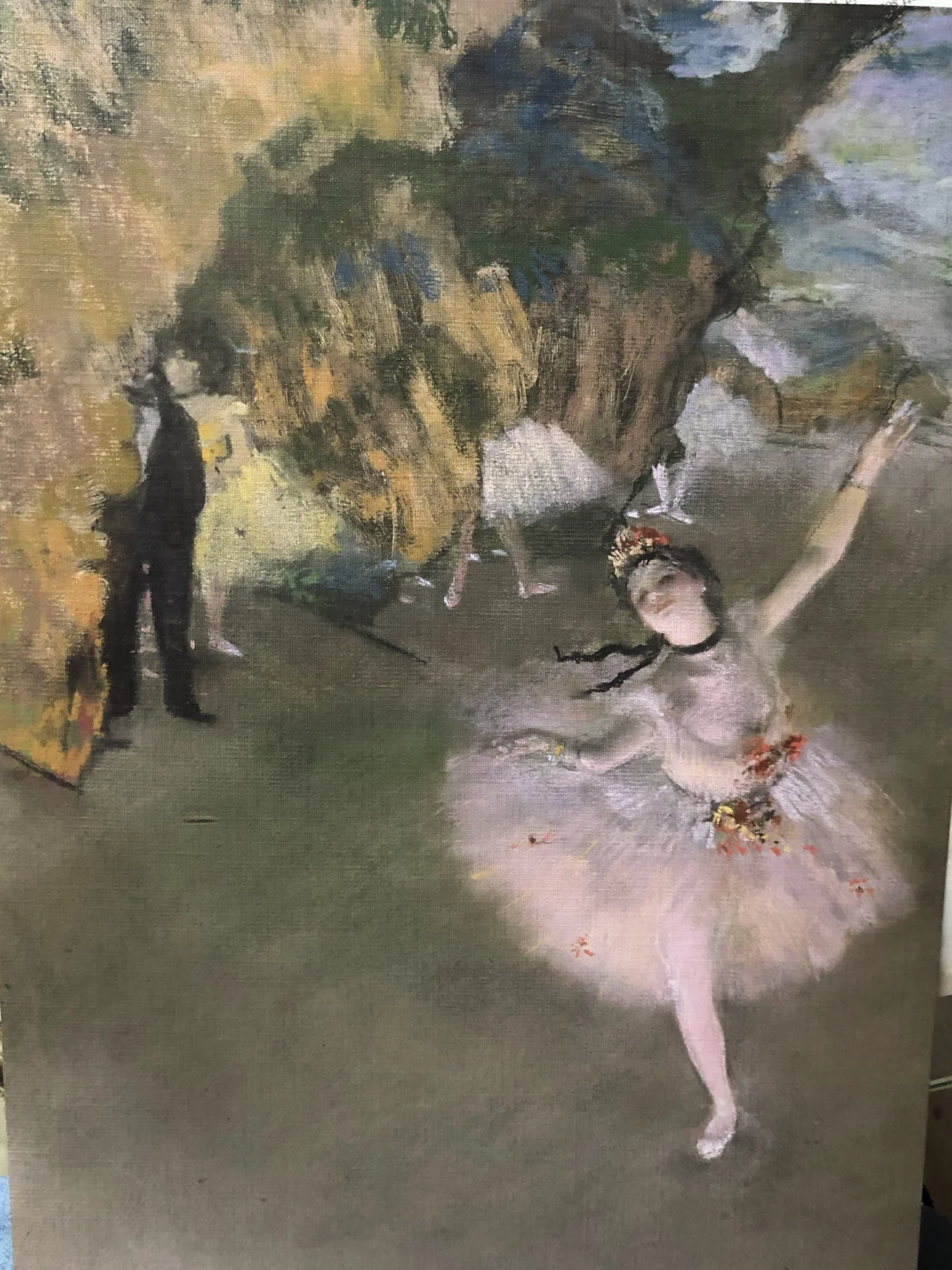
In the stage limelight a dancer performs a solo. Degas observes and records the fleeting moment of graceful movement as the prima ballerina twirls into the centre of the stage. This captivating depiction of female beauty is also remarkable for the way the painter contrasts the main action with the backdrop, applied in heavy, bold colours, which looms menacingly behind the feather-light dancer.
Capturing Movement
Although he was highly skilled in portrait painting, Degas was most interested in capturing movement. He made pictures of racecourses a few seconds before the start, painted nude women washing or dressing, but we remember him above all for his pictures of ballet dancers. In the early 1870s Degas painted pictures of ballet rehearsals with a distinctive artistic vision and an unerring ability to capture and depict the passing moment. Although his subject is the presentation of the embodiment of feminine charm — the elegant ballerina — his ballet scenes from his early period do not necessarily strive for aesthetic beauty. A characteristic example of his pictures of rehearsals is The Dance Class (1874). Degas’ paintings often depict ballerinas in unattractive situations: yawning, stretching, scratching.
By contrast, The Arabesque presents the dazzle of the performance. As a strictly objective observer, Degas seems most interested in how the shadow of artificial light plays on the ballerina, and by creating an unusual viewpoint and composition he unsettles the viewer’s expectations of how such a feminine pose should be depicted.
Master of Pastel
In the late 1870s Degas used pastel more often than oil paint, and many of his best works were made in this technique. Using pastel he could apply colours quickly and effectively, adding line and tone at the same time. With light, bright and lively strokes he gives the dancer’s dress an airy, cobweb-like effect. The delicacy of the ballerina’s white costume is counterpointed by the quick, vibrant lines, patches and blurred outlines of the three layers of wings in the upper part of the picture. At first glance this area of the picture is an indistinct mass of rust red, yellow, brown and green, but then the patch begins to clear: in front of the wings we can make out the silhouette of a gentleman in black, and the white patches of the pointed ballet shoes of six or seven dancers waiting to go on stage also become visible.
A Floating Ballerina
In ballet terminology the pose called an arabesque is meant to create the illusion of flight. Degas captures the stunning moment when the ballerina seems to float gracefully, with only one bent foot touching the stage. The dancer’s eyes are closed, but it may be that they are merely shaded by the stage lights. Although Degas called himself a realist painter all his life, his bold compositions and seemingly random framing are highly characteristic of Impressionism.
We look at the picture from above, at an oblique angle, as if from a theatre box. The structure of the work is also distinctive: although the subject of the picture is obviously the ballerina, the viewer’s attention is also held by the faded and fiery colours of the scenery on the left. The figure of the prima ballerina is not placed in the centre; she almost disappears off the edge of the picture. In the lower left quarter of the composition a huge empty area yawns, its lit corner perhaps a subtle allusion to the orchestra pit and the edge of the stage. This lighter area, with the tilted perspective and the essentially lateral and oblique structure of the picture — the diagonal plane of the scenery mirrors the line of the ballerina’s raised left arm — lends even more energy to the dancer’s movement.
Artistic Esteem
The Arabesque was bought by Gustave Caillebotte, a contemporary realist painter who, interestingly, was also famous for the unusual perspective of his paintings. Caillebotte was an enthusiastic supporter of the Impressionist painters and bought many pictures from them. Despite his early death in 1894, he bequeathed a substantial art collection — including The Arabesque — to the French state. The Arabesque, together with a collection of pictures, was originally exhibited in the Louvre and can now be seen in the Musée d'Orsay in Paris.
- Interior of the Musée d'Orsay
- Degas’ painting The Dance Class
- Degas: Two Dancers Resting