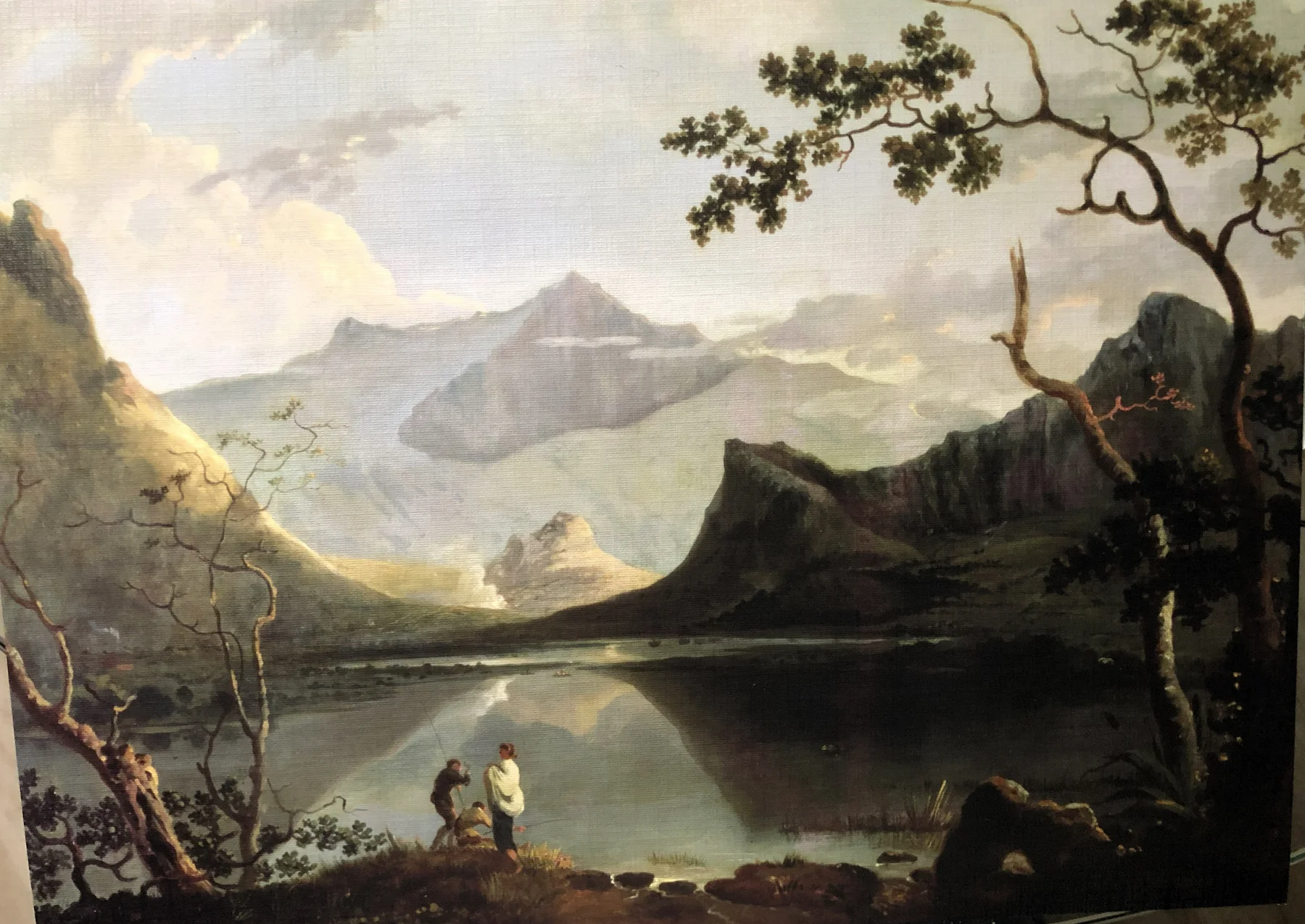
SNOWDON FROM LLYN NANTLLE
Richard Wilson
- Artist
- Richard Wilson (1714–1782)
- Date
- 1765
- Dimensions
- 101.6 x 127 cm
- Medium
- Oil on canvas
- Location
- Walker Art Gallery, Liverpool, England
Richard Wilson was the first major British landscape painter. In the 1700s and 1800s he was regarded as one of the finest of the British artists renowned for their landscape painting. He occupies an outstanding place in British art history, since he is considered the first who was able to express real emotion through his landscape painting. Through his wonderful talent landscapes — such as the famous view of Snowdon in Wales — appear in a dramatic setting. Wilson treated mountains and trees as if he were depicting ancient Roman ruins and remains. He did not paint what he saw in front of him but put visual effect first, subordinating everything to harmony. The natural beauty of Snowdon and its surroundings was rearranged under his brush, and the result is poetry itself.
A Masterly Work of Art
Snowdon from Llyn Nantlle was made for William Vaughan of Corsygedol, a wealthy Welsh landowner in the mid-1700s. Vaughan was a key figure in the Celtic revival movement established to preserve Welsh culture, and it is not hard to imagine how strongly this romantic Welsh landscape appealed to him.
The painting remained in the Vaughan family’s possession until 1930, when it was sold to the Agnew’s art dealers. The picture’s present owner, the Walker Art Gallery in Liverpool, bought the treasure in 1935 for £950, a considerable sum at the time.
Early Years
Richard Wilson was born in 1714 in North Wales into a well-to-do family. His father was a clergyman who gave his son an excellent education and at the same time encouraged his interest in the arts. A very wealthy uncle also recognised his artistic inclinations, and thanks to his financial support the boy went to London at 16 to study painting. With his own studio and a generous allowance, for years Wilson spent more time on amusement than on work. In the 1740s, however, he turned seriously to painting and, through his family connections, became a successful portrait painter to wealthy patrons.
Changing Times
After eight years of working and studying in Italy, Wilson returned to London in 1757. He was then at the height of his art: he had a reputation as an excellent landscape painter and a ready market among wealthy patrons returning from their tours of Europe’s ancient sights. In this period he also painted many landscapes of his homeland, Wales, including Snowdon from Llyn Nantlle. As the subject of his painting he chose landscapes that for him represented the essence of Welsh tradition. The area around Lake Nantlle, known for its good-quality slate, is still distinctly Welsh today, its culture and language still intact.
Wilson’s unique style of landscape painting, which followed neither the dry academic canon nor strict topographical considerations, did not enjoy undivided recognition among his contemporaries. Wilson’s fusion of antiquity and Romanticism slowly went out of fashion towards the end of the 1770s. As a result of his high prices and a haughty manner that ignored demand, Wilson’s artistic career began to decline. He drank heavily, lost his fortune and his health failed. His friends and family tried to improve his situation and in 1781 moved him back to Wales, but he died a year later — his fate can be called tragic.
Enduring Influences
Wilson’s deeply individual style can be clearly seen in Snowdon from Llyn Nantlle, which reveals a love of nature not yet at all characteristic of his time. The painting radiates calm and dignity, created by the artist through the subtle tones of the colours and the harmony of the pictorial elements. Wilson’s style was well ahead of its time and received due recognition only decades later, from J. M. W. Turner and John Constable.
- View of London in 1757
- Two examples of Wilson’s painting: Landscape, 18th century (above), Fallen Tree at Ariccia (below)