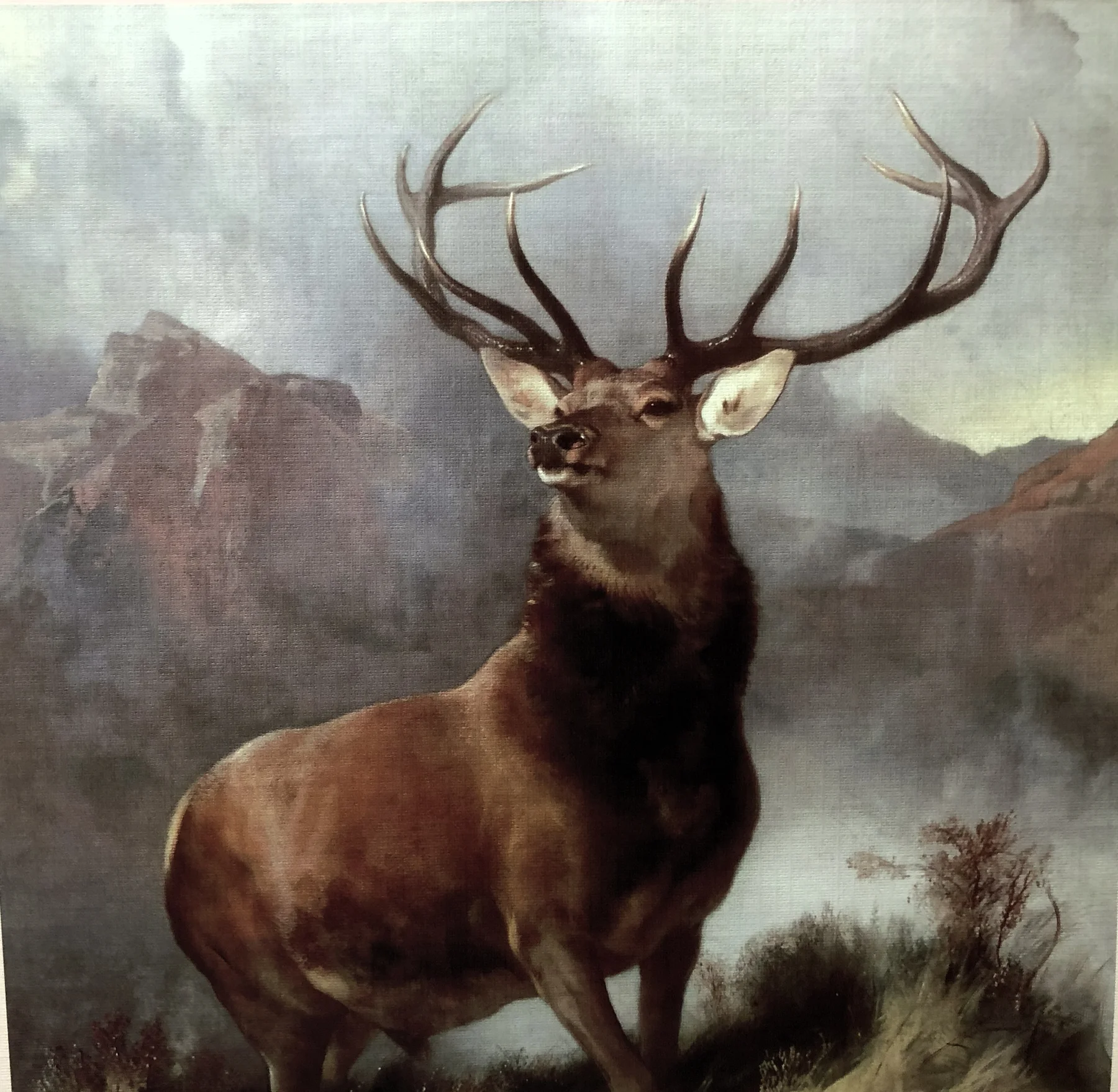
THE MONARCH OF THE GLEN
Sir Edwin Landseer
- Artist
- Sir Edwin Landseer
- Date
- 1851
- Dimensions
- 163.8 x 169 cm
- Medium
- Oil on canvas
- Location
- Diageo private collection, London
A stag looks proudly around his realm, the Scottish Highlands. The image of the majestic ruler may seem familiar, if from nowhere else then from the label of the Scotch whisky Glenfiddich. Edwin Landseer was Queen Victoria’s favourite painter and enjoyed great popularity in his own time, but despite his outstanding talent he has now largely gone out of fashion. As a child Edwin Landseer was encouraged by his engraver father to draw animals from life. The child prodigy’s first works were exhibited at the Royal Academy in London in 1815, when he was only 13. In 1826 Landseer became an associate of the Royal Academy and then a regular exhibitor. Later in life, in 1865, he was offered the presidency of the prestigious institution, but he declined.
A Royal Patron
Queen Victoria was well known for her love of animals, and Landseer painted portraits of her horses and dogs, including her favourite spaniel, Dash. During his life the artist received considerable support from the Queen and Prince Albert, as well as from several other wealthy patrons. Public taste of the time craved sweet, humorous depictions of cats, dogs and monkeys. Landseer did not fall into the trap of what today seems tasteless sentimentality, and thanks to his innate talent he was able to remain a successful artist. The Monarch of the Glen was the best-known and most popular picture of the mid-19th century. The painter also sold many engravings of his works.
A Scottish Stag
The Romantic writer Sir Walter Scott may have been the original inspiration for Landseer’s Monarch of the Glen and his other Highland pictures. The Highlands depicted in Scott’s poetry and prose fanned the Victorian enthusiasm for Scottish landscapes and the country’s unique history. Landseer visited Scott at Abbotsford in 1824 and then decided to continue his journey to the Highlands, where he had never been. The painter was captivated by the mountains, glens, heather moors, mountain streams and, of course, the forests teeming with deer. For forty years he visited the Highlands every autumn to paint and hunt. The stag was at the centre of both activities.
Politics and Painting
In 1850 Landseer was commissioned by Her Majesty’s Fine Arts Commission to make three oil paintings for the new Palace of Westminster in London. The Monarch of the Glen would have been among these three works, to be hung in the House of Lords, but the members of the House of Commons voted down the funds for the paintings, so the picture was never exhibited in Parliament.
The painting was bought by a private individual, Lord Londesborough, for just 350 guineas, a little under £370. It then passed to two other peers, Lord Fitzgerald and later Lord Cheylesmore. By 1892 the painting’s purchase price had risen to £7,245. In 1916 the whisky-distilling Dewar family acquired The Monarch of the Glen, which is now part of the Diageo collection in London.
At the Height of His Art
Like the animal painter George Stubbs, who lived a century earlier, Landseer studied anatomy and dissection in order to perfect his skill at drawing animals. The keen-eyed Landseer’s anatomical expertise can be clearly seen in his depiction of the stag’s musculature and underlying bone structure. The majestic creature stands motionless, yet we sense its dormant strength, its raw nature.
Proud but Vulnerable
Landseer liked to hunt, but here the artist treats his quarry with sympathy, even admiration, as he presents it in its majestic solitude. Landseer painted the stag from below, emphasising the superiority of the wild animal over the hunter. At the same time the picture also depicts the stag as a hunting trophy, which, although capable of rapid movement, is captured in stillness, as easy prey for any hunter.
The Monarch of the Glen is far from the open sentimentality of some of Landseer’s other pictures. Victorian taste humanised animals, endowing them with almost human emotions and expressions. As an extremely accomplished painter Landseer was able to satisfy the public’s demands in this respect. The depiction of wild animals in his picture Wild Cattle of Chillingham (1867) does not bear comparison with The Monarch of the Glen. Although the bull’s posture in this late oil painting is almost a mirror image of the stag’s, the hackneyed picture looks as if it came from a Victorian family album, with the cow and calf below personifying an obedient wife and a submissive child.
Artistic Connection
Landseer was almost 30 years older than his artist friend Sir John Everett Millais. Both were child prodigies, and the older artist encouraged the young Millais in his painting career. Millais belonged to the circle of the Pre-Raphaelites and worked in an entirely different style. Landseer’s last wish [was that Millais should take] his unfinished pictures into his care and complete them.
- Landseer: Queen Victoria in Windsor Home Park
- Landseer: Portrait of Sir Walter Scott
- Landseer: Wild Cattle of Chillingham