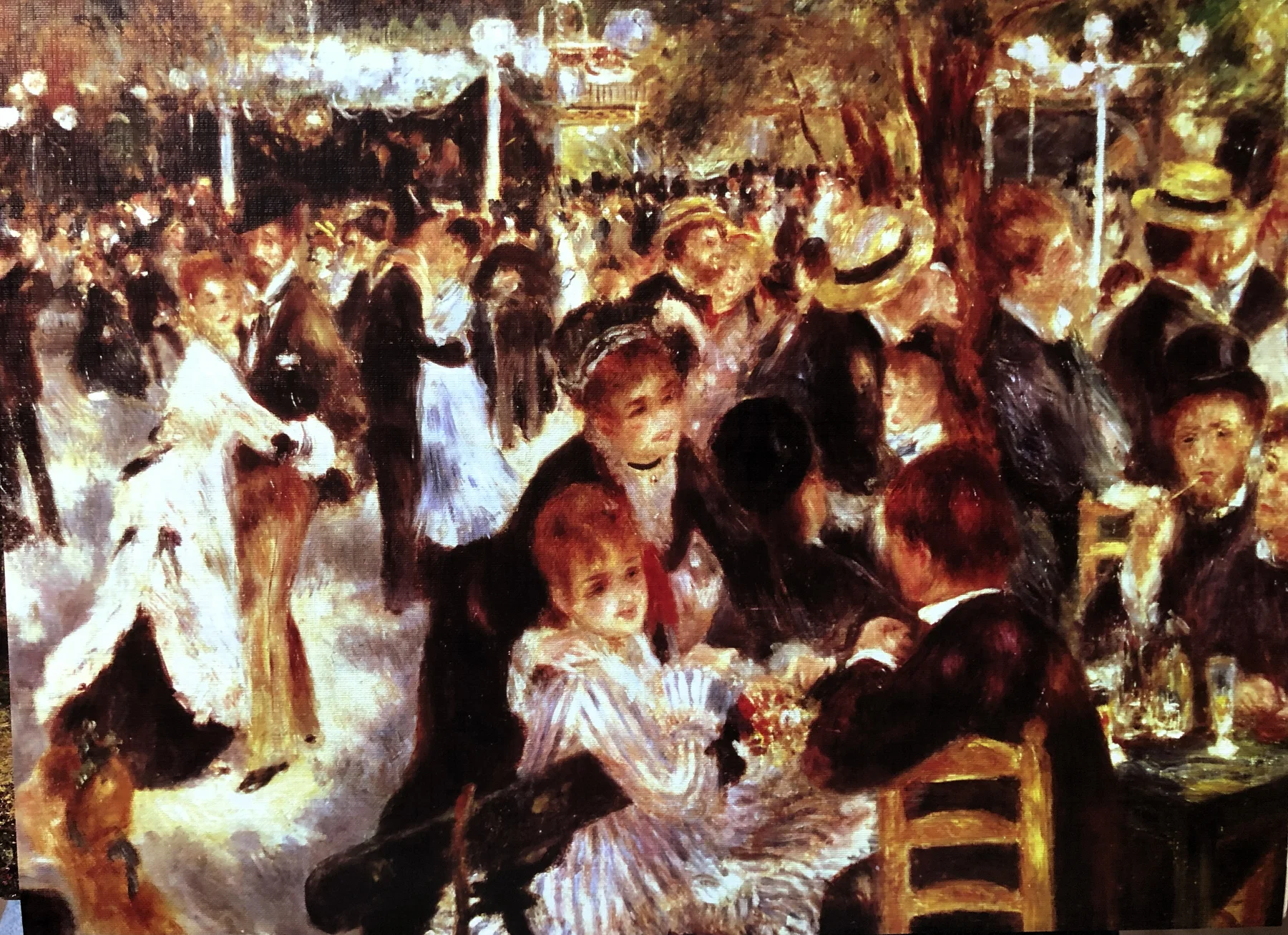
DANCE AT THE MOULIN DE LA GALETTE
Pierre-Auguste Renoir
- Artist
- Pierre-Auguste Renoir (1841–1919)
- Date
- 1876
- Dimensions
- 131 x 175 cm
- Medium
- Oil on canvas
- Location
- Musée d'Orsay, Paris, France
Renoir loved to celebrate the joys of life in his paintings, and the light-hearted gaiety of Dance at the Moulin de la Galette makes it one of his most cheerful compositions.
Dance Parties
The Moulin de la Galette was an old mill in the Montmartre district of Paris, converted in the 1870s into a popular open-air dance hall. The rooms of the establishment, which consisted of two windmills — moulin in French — were set up as a ballroom, and the courtyard shaded by acacia trees held tables and gas lamps.
Renoir, who rented a studio in Montmartre from April 1875, immediately fell under the spell of the Moulin de la Galette and began numerous studies at the popular haunt. The dance hall’s mixed clientele came from the lower middle classes seeking carefree entertainment; besides local artists and students it was frequented by grisettes, young bohemian girls who loved drinking, dancing and flirting.
The People’s Paris
At the Moulin Renoir found the open and sincere expression of the joy of life he so loved to depict. The painting buzzes with the energy of a crowd out for fun on a summer afternoon: some sit at tables casting flirtatious glances at one another, others twirl on the dance floor, and the benches are filled with courting couples and smiling children. One of Renoir’s writer friends, Georges Rivière, wrote of Dance at the Moulin de la Galette in 1877: “The picture is a page of history, a delicate and precise depiction of Parisian life.” Renoir captured the spontaneity of the Moulin’s clientele in true Impressionist style, working on the spot rather than in the studio. In terms of scale the painting was an ambitious undertaking — most Impressionist works made outdoors were on small canvases with relatively simple compositions. Making the painting took several weeks. Every single day Renoir’s friends helped carry the huge canvas and easel from the artist’s studio in the rue Cortot to the dance hall, where Renoir set up camp with his equipment among the tables.
Friends as Models
The same friends of Renoir also served as models for the painting. At the table on the right sit two painters, Lamy and Goeneutte, and a writer, Georges Rivière, with the artist’s two female models, Jeanne and her sister Estelle. In the centre of the picture the elegant Cuban painter Don Pedro Vidal dances with his girlfriend, Renoir’s favourite model, Marguerite Legrand. Further friends of Renoir fill the background. Looking at the picture, we can well sense that Renoir was on intimate terms with several of the figures depicted. Some cast a warm glance towards him (and thus towards us), drawing us into the bustling whirl of the dance hall.
A Well-Constructed Composition
Renoir showed his work at the third Impressionist exhibition in Paris in 1877, where it received an unfavourable reception from the leading Paris art critics, who judged the picture disorderly and confused. But if we examine the painting more closely, it becomes clear that although the placement of the figures reflects randomness and chance — exactly the effect Renoir intended to convey — it is in fact a scene composed with great care.
The artist organised the figures into two circular groups: one is formed by the members of the company sitting close together at the table on the right, while the wider, more open circle forms around the couple dancing on the left. The arrangement of the three figures in the foreground forms a pyramid. Renoir built a subtle grid into the painting, with firm vertical and horizontal dimensions, thereby balancing the looser composition of the groups of people. For example, the gas lamps, wooden structures and clusters of people in the background create a purely horizontal effect, while the vertical dimension is provided by the lamp posts, tree trunks, chair backs and the dancing figures.
Fantastic Light
The beauty of the painting comes above all from Renoir’s use of colour, as dancing sunbeams filter through the canopy of leaves arching over the courtyard. The whole scene is dappled with spots of light, further heightening the lively effect created by the dancers. Because of this broken light effect a flood of contemporary criticism fell on Renoir. Of his painting of a young couple made with a similar technique, The Swing of 1876, a critic wrote: “The sunlight effects are like… grease stains on the model’s dress.” Today, however, it is precisely this that is one of the best-loved features of his works.
An Unwanted Gift
Dance at the Moulin de la Galette was bought by Renoir’s friend, the painter and collector Gustave Caillebotte. The painting’s size, its “vulgar” content and the revolutionary use of the broken light of sunbeams made the picture hard to sell, but Caillebotte was a passionate collector of Impressionist works. On his death in 1894 he left his extensive collection to the French state, to the great outrage of the academic painters, who protested vigorously against putting such “daubs” on public display. Finally a compromise was reached under which only the “best” works would be exhibited, among them six of the eight Renoirs in the Caillebotte collection, half of Monet’s paintings and seven of the eighteen Pissarros. The canvases, including the Moulin de la Galette, were exhibited in the Musée du Luxembourg in Paris.
- The Moulin de la Galette in Paris, photograph from 1900
- Renoir: Couple Reading, with Legrand in the foreground
- Renoir: The Swing, 1876