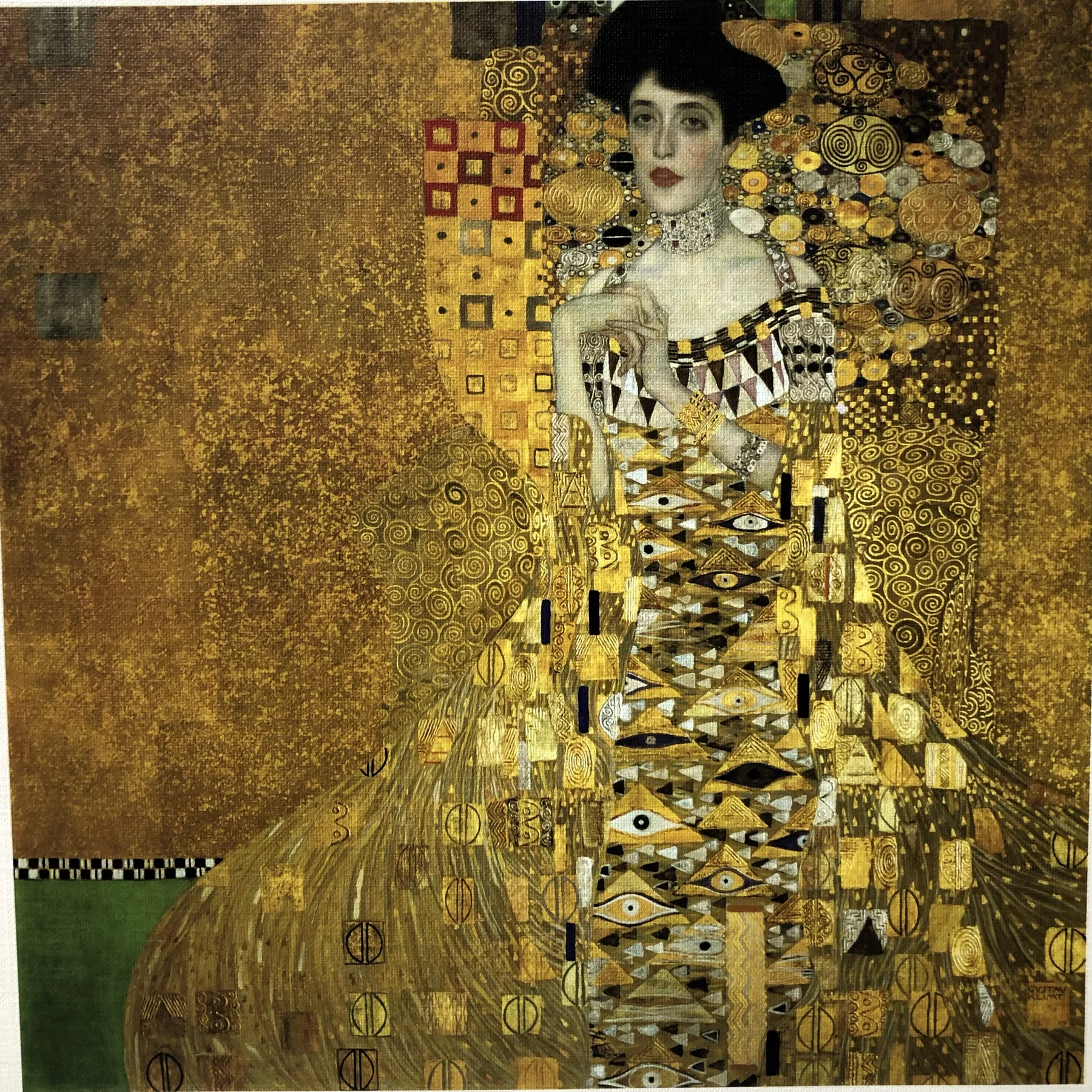
PORTRAIT OF ADELE BLOCH-BAUER I
Gustav Klimt
- Artist
- Gustav Klimt (1862–1918)
- Date
- Between 1903 and 1907
- Dimensions
- 140 x 140 cm
- Medium
- Oil, gold and silver leaf on canvas
- Location
- Neue Galerie, New York, USA
With its enigmatic gaze and sensual ruby-red lips, Gustav Klimt’s sumptuous Portrait of Adele Bloch-Bauer I is one of the most famous portrait paintings of the 20th century. The intricate, swirling patterns of gold and silver leaf make the painting the masterpiece of Klimt’s Golden Period, and it is also a fine document of the breathtaking splendour of fin-de-siècle Vienna. When Klimt began work on the picture in 1903, Vienna was the artistic and cultural centre of Europe. One of the most important and controversial artists of Vienna, then enjoying “the last spark of the imperial age”, Klimt began his career as a decorative painter, turned to easel painting by the age of thirty, and around the turn of the century became the leading portrait painter of the Viennese upper middle class.
An Artist Who Rejected Convention
Klimt’s works, however, were far from traditional depictions. Turning against conservative academic traditions, in 1897 he was one of the co-founders of the Vienna Secession, a group of avant-garde artists seeking to develop a unique mode of expression free from historical influences. Klimt painted in a highly decorative style, and his portraits placed particular emphasis on feminine seduction, mystery and sensuality. His style did not please everyone, but it was bold and dramatic, and its distinctive beauty and elegance aroused the interest of Vienna’s leading patron of the arts, Ferdinand Bloch-Bauer.
The Bloch-Bauer Family
A wealthy sugar magnate of Jewish origin, Bloch-Bauer was a committed patron of the arts, including Klimt. He commissioned Portrait of Adele Bloch-Bauer I to celebrate his recent marriage. In Bloch-Bauer’s eyes Klimt’s unconventional art perfectly conveyed Adele’s similarly distinctive beauty and intelligence. What he did not know was that Klimt may have known Adele before. It is said that Adele had already modelled for Klimt in 1899 and that a romantic relationship developed between them. Almost unbelievably, Klimt worked on the Bloch-Bauer painting for three years. When he finished it, rumours again spoke of their intimate relationship.
Golden Adele
The rumours did not affect Klimt’s relationship with his patron in any way. On the contrary, by all accounts Ferdinand was very pleased with the picture, which he hung on the wall of their bedroom. Depicted in a regal pose, Adele’s goddess-like figure floats on a swirling sea of gold. The patterns of the background labyrinth — from geometric shapes to Egyptian motifs, from exotic symbols to the letters of Adele’s name — create a startling effect. Only the woman’s face and hands are painted naturalistically; with her enigmatic expression Klimt presents both the woman’s fiery sensuality and her sharp intellect, and in Adele he also creates the archetype of the femme fatale. Interestingly, Klimt heightens this effect by placing a silver collar around the woman’s neck, almost identical to the one worn by the biblical man-slayer Judith in the picture Judith I.
A Century-Long Journey
Portrait of Adele Bloch-Bauer I is the jewel of the collection of the Neue Galerie in New York, housed in a fashion-salon-style building. The troubled story of the picture’s century-long wandering from one continent to another is overshadowed by tragedy and war. First Adele died of meningitis in 1925, then in 1938, on the eve of the Second World War, Hitler annexed Austria. This put the Jewish Bloch-Bauer in terrible danger; he fled to Switzerland, leaving his property and art collection to the Nazis. One of the seven Klimt pictures seized by the Germans, Golden Adele went to the Austrian National Gallery in Vienna, where it found a home for nearly 70 years.
In her last will Adele had asked that the Klimt pictures pass to the state, but Ferdinand disagreed. Disillusioned by Austrian support for the Nazis, shortly before his death in 1945 he rewrote his will and left all his property to his nephew and two nieces. Ferdinand’s heirs also fled Austria during the war, settled in the United States and in the following decades tried to recover the lost pictures — in vain. In 2006, however, after an American lawsuit and the adoption of new Austrian restitution laws, Adele’s portrait, together with four other paintings, finally passed into the possession of Ferdinand’s only living heir, Maria Altmann.
A Record Price
The news that Maria Altmann had recovered the Klimt paintings and wanted to sell them caused a great sensation. In June 2006 Portrait of Adele Bloch-Bauer I was sold for 135 million dollars to Ronald Lauder’s Neue Galerie, at the time the highest sum ever paid for a painting. After the picture was acquired, the museum’s weekly attendance jumped from 1,750 to more than 10,000. It seems Klimt’s enigmatic femme fatale has lost none of her allure.
- Adele Bloch-Bauer
- Judith I, 1901
- Maria Altmann with the painting