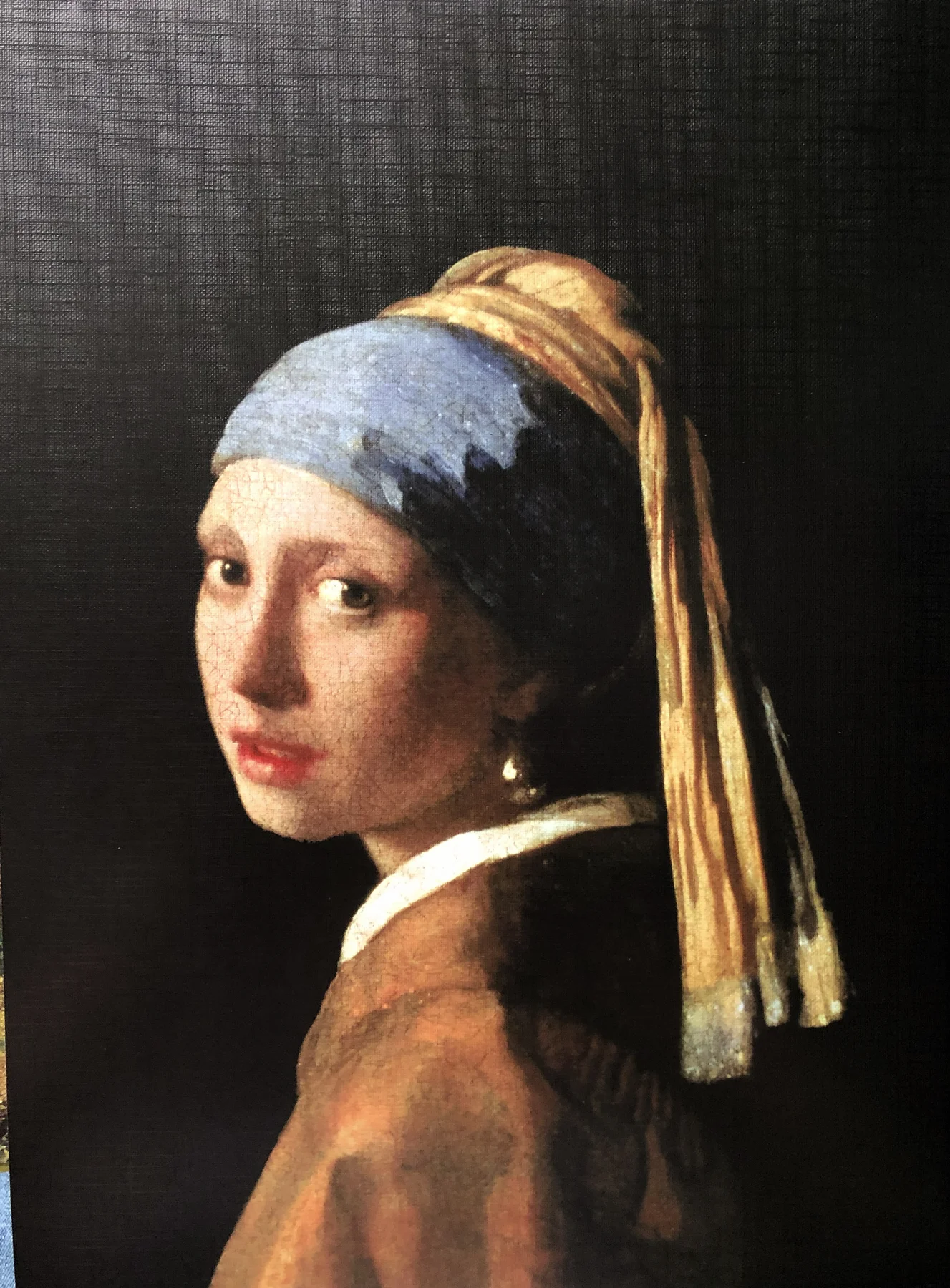
GIRL WITH A PEARL EARRING
Johannes Vermeer
- Artist
- Johannes Vermeer (1632–1675)
- Date
- Between 1665 and 1667
- Dimensions
- 44.5 x 39 cm
- Medium
- Oil on canvas
- Location
- Mauritshuis, The Hague, Netherlands
Girl with a Pearl Earring is one of the best-known paintings in the world — its radiance, timelessness and mystery are endlessly captivating. An air of enchantment pervades it: who is this wide-eyed girl? Is it contentment or surprise on her face? No wonder, then, that this picture is called the “Dutch Mona Lisa”. The central element of the painting is the pearl, which best characterises Vermeer’s work: the little earring — almost unbelievably, it consists of just two brushstrokes — is a masterpiece of both softness and precision. This infinitely simple scene is poetry itself.
A Local Artist
In keeping with the customs of his time, Vermeer worked for a patron — one of the richest citizens of Delft, Pieter van Ruijven — who bought his pictures. Although this arrangement gave Vermeer some income, it proved a double-edged sword. Since van Ruijven bought most of his pictures, Vermeer remained relatively unknown beyond the boundaries of Delft.
A Mystery for Sale
The origin of Girl with a Pearl Earring — and the history of its ownership — has always remained obscure and has divided expert opinion. A sculptor named Johan Larson is said to have bought a picture directly from Vermeer at the time Girl with a Pearl Earring was painted. Larson’s heir later claimed that the picture was passed on for 10 guilders. The first sure evidence of the picture’s sale dates from 1881, when it was auctioned in The Hague. The painting was in poor condition and its creator could not be identified, as the signature “IVMeer” was no longer legible. Nevertheless it aroused the interest of a collector and leading figure of the art world, A. A. des Tombe. He acquired the masterpiece for 2 guilders. He restored the painting and was the first to see Vermeer’s signature. When des Tombe died in 1902, he left the work to the Mauritshuis in the Netherlands, where it can still be seen today.
The painting underwent thorough restoration in 1994, during which the yellowed varnish that had dulled the colours was removed, as were the retouchings. The world could once again admire Vermeer’s wonderful vivid colours and the painting’s true brilliance in their former glory.
Vivid Colours
Girl with a Pearl Earring — and many other works by Vermeer — owes its wonderful blue to the use of natural ultramarine. The pigment itself is obtained by crushing a pure dark blue semi-precious stone, lapis lazuli. The pigment was extremely expensive and was usually reserved for painting the Virgin Mary’s robe. No painter of the time used this colourant as lavishly as Vermeer, who used it among other things for portraits such as Girl with a Pearl Earring.
The Dutch Golden Age
The Netherlands had given the world great artists before, but in the 17th century brilliant creators such as Rembrandt, Frans Hals and of course Vermeer came onto the scene. The country was free of foreign influence and had grown very rich through foreign trade. The Dutch attached great importance to private life, and works of art made for private purposes enjoyed great popularity. There was demand for depictions of small scenes of family life, and in contrast to religious paintings, which were identified with Catholicism and foreign rulers, more secular subjects were preferred. The family scenes are pervaded by an air of quiet contemplation and devotion, not far removed from the mood of churches.
Tronie
The young girl in the painting wears a turban, which is rather unusual for a 17th-century Dutch girl. Why? And what does it all mean? The most likely answer is that this is not a portrait but a tronie, a kind of depiction intended to present a particular expression or mood, in this case an exotic, oriental one. The tronie style was made popular by Rembrandt, and Vermeer mentions two such works in his will, one of which is probably Girl with a Pearl Earring.
Unsigned Masterpieces
Since Vermeer rarely signed or dated his paintings, they were an open field for forgers. One such astonishing case occurred in May 1945: Han van Meegeren was arrested on charges of collaborating with the enemy for selling an “original Vermeer” to the Nazi leader Hermann Göring. At the trial, to general astonishment, Van Meegeren came up with a unique defence against a charge that then carried the death penalty. He claimed that the “Vermeer” — one of his extensive Vermeer collection — was a forgery he had made himself, and to prove it he began painting in front of the court. He confessed to having made five more fake Vermeers. He never served his prison sentence, as he died of a heart attack before sentencing. His Vermeer forgeries are said to have earned Van Meegeren 25–30 million dollars.
- Vermeer: View of Delft
- Lapis lazuli
- Van Meegeren painting a “Vermeer” in court