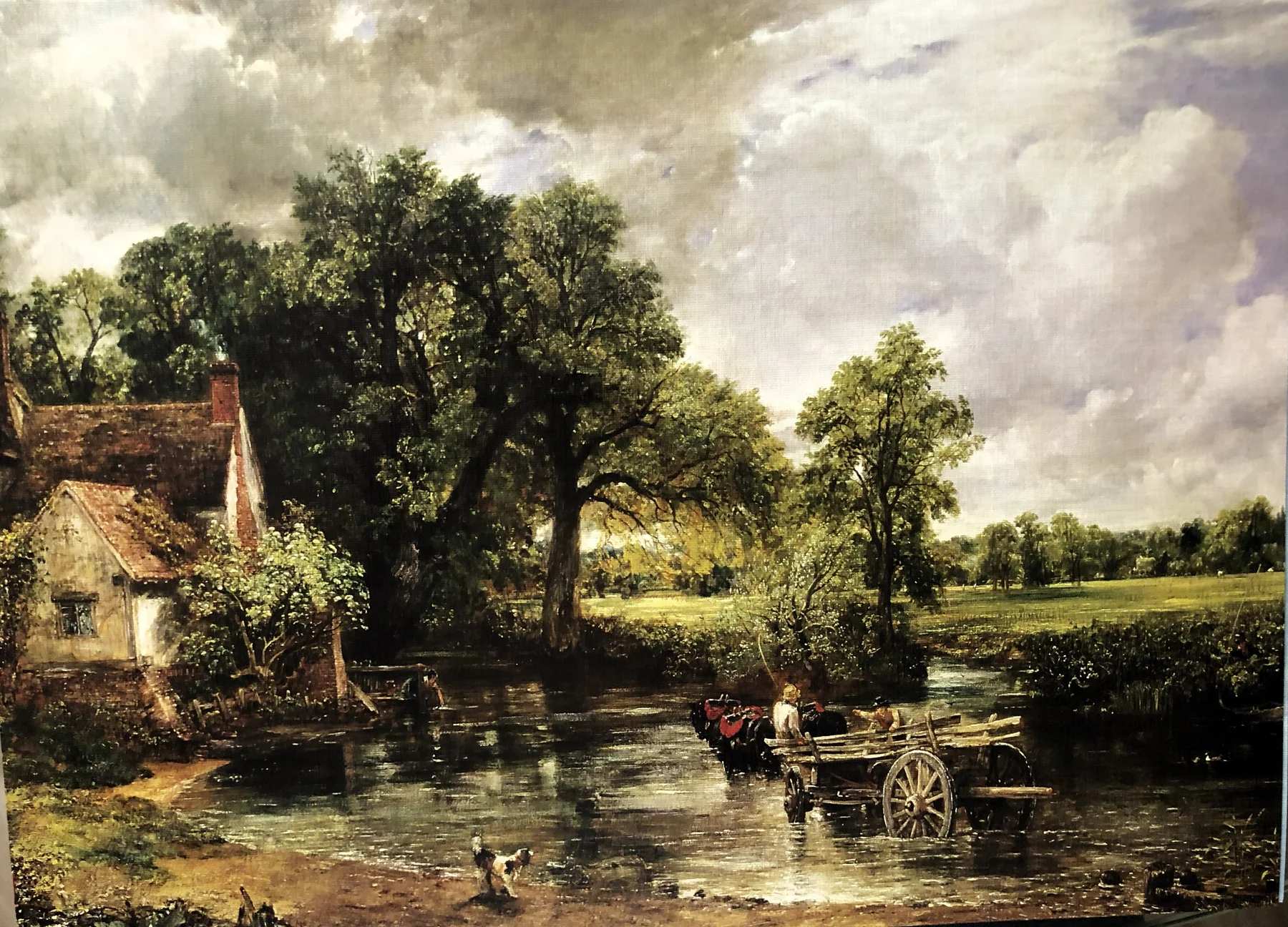
THE HAY WAIN
John Constable
- Artist
- John Constable (1776–1837)
- Date
- 1821
- Dimensions
- 130 x 185 cm
- Medium
- Oil on canvas
- Location
- National Gallery, London, England
The Hay Wain depicts a peaceful village scene from rural England. The harvest team crosses a shallow ford beside Flatford Mill; on the left is Willy Lott’s house, which belonged to Constable’s father and where Constable himself grew up. Beyond the meadow, in the background on the right of the picture, haymakers are at work. Originally exhibited under the title Landscape: Noon, the painting was first referred to as The Hay Wain by Constable’s friend Archdeacon Fisher back in February 1821, and this name quickly became popular. In The Hay Wain Constable depicts the landscape extremely vividly, without any artificiality, which is why the French writer Stendhal called the painting “the mirror of nature”.
A Romantic Adventure
Following the fashion for painting romantic mountain landscapes, Constable spent long periods in Derbyshire and the Lake District, but his own style, seen in The Hay Wain, developed only after his return to calmer, less spectacular Suffolk, with its rural atmosphere.
In 1810 Constable began a series of drawings and oil sketches. In these depictions made outdoors he presents his native region in an unusually fresh, direct way. Constable studied various cloud formations with scientific thoroughness in order to render them accurately in his pictures. He knew well that the mood of a landscape is best expressed through clouds. Through intense observation of the sky and clouds he was able to give his pictures a special atmosphere; this particular atmosphere is well conveyed by the dark, threatening clouds dominating the painting.
The Story of the Picture
After marrying Maria Bicknell in 1816, Constable moved to London, but he continued to spend his summers painting rural scenes at East Bergholt in Suffolk, near his former home, at Flatford Mill by the river.
He was still a virtually unknown artist when, longing for public esteem and as an expression of his feelings for the Suffolk countryside, he submitted a series of large paintings to the Royal Academy’s annual exhibition in 1821. The first such six-foot canvas, or “six-footer” as they were later called, was The White Horse, the second Stratford Mill and the third The Hay Wain.
Growing Success
Although The Hay Wain was exhibited at the Royal Academy, it found no buyer. Constable finally managed to sell it in 1823, together with two other pictures, to an Anglo-French art dealer, who exhibited the paintings at the Paris Salon of 1824. The work, along with Constable’s other works, caused a great sensation among French painters and won the Gold Medal awarded by Charles X, crowned King of France in 1824.
Flatford Mill Today
The landscape painted in The Hay Wain is still recognisable today. Willy Lott’s house stands intact behind Flatford Mill. The building and the little river have changed little since the early 19th century, and the site is still a popular tourist destination, as visitors curiously compare the real landscape with the painted scene.
Related to the Work
The desire for greater professional recognition may have prompted Constable’s bold decision in 1818 to start painting on large canvases, thereby competing not only with the landscapes of the old masters but also with those of his celebrated contemporary, J. M. W. Turner.
- A Constable painting of East Bergholt
- Constable’s father
- Constable’s wife, Maria
- Charles X awards Constable a gold medal
- Willy Lott’s house today