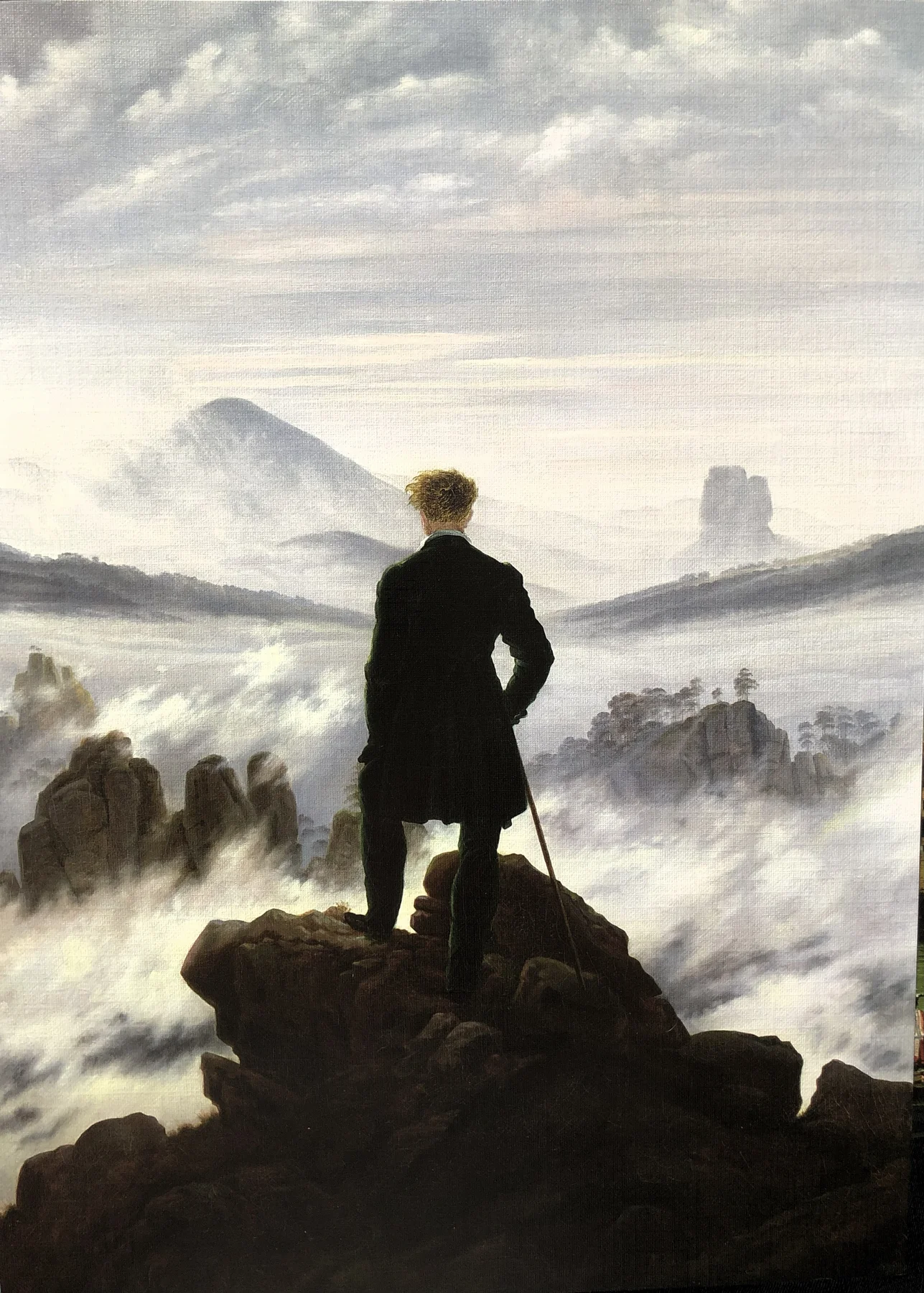
WANDERER ABOVE THE SEA OF FOG
Caspar David Friedrich
- Artist
- Caspar David Friedrich (1774–1840)
- Date
- 1818
- Dimensions
- 98.4 x 74.8 cm
- Medium
- Oil on canvas
- Location
- Hamburger Kunsthalle, Hamburg, Germany
A masterpiece of German Romantic painting, Wanderer above the Sea of Fog depicts a sublimely beautiful dramatic landscape. A solitary figure — probably Friedrich himself — stands at the edge of a jagged precipice, gazing at the fog-shrouded peaks opposite. The view is breathtaking: the soft tones of blue, grey, violet and yellow of the endless sky form a dazzling blend above the lazy blanket of fog pierced by sculptural rock formations. Friedrich passionately depicted man’s personal encounter with the sublime beauty of nature: he placed his figures in the deepest chasms, on deserted seashores or, as here, on a windswept mountain peak. At the heart of his artistic and spiritual philosophy was the idea that in contemplating sublime nature man senses the divine in the surrounding landscape and enters into spiritual communion with God and with himself.
A Mountain Man
Friedrich was born in Greifswald, on the picturesque Baltic coast of northern Germany, and began studying art there at 16 before going to Copenhagen to continue his studies. In 1798, at the age of twenty-four, he returned to Germany and settled in Dresden. From there he made regular trips to the nearby Elbe Sandstone Mountains along the German–Bohemian border, filling his sketchbook with meticulous studies and drawings of the most spectacular, dramatic places. Several peaks and rock formations of the range can be recognised in Wanderer above the Sea of Fog, for example the distinctive massif of the Zirkelstein in the background on the right. Although the setting looks natural enough, Friedrich completely rearranged the positions of the peaks for the sake of the composition.
Man in Focus
Wanderer above the Sea of Fog is essentially a landscape, but the importance of the solitary figure cannot be ignored. Placed exactly in the centre of the canvas, the figure’s silhouette stands out sharply against the brilliant sky. Everything in the composition points towards him: from the triangular crag on which he stands to the soft V-shaped form of the slopes running through the middle of the picture. Against the billowing fog the wanderer embodies the solidity emanating from the rock. The two elements are linked by dark tones and by the triangular composition formed by the end of the man’s walking stick, his coat and his arm. This effect is one of the painting’s interesting, ambiguous details — the figure seems part of nature, yet also separate from it.
Rückenfigur
Like many of Friedrich’s other pictures, Wanderer above the Sea of Fog is more than a mere allusion to solitude. Many critics attribute the melancholy of Friedrich’s art to the losses he suffered in childhood — while he was still a small boy his mother, two sisters and a brother died — and in addition he suffered bouts of depression several times during his life. Friedrich contributes to conveying the wanderer’s solitude by depicting his figure from behind, using the artistic device called the Rückenfigur (literally “back figure”), which he, like other German Romantic painters, often employed. Although this device prevents us from engaging with the figure of the wanderer, it encourages us to imagine ourselves in his place and share with him the grandeur of the landscape.
A Complex Work
Besides its wonderful beauty, Wanderer above the Sea of Fog also has a mysterious appeal, full of enigmas and unanswered questions. The figure’s prominent position and confident posture suggest a kind of mastery over the landscape, but his isolation and the dramatic setting also create a sense of insignificance. Similarly, the German word “Wanderer” can be translated as wanderer or as hiker: the first interpretation suggests someone with no, or only vaguely defined, purpose or destination, while the latter implies a traveller with firmer ideas. Friedrich often used symbols in his works, especially in his late paintings, and many critics believe this picture is a metaphor for the unknown future: the wanderer now stands firmly on the rock symbolising the present day, but gazes into the dense, impenetrable fog of what is to come.
- Greifswald today
- Friedrich in his studio