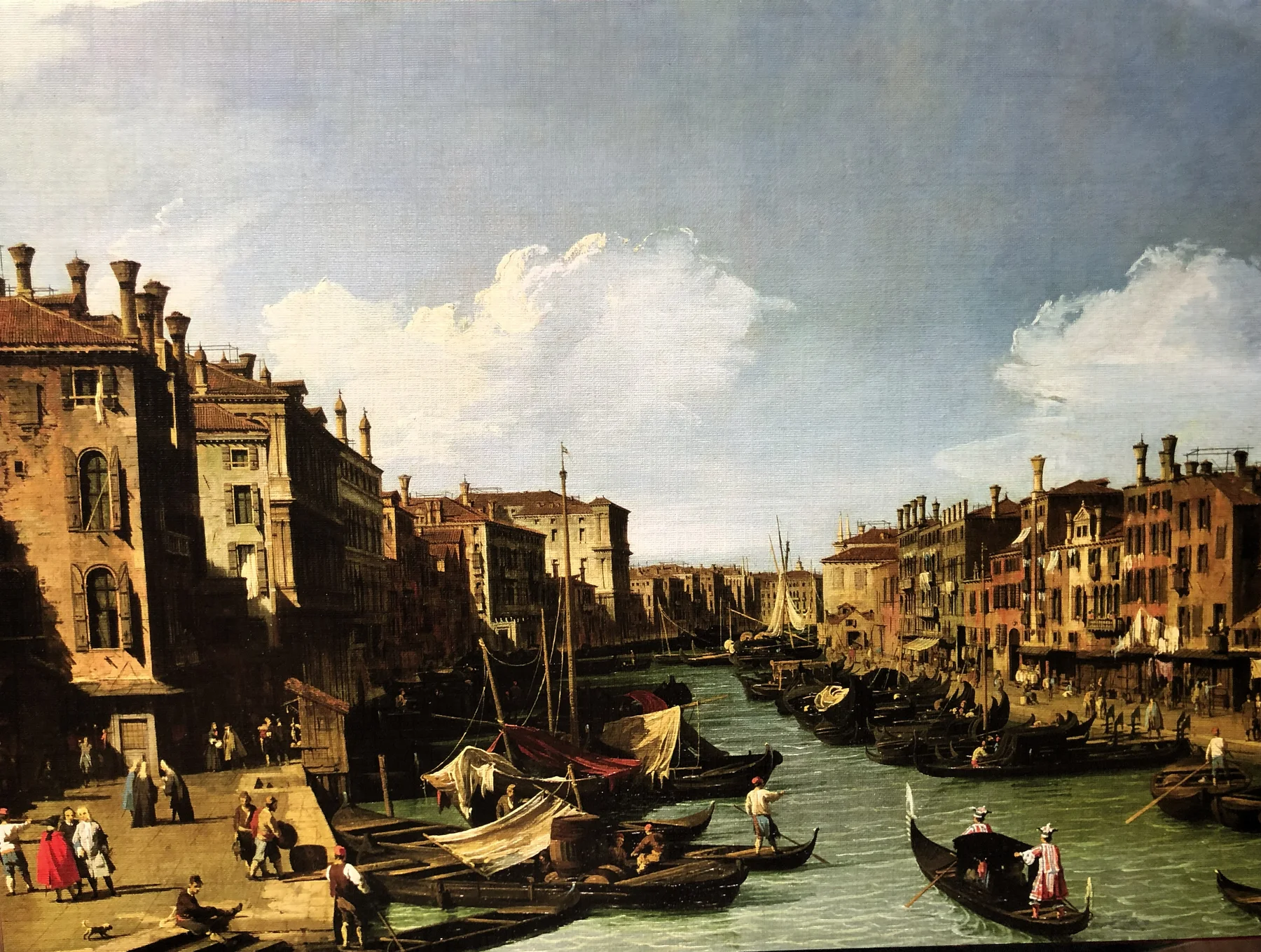
THE GRAND CANAL NEAR THE RIALTO BRIDGE, VENICE
Canaletto
- Artist
- Canaletto (1696–1768)
- Date
- 1730
- Dimensions
- 49.6 x 73 cm
- Medium
- Oil on canvas
- Location
- Currently on display in the Museum of Fine Arts, Houston, Texas. (In the Robert Lee Blaffer Memorial Collection, gift of Sarah Campbell Blaffer.)
The Grand Canal near the Rialto Bridge, Venice was one of many pictures of Venice that Canaletto painted on commission. The majestic canal, Venice’s main artery, was his favourite subject. Canaletto was born very close to the place depicted in the painting and captured the life of his native city — its people, buildings, light and colours — with effortless ease. Venice has always attracted writers and painters and for centuries has been a favourite destination of travellers. Its breathtaking beauty and splendid architecture were made even more enchanting by the fact that the city is disappearing as it slowly sinks beneath the water. The decline of Venice has been predicted for centuries, which is why it became a popular subject among painters who sought to capture the city’s elegant decay. Canaletto, however, did not follow this dreamy style of painting and created meticulously detailed views of everyday places which, surprisingly, are still recognisable today. Canaletto was undoubtedly one of the most famous topographical painters of his time, making incredibly detailed and accurate townscapes of, for example, Venice and London.
A Souvenir for a Tourist
Canaletto made the vast majority of his works for travellers, and this painting was no exception. He created countless views on commission from wealthy travellers who wanted a souvenir of the city, still known as the “Most Serene Republic of Venice”. Canaletto’s works were most popular among the English, who became his most popular patrons on their European tours. Later Canaletto himself lived in England for a while.
Canaletto sold many of his pictures through two main buyers who were also his agents. One was Owen McSwiney, who introduced the artist to his first English buyer and encouraged him to paint small, cheerful pictures that the tourists flocking to Venice would want to buy. The other was Joseph Smith, an influential patron of the arts who became His Majesty’s consul in Venice in 1744. Smith was responsible for selling many of Canaletto’s pictures to perhaps the most eminent patron of all: King George III of England.
The Grand Canal near the Rialto Bridge, Venice and The Entrance to the Grand Canal: Looking West (both in the Museum of Fine Arts, Houston) were made on Smith’s commission for the Earl of Wicklow. The total cost of the paintings, including shipping to Ireland via London, customs and framing, came to £23 and 11 pence. The receipt dated 22 August 1730 is still kept in the family archive, although the paintings were sold in 1955.
The View from the Bridge
Canaletto tried to paint the bustling city as it really was. We can see lottery tickets being sold in the stalls on the quay and Venice’s famous gondoliers hunting for passengers. In this painting they wear the elegant dress they usually put on for the regattas. On the left of the picture various palaces can be seen: the Dolfin-Manin, the Bembo and the huge Grimani, which today houses the Court of Appeal.
Venice and the Grand Canal
The Grand Canal is Venice’s main artery. This broad waterway reflects the city’s luxurious palaces, offering a fairy-tale spectacle. The Rialto is the city’s most splendid bridge, situated halfway along the winding canal. Built in 1591, it boasts an elegant arch and is flanked on both sides by the oldest houses in Venice. The view of the bridge is the most picturesque part of the whole canal.
- George III
- The Grand Canal in Venice today, at night
- The Museum of Fine Arts in Houston, Texas
- The Rialto Bridge in Venice