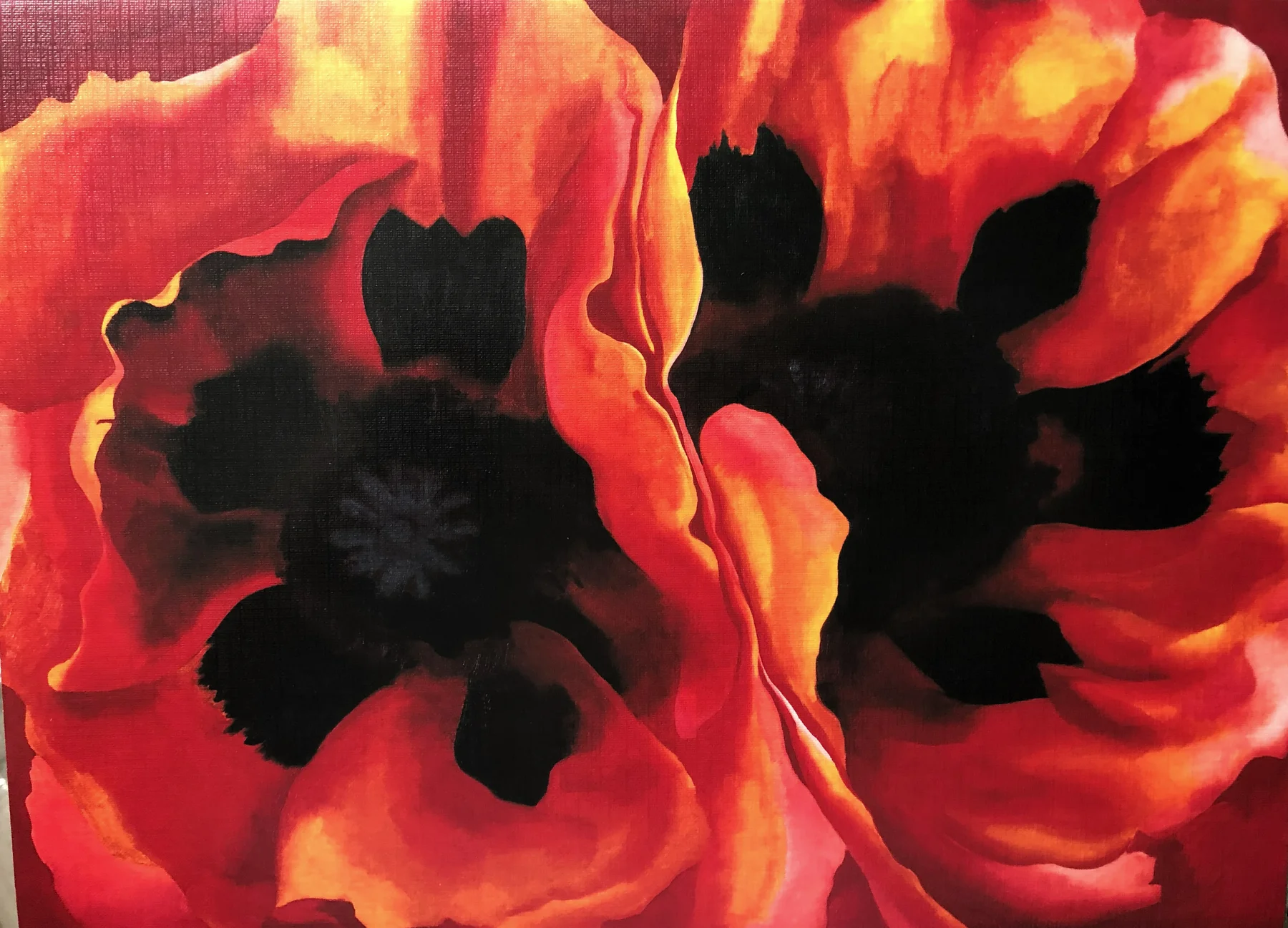
POPPIES
Georgia O'Keeffe
- Artist
- Georgia O'Keeffe (1887–1986)
- Date
- 1928
- Dimensions
- 76.2 x 101.6 cm
- Medium
- Oil on canvas
- Location
- Frederick R. Weisman Art Museum, Minneapolis, USA
Georgia O'Keeffe is perhaps the greatest American woman painter of all time. Her pictures, painted in vivid colours, radiate calm and, despite their undoubted modernity, seem to stand in constant contrast to the chaotic world around them. Usually conceived from the natural world, her paintings have a timeless quality, and the best known are her huge depictions of flowers. In her pictures she enlarges everyday objects to such an extent that they border on abstraction, yet they seem lifelike. Her colours are so rich and dazzling that the viewer feels like reaching out and touching them. O'Keeffe was not concerned with the botanical features of flowers; only colour and form mattered to her. One of her most famous such paintings is Poppies. The sensual reds of the petals floating across the canvas are held back only by the jet-black interiors of the flowers.
Shaping the Flowers
O'Keeffe wanted to draw viewers’ attention to the fragile beauty of flowers, which in her view is so fleeting that people cannot really appreciate their brilliant splendour. As she observed in 1922: “Nothing is less real than realism. Details are confusing. It is only by selection, by elimination, by emphasis that we get at the real meaning of things.” Like many modernist painters, O'Keeffe held that the innermost essence of things is “more real” than their physical appearance.
O'Keeffe began painting her large flower pictures in 1924, the first of which was Petunia No. 2. She made her huge canvases depicting resplendent flowers until 1928, the year Poppies dates from. After 1928 her artistic career took a new direction.
The Artist’s Partner
Georgia O'Keeffe was born on 15 November 1887 in Sun Prairie, Wisconsin. Even as a child she knew she wanted to paint. Her early works were exhibited in 1916 by Alfred Stieglitz, an influential New York art dealer and curator and one of America’s finest photographers. This event marked a turning point in O'Keeffe’s life. Her meeting with Stieglitz eventually led to their marriage in 1924.
Photographic Influences
The photographic style of Stieglitz and his colleague, the modernist Paul Strand, had a great influence on O'Keeffe’s art. The photographers took pictures of everyday objects and then cropped the images to reveal smaller details, allowing the discovery of what they considered the innermost essence. In this way ordinary objects received a depiction entirely different from the usual. This technique inspired O'Keeffe in creating her flower pictures and her brilliant paintings of New York skyscrapers. Almost unbelievably, O'Keeffe was able to present these symbols of the metropolis as beings sprouting from the earth.
Abstract Flowers
The enlarged flowers in O'Keeffe’s paintings, torn from their natural surroundings, give the viewer the opportunity to examine their unique beauty in detail. O'Keeffe paid great attention to working out her pictures, carefully creating every pictorial element with thick oil paint. She also applied a thick ground to achieve an even surface. Her works are sensual, almost surreal in form, as she depicts the elements of nature in a new light.
The public and critics alike tried to read many things into the flower paintings: are they about sexuality, or do they capture the cycle of life and death? O'Keeffe gave no answer to these questions, merely stating that she painted what she saw before her.
A Desert Dream
O'Keeffe wanted to discover America’s natural beauty, so in 1929 she travelled by train to New Mexico. The trip changed her life: she was captivated by the barren, dreamlike desert landscape. She bought a house and spent the winters there. After Stieglitz’s death in 1946 she moved to her beloved New Mexico and lived there for the rest of her life. From then on she devoted her life and work to the American Southwest.
- Alfred Stieglitz and Georgia O'Keeffe
- The present home of Poppies (Frederick R. Weisman Art Museum)
- O'Keeffe at work
- O'Keeffe’s home: a ranch in the desert