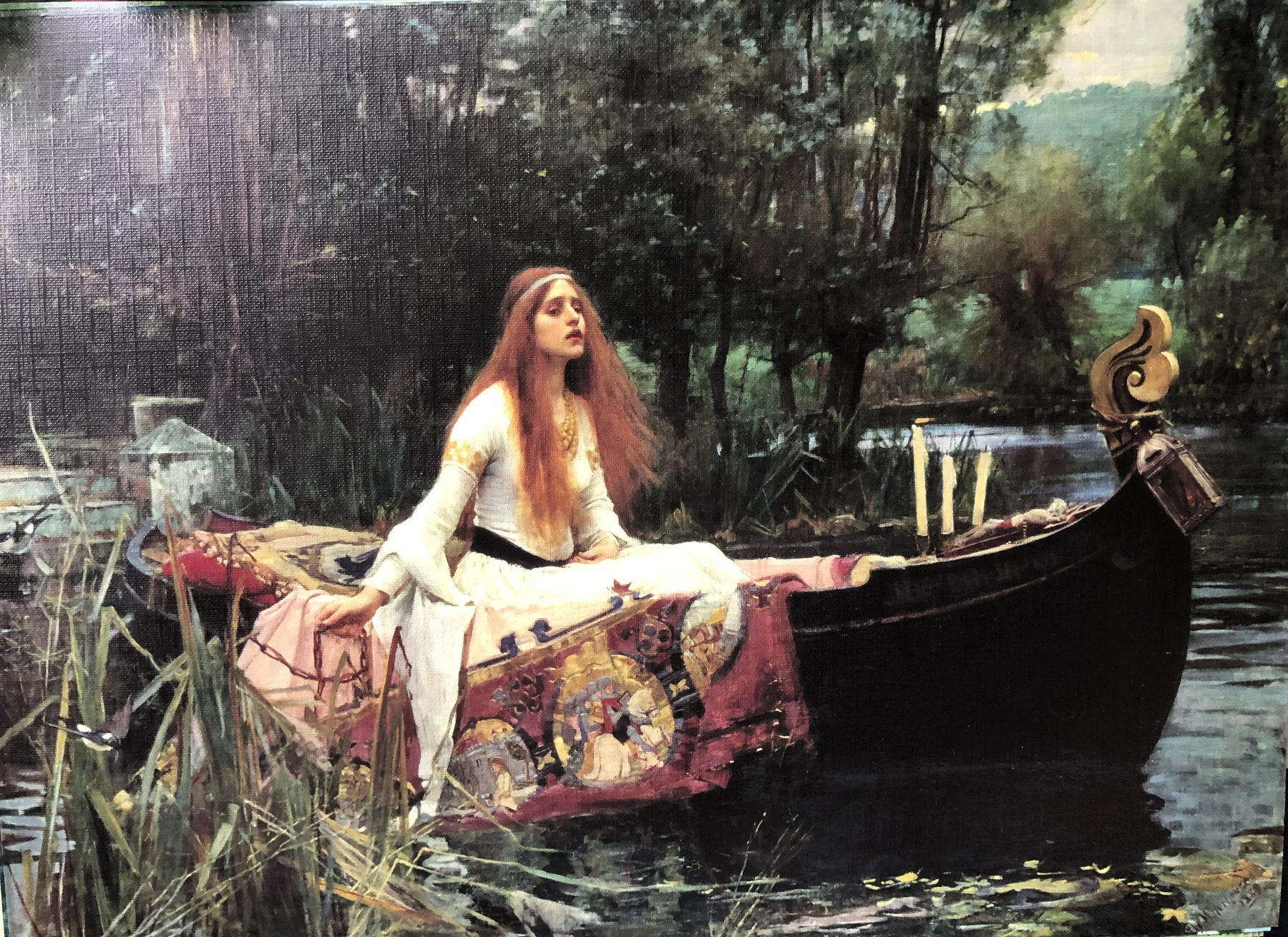
THE LADY OF SHALOTT
John William Waterhouse
- Artist
- John William Waterhouse (1849–1917)
- Date
- 1888
- Dimensions
- 152.4 x 199.4 cm
- Medium
- Oil on canvas
- Location
- Tate Britain Gallery, London
The Lady of Shalott is one of the most acclaimed and best-loved English paintings. It was inspired by the poem of the same title by the outstanding English poet Lord Tennyson, published in 1832. It belongs to the Arthurian cycle and tells the story of Elaine of Astolat, who is under a curse — she may not leave the tower on the island of Shalott and is condemned to live in solitude for the rest of her life. She dares not look out of the tower window, for if she does the curse will fall upon her, and she can view the outside world only through her mirror. One day she glimpses in the mirror the most famous and most dashing of all knights, Sir Lancelot. The lady looks out of the window, straight at the knight, but as she does so her mirror cracks into pieces. The curse is fulfilled. The picture depicts the moment in the poem when the lady sets off for Camelot to meet the brave knight, Sir Lancelot, with whose reflected image she has fallen in love, knowing that her fate is sealed. The lady is desperate, her gaze pained and weary; the curse has come upon her. Her right hand releases the chain mooring the boat, and with this gesture she lets go of life too. Although the story is tragic, the painting is beautiful. We feel compassion for the lady, who is literally in love unto death.
The Pre-Raphaelites
Disillusioned by the artificiality of modern life in Victorian England, the members of the Pre-Raphaelite group of artists longed to return to the purity and grace of early Italian art (the age before Raphael), which is why the legend of King Arthur held their interest. The group was founded in 1848, and its best-known members were William Holman Hunt, Edward Burne-Jones and John Everett Millais. Waterhouse joined the circle in a later period of the movement, and his style was somewhat freer than the rather lofty stiffness of the others. The lady is a classic Pre-Raphaelite beauty, and doomed love is an evergreen theme of the movement.
The Story Behind the Work
Even as a child Waterhouse was obsessed with classical subjects. He loved the legends of the past, so he chose them as the subject of many of his works. His interest matched that of many artists connected with the Pre-Raphaelite movement, several of whom also painted scenes from Tennyson’s poem.
The idea has been raised that Waterhouse perhaps intended this picture as an allegory of artists who observe their lives more consciously, or as a symbol of the social role of women trapped in their homes by a male-dominated world. The latter may be the more likely explanation: this picture is one of the few paintings of the time showing a woman alone, outside her home — where a woman appears in public without a male escort. She renounces her traditional social role and so must be punished.
As with many of his works, Waterhouse exhibited this painting at the Royal Academy in 1888, where it was generally considered the picture of the year. The sugar magnate Sir Henry Tate saw The Lady of Shalott and promptly bought it at a price much higher than was usual at the time — reportedly the astonishing sum of 600 guineas. In 1894 Tate gave the work to the gallery named after him on the riverbank in London. The painting was one of the first pictures to enter the possession of the Tate Gallery and has remained there ever since.
Waterhouse and the Poem
Waterhouse painted the three most dramatic moments of the poem: one is The Lady of Shalott (featured here), when the lady sets off by boat for Camelot; another painting with the same title, from 1894, captures the moment when the lady turns to look at Sir Lancelot, thereby sealing her fate; and finally “I Am Half-Sick of Shadows,” Said the Lady of Shalott, made by Waterhouse in 1915. By then the artist was seriously ill with cancer, but death claimed him only two years later. The last painting takes its title from a famous line of the poem, when the lady voices her tormenting dissatisfaction with her lonely life and, risking her life, prepares to look out of the window at the world outside.
- Tennyson
- Hunt
- Burne-Jones
- Millais
- Left: the 1894 version of Waterhouse’s The Lady of Shalott