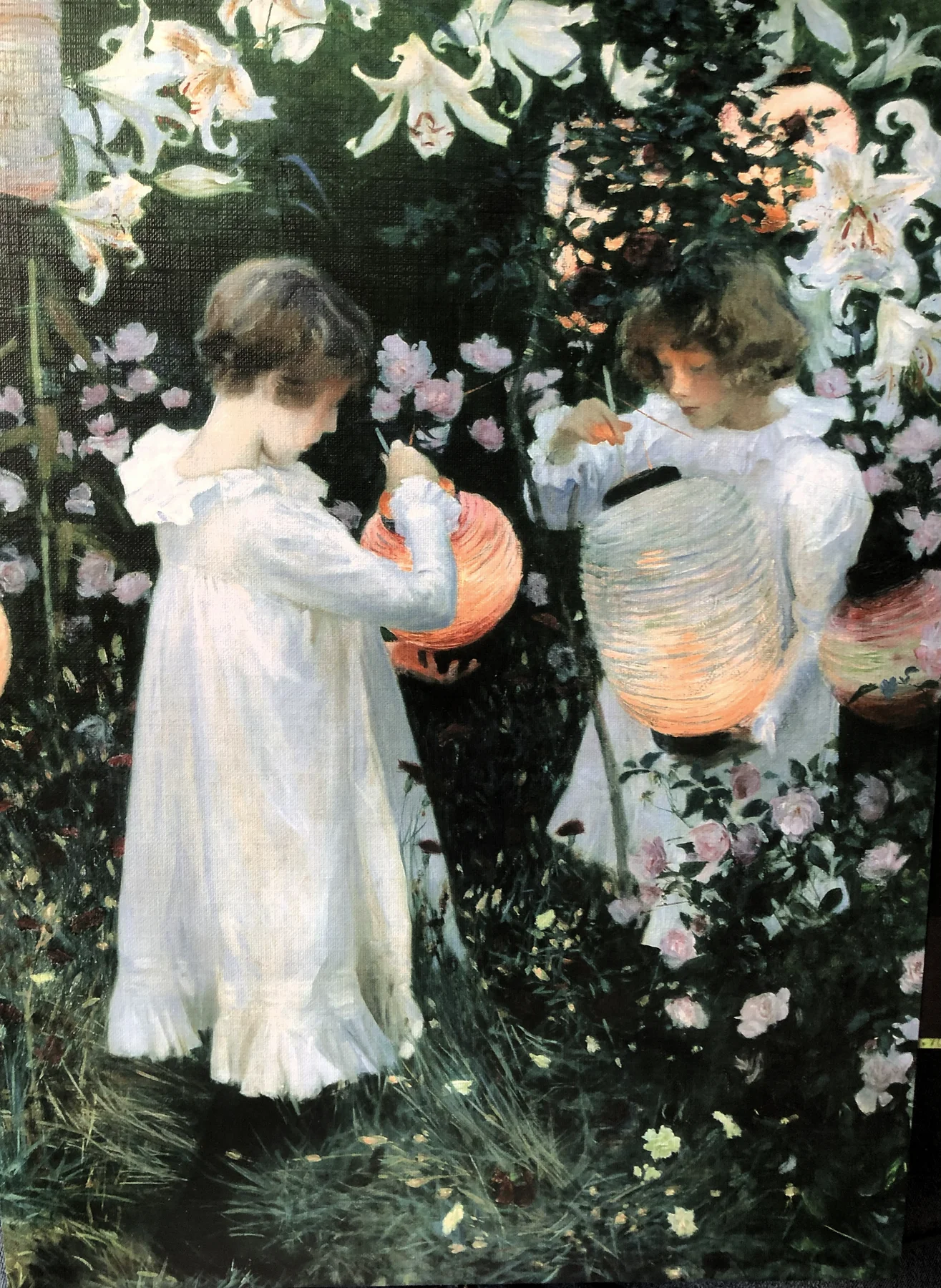
CARNATION, LILY, LILY, ROSE
John Singer Sargent
- Artist
- John Singer Sargent (1856–1925)
- Date
- 1885–1886
- Dimensions
- 174 x 153.7 cm
- Medium
- Oil on canvas
- Location
- Tate Britain, London
If we are looking for a painting that perfectly captures the intimate radiance of childhood innocence, John Singer Sargent’s Carnation, Lily, Lily, Rose is the perfect choice. This painting uniquely brings a smile to the viewer’s face as it recalls almost forgotten family moments in the garden at the end of summer, when we have no care for the troubles of the world. In the picture we see everything from a child’s point of view, from the beautiful warm colours to the size of the garden lilies.
Inspired by the Sunset
Sargent regarded this painting as a challenge — he wanted to capture the sight of a perfect sunset, the magical combination of light and shadow, its pale colours. The work was partly inspired by boating trips in London, when, drifting lazily on the Thames in his boat, the painter observed a garden decorated with lilies and Chinese lanterns.
The Story of the Picture
Carnation, Lily, Lily, Rose might never have been made had it not been for Sargent’s unfortunate accident. He was boating on the Thames with an American painter friend, Edwin Abbey, when he dived into the water and badly hit his head on a rock. Abbey took him to Broadway, a picturesque Cotswold village in Oxfordshire, where his recovery was helped by the community of an artists’ colony made up mainly of famous American creators — including the painter Francis David Millet and the writer Henry James. Sargent painted the picture a few months later, asking the children of his fellow artists to model for him.
A Fleeting Moment
How do you capture light that is perceptible for only a few minutes a day? Sargent began work on his painting in September 1885. Every day, when the sun had lost enough of its light, the artist stopped what he was doing — usually playing tennis — and hurried to the canvas. He then worked feverishly, sometimes for only two or three minutes, but never spending more than ten minutes in front of the picture, then headed back to the tennis court; this was the daily ritual. Needless to say, a painting of this size could not be finished quickly at this pace. His friends also mentioned that Sargent often scraped off the previous day’s work because he was dissatisfied with the light or the colours.
As autumn set in and the flowers began to wilt, Sargent was forced to use potted flowers. He decided to work only outdoors, so in November he had to suspend work until the following summer.
Models
Sargent envisaged a special hair colour for the figure in the painting. At first he used Millet’s five-year-old daughter as a model, but the little girl had to wear a wig to achieve exactly the right shade. Eventually the daily ritual of motionless waiting was too much for the poor child, and the illustrator Frederick Barnard’s two older daughters, Polly and Dolly, became the new models.
The painting was first exhibited at the Royal Academy in London in 1887 and received loud acclaim for its stunning colours. In the same year the painting was bought for the Tate Gallery as part of the Chantrey Bequest. The trustees of the bequest had been established in 1877 to build up a British national art collection, and it was a great honour for an artist, especially one who was not a British subject, to have his work chosen. Carnation, Lily, Lily, Rose can still be seen in the Tate and is among the institution’s most popular paintings.
- Sunset on the Thames
- Cotswold village of Broadway
- Royal Academy of Arts, London
- Sargent’s sketch of Edwin Abbey