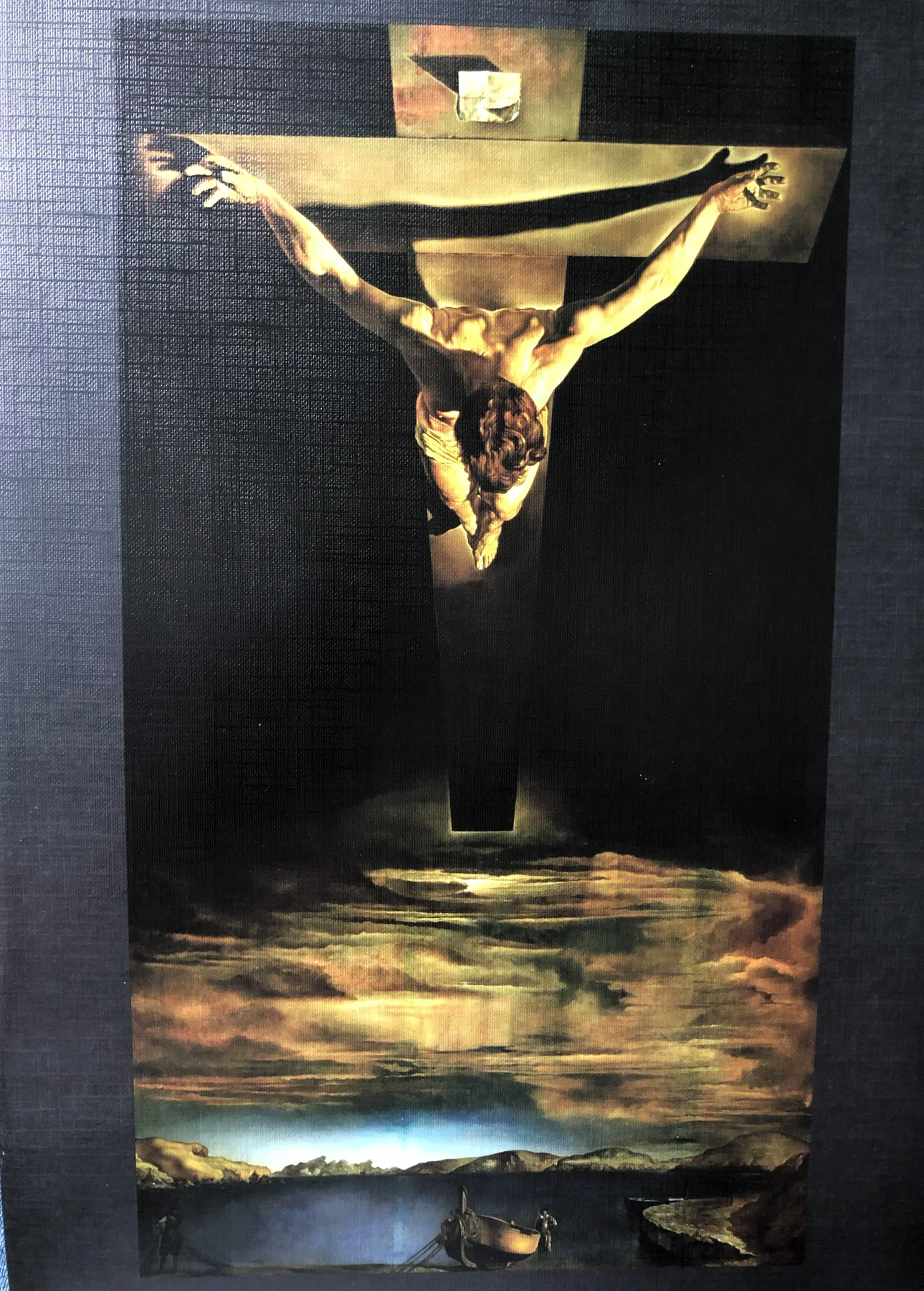
CHRIST OF SAINT JOHN OF THE CROSS
Salvador Dalí
- Artist
- Salvador Dalí (1904–1989)
- Date
- 1951
- Dimensions
- 205 x 116.1 cm
- Medium
- Oil on canvas
- Location
- Kelvingrove Art Gallery and Museum, Glasgow, Scotland
Salvador Dalí, who considered himself a genius, moved easily through the various phases of modern art, including Cubism, Futurism, Metaphysical painting and Surrealism, until the 1930s, when after a trip to Italy he turned to a more traditional style. In 1945 a world-shaking event, the atomic bombing of Hiroshima, brought religious subjects back into his works. The horror surpassed anything the artist could imagine, and he wrote that “the atomic explosion of 6 August 1945 shook me seismically”. In the aftermath of the destruction Dalí turned devoutly to religion. It was then that he created his series of more traditional religious paintings, including the best known and much admired Christ of Saint John of the Cross. In his masterly painting of the Crucifixion he did not depict suffering, since we do not see Christ’s tormented face. Dalí sought to express what he felt to be the ultimate divine beauty.
Religious Influence
Dalí was raised a Catholic but was not religious in the traditional sense. After he later became a deep believer, his faith in his own mystical abilities also grew stronger. It was then that he made this painting, one of several large works on traditional New Testament subjects.
In 1951 a local curator saw the picture in a London gallery and bought it, and the following year it was taken to the Kelvingrove Art Gallery and Museum in Glasgow. At the time the painting caused controversy — many modern art critics felt it was a step backwards because it was made in a traditional painting style. Despite petitions opposing the purchase, the museum committee bought it without hesitation for £8,200 — a considerable sum at the time. To this day it is the only Dalí painting in the United Kingdom exhibited outside London.
Surrealist Beginnings
Surrealism, Dalí’s most famous painting style, was born in 1924, following André Breton’s first Surrealist Manifesto. Breton led a strange group of Parisian poets known as the Dadaists, from whom he drew inspiration in the early 1920s. Dada suggested anarchic and destructive feelings. Surrealism offered a more positive choice for artistic expression. The Surrealist idea was that great works are born in the subconscious described by Freud, so dreams and desires became favourite subjects of Surrealist works. They believed that if they picked up a pen or brush and, without conscious control, let creativity flow freely, a work of art would be born.
The Surrealist movement began to decline and finally ended in the 1930s. Dalí left Paris, returned to Spain and within a short time became a devoted follower of Catholicism. It was then that he began painting his religious works, including Christ of Saint John of the Cross.
Inspiration
The picture was titled Christ of Saint John of the Cross because Dalí was inspired by a pen-and-ink drawing made by the Spanish Carmelite friar (1542–1591) canonised as Saint John of the Cross.
First Exhibition
The painting, now worth tens of millions of pounds, was first shown at the Kelvingrove on 23 June 1952, and ever since it has aroused enormous admiration as well as controversy. The picture is an undeniably moving work of genius — the depiction of the crucified Christ from an unusual angle disconcerts the viewer, and the light coming from different directions creates a mystical contrast of light and shadow.
At first the painting was exhibited together with other religious pictures, but eventually it was moved to a special curtained area on the gallery balcony, and it can now be seen in a place of honour in one of the arched colonnades of the upstairs corridors.
- Kelvingrove Art Gallery
- Dalí (centre) with Breton (left)
- Dadaists (left to right): Breton, Éluard, Tzara, Péret
- Saint John of the Cross