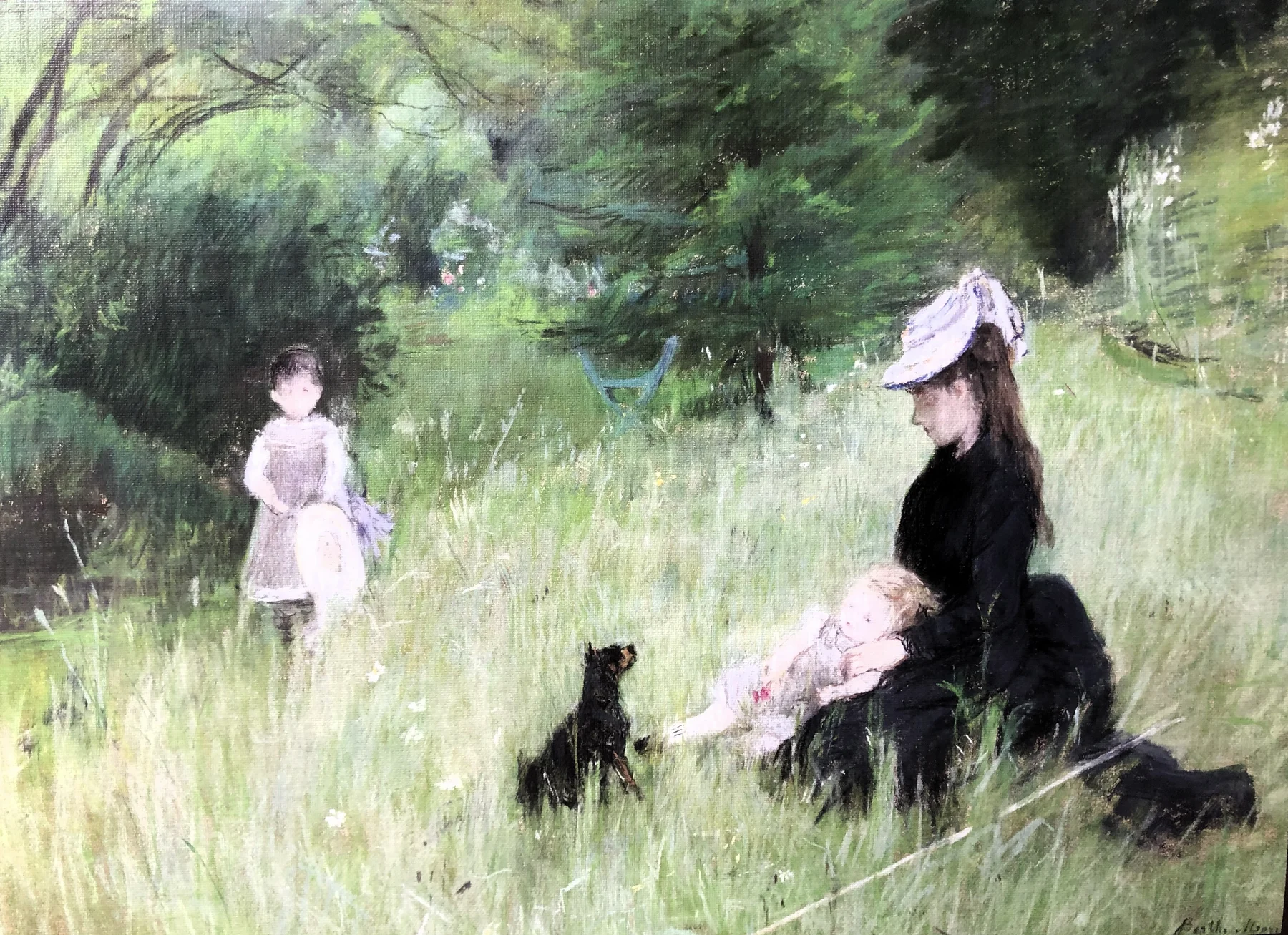
IN THE PARK
Berthe Morisot
- Artist
- Berthe Morisot (1841–1895)
- Date
- c. 1874
- Dimensions
- 72.5 x 91.8 cm
- Medium
- Pastel on paper
- Location
- Musée du Petit-Palais, Paris
Morisot’s intimate family scene, painted with her characteristically delicate brushstrokes, depicts a mother playing with her children and dog in the tall grass of a meadow. Although Morisot is one of the most accessible and enjoyable Impressionist painters, she was ready to defy convention for her art. Strong and committed, Morisot was the first woman to join the group of French Impressionists.
A Love of the Open Air
Morisot depicted what she saw and experienced in everyday French life. Using her family and friends as models, she painted many portraits and interiors, but she preferred to work outdoors. She made landscapes and garden scenes, but she also often chose women and children as her subjects, especially her sister Edma and her family. In In the Park she depicts her sister outdoors with her two little daughters, Jeanne and Blanche. The calm scene shows something of the close relationship between Morisot and her sister and her sister’s family. Earlier, in 1872, Morisot had already painted her sister with her youngest daughter, Blanche. This intimate picture, The Cradle, became her most famous work.
The Story of the Work
In the Park was probably made in 1874 and was sold at auction in March 1875. In 1874, after the first Impressionist exhibition, the painter Renoir suggested that Monet, Sisley, Morisot and he himself hold an auction of their paintings at the Hôtel Drouot in Paris. The bidding for the 73 paintings was extremely low, and they were mocked and ridiculed. Despite the unfavourable reception, Morisot’s 12 pictures did sell, though mostly among friends and relatives. In the Park was bought by a private collector for 320 francs, the second-highest price at the auction. The highest price, 480 francs, was paid for Morisot’s painting Interior, made in 1872. In the Park can now be seen in the Musée du Petit-Palais in Paris.
A Study in Green
Over her life Morisot developed her own painting style. By the time this picture was made she was already painting in oil on canvas and using lighter brushwork. In In the Park she used another technique, pastel. The viewer can nevertheless discover Morisot’s characteristic delicate strokes. The artist managed to persuade Édouard Manet to try painting outdoors and to give up his customary black in favour of lighter colours.
Morisot knew and understood how to capture light and the subtle nuances of the faintest changes of colour and form in a natural setting. There are no blue skies here, but In the Park reveals Morisot’s craftsmanship, especially in the rendering of natural light. Apart from the figures, the picture is a study in green. The artist’s lighter technique makes the light appear more brilliant and the standing blades of grass in the foreground yellower and greener. Only the blades of grass outlined against the black dress are drawn more carefully. At the back the darker shade of the evergreen tree creates a three-dimensional effect, and Morisot masterfully conveys the further depth of the picture, since still further away dense dark green-black foliage can be seen.
The Family at Play
Morisot also painted her sister and her children in a meadow in The Butterfly Hunt (1874). The same butterfly net can be seen in both paintings, but the family is depicted noticeably more soberly in In the Park. 1874 was an eventful year for the Morisot family — Berthe married Eugène Manet at the end of the year, and her father had died earlier the same year, before the wedding. The family was still in mourning during the summer, so the black dress Edma wears is quite understandable. The hat casts a shadow over Edma’s face, and her features are barely discernible. The features of the solitary figure standing further away from her mother, sister and the dog, Jeanne, are not really recognisable either. The younger girl, Blanche, seen in the foreground, is by no means painted uniformly. Whether this mode of depiction is the result of the artist distancing herself somewhat from the subject, or whether she wanted rather to show the texture of the lawn and the leaves, is left for the viewer to decide.
Artistic Connections
Berthe Morisot and Édouard Manet both studied at the École des Beaux-Arts in Paris, but at different times. In 1868 the French painter Henri Fantin-Latour introduced the woman painter to Manet during a visit to the Louvre in Paris. Although Morisot was nine years younger, she influenced Manet, who the following year began experimenting with painting outdoors in Boulogne. A long, close friendship bound them together, and in 1874 Berthe married Manet’s brother Eugène.
- Musée du Petit-Palais
- Morisot’s painting, The Cradle
- Morisot’s picture, The Butterfly Hunt
- Eugène Manet, Berthe Morisot and their daughter, Julie