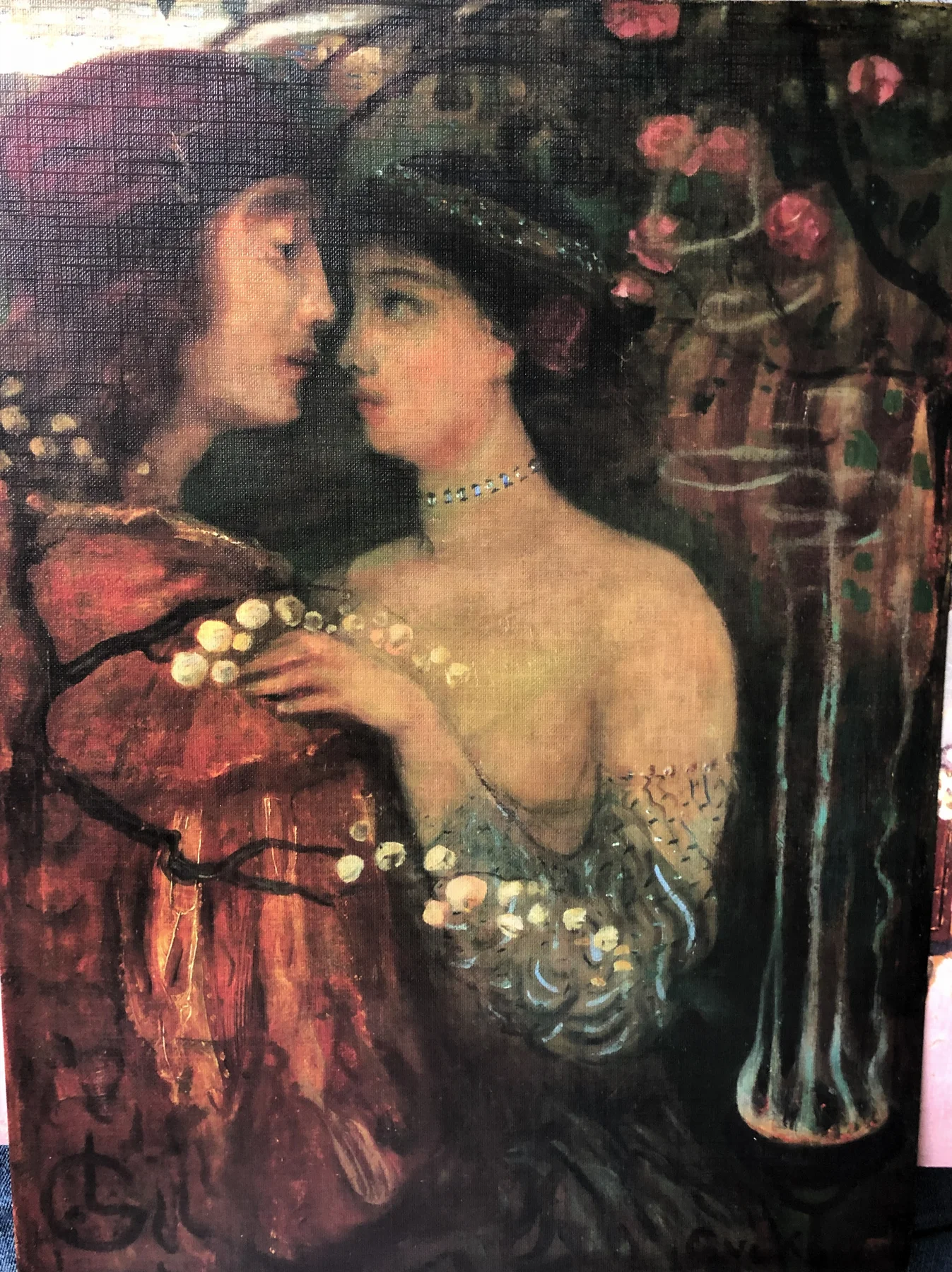
ENCHANTMENT
Lajos Gulácsy
- Artist
- Lajos Gulácsy (1882–1932)
- Date
- Between 1906 and 1907
- Dimensions
- 85.8 x 63 cm
- Medium
- Oil on canvas
- Location
- Hungarian National Gallery, Budapest
The dark-toned pictures of this brilliant but tragic painter of the turn of the century strike us as faded memories of ancient moods and bygone ages. In them we see the shadows of mysterious, dim medieval monasteries and alleys thick with the smoke of pyres, and reflections of Renaissance courts, the clumsy peasant world of the Low Countries and Rococo garden festivities. His figures dissolve into the landscape, uncertain desires flit across the women’s faces, and even in his self-portraits he hides behind a costume.
Under the Spell of the Past
For Gulácsy the enchantment of the past is not mere quotation. He does not copy the artistry of the Renaissance but recreates it, indeed relives it. Accordingly, he felt much more at home in Italy and, whenever he could, spent all his time there, even if it meant living in poverty. Here he sought backdrops for his dreams and amorous, tragic or heroic stories, into which he then placed himself in order to experience reality more vividly through them.
He was a characteristic representative of that fruitful turn to the past already seen in the Pre-Raphaelites, who in fact had a great influence on him. Art Nouveau then further strengthened this cult, which at the turn of the century, mixed with aestheticism and decadence, created a bizarre, symbol-laden, refined artistic vision through artists such as Oscar Wilde or Aubrey Beardsley.
The Misunderstood Masterpiece
The painting first appeared in 1907 under the title “Enchantment”, at Gulácsy’s first major showing at the Uránia art dealership. He held it in high esteem, showing it at two exhibitions within a year and asking an unprecedentedly high price, 1,000 crowns, for it. Its later title came from a short story by Géza Csáth on a different subject, “The Magician’s Garden”.
The painting shows the half-length figures of a cloaked man and a woman in a veil-like dress facing each other in a garden. The flame of the brazier imitates the warmth of the female body, and it sparkles in the budding flowers of the branches reaching in and on the rosebush. The rising smoke conveys a state of timelessness or of being cast out of time.
The intimate closeness and the woman’s longing eyes betray the presence of love, whose intimate setting is created by a garden, while the man’s clothing places the picture in the Renaissance. These signs led to the widespread misunderstanding of the work as depicting a Renaissance love scene.
The apparent amorous harmony, however, is disrupted by a few disturbing elements. While the woman’s gaze reflects complete devotion, the man’s expression is reserved, even condescending, as he looks back down at her; he does not even return the embrace of the woman nestling against him, whose nakedness creates a sense of vulnerability beside the man wrapped in his cloak.
The censer creating the narcotic atmosphere is not a usual prop of love scenes either. As the smoke wreathes around the woman, the amorous longing on her face turns into the daze of the seduced. In the context of seduction the branches of the garden also seem like greedy arms trying to entwine the female figure, as it were transforming her into a flower of the garden at the will of the man, who seems to be of one substance with the garden, as the lushly budding branches sprout from him. The enchantment of the title therefore refers not so much to love as to the magic of seduction, in which the man is the conquering magician.
The Cult of Tragic Love
This conception of love fits both into Gulácsy’s oeuvre and into the cult of tragic love seen in the art of the period. Thus the stories of Hamlet and Ophelia, Paolo and Francesca, Dante and Beatrice, Tristan and Isolde became popular. But he may also have found an example of a scene very similar to the painting in Turgenev’s short story “The Song of Triumphant Love”, which appeared in print several times during Gulácsy’s life.
- Lajos Gulácsy: Dante Meets Beatrice
- Lajos Gulácsy in Hamlet costume
- Title page of Lajos Gulácsy’s novel Guyp
- Lajos Gulácsy: Raphael as the Knave of Hearts