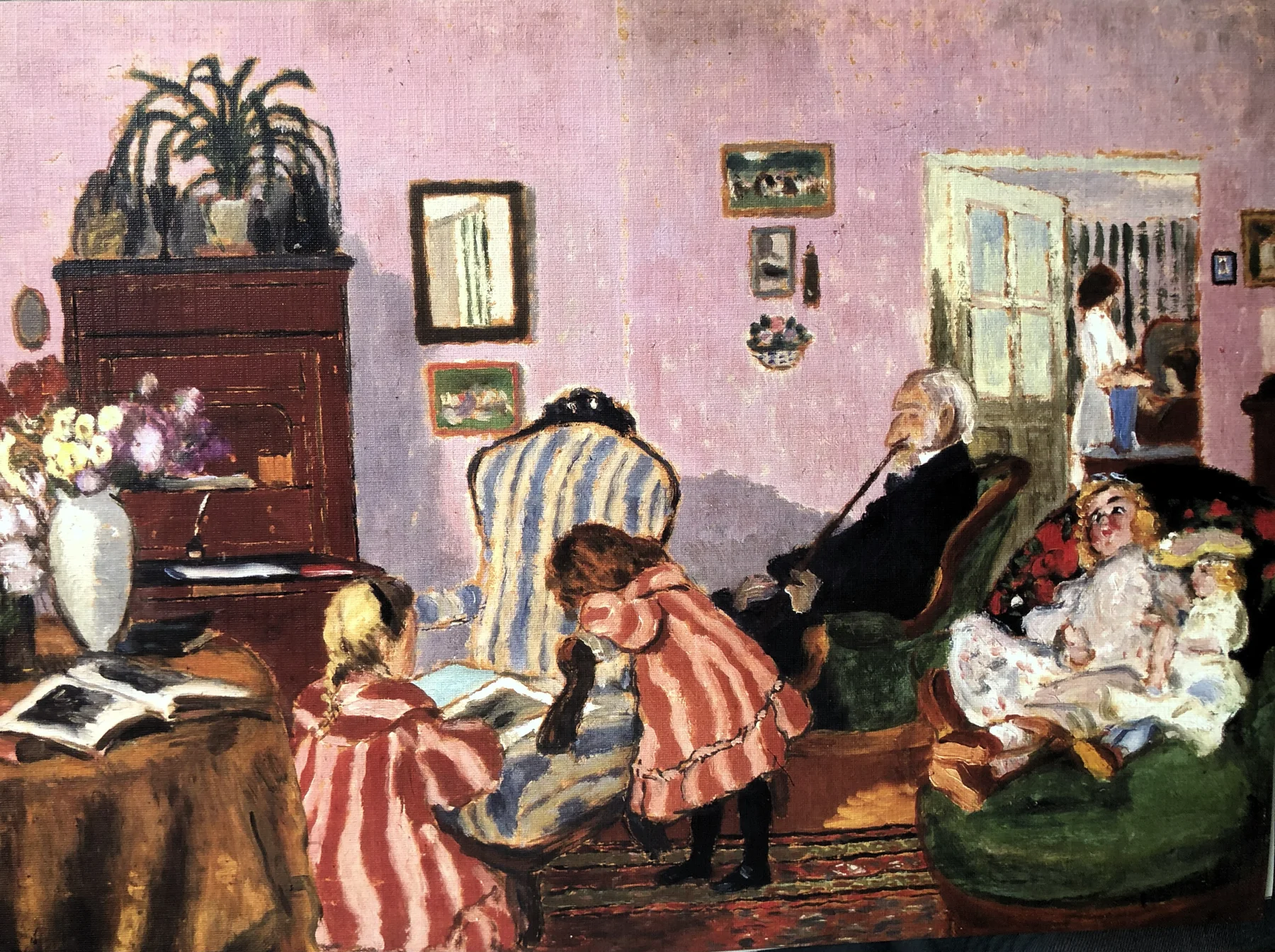
UNCLE PIACSEK WITH DOLLS
József Rippl-Rónai
- Artist
- József Rippl-Rónai (1861–1927)
- Date
- 1905
- Dimensions
- 71.3 x 103 cm
- Medium
- Oil on cardboard
- Location
- Hungarian National Gallery, Budapest
The painter who introduced Post-Impressionism into Hungary, an equal exhibiting partner of the Nabis group of artists following in Gauguin’s footsteps — that is, a follower of the most modern painting styles — after the lights of Paris settled in a small provincial town, his birthplace, Kaposvár, which Endre Ady dubbed “the dustiest town”. In these surroundings, considered insignificant, he created the most colourful pictures of Hungarian painting.
The Poetry of Small-Town Life
Rippl-Rónai moved back to Kaposvár in 1902, where he bought a small white house on Fő utca (Main Street). Learning from his earlier unsuccessful attempt to return home, he deliberately turned away from his symbolic, near-abstract French style towards an epic subject, the depiction of everyday life, and an unaffected style.
He consciously sought to present his immediate surroundings in a diary-like way. He captured everyday scenes, in fact uneventful but emotionally charged states.
The figures in the pictures are themselves the props of small-town life. Uncle Piacsek, sitting in a green armchair in the painting smoking a long-stemmed meerschaum pipe — Ferenc Piacsek, the white-haired, round-bearded old gentleman — is a recurring figure in Rippl-Rónai’s pictures and in himself the embodiment of the small-town bourgeois way of life. A retired forester of the Bishopric of Veszprém, he was the father-in-law of the painter’s younger brother Lajos, and since he spoke French he became the companion of Rippl-Rónai’s French wife, Lazarine. The old gentleman, a supporter of Kossuth’s party, seems a living anachronism among the pink walls, surrounded by children and toys.
A Picture of Home
The painting shows the drawing room with green armchairs, temporarily turned into a nursery, where besides Uncle Piacsek two little girls look at picture books by the blue-striped armchair; one of them is his granddaughter, Baby, that is, Marianne Martyn. Two dolls have been seated in the other green armchair.
The imagination of childhood, blurring fictional and real worlds, pervades the room, where every object has a personality and almost speaks, while the adults are hazy fairy-tale figures.
In his interior pictures Rippl-Rónai experiments with possibilities of spatial illusion such as the open back door or a composition diagonal in depth, as we see in this picture. In the background the other room opens up, where the seamstress is fitting a pink dress on Lazarine.
Every motif is of equal importance in the still-life-like composition. The apparent randomness is the result of carefully calculated proportions and placements. Rippl-Rónai achieves an artistic effect by refined means; for example, the pictorial quality is multiplied by the paintings hanging on the wall, the mirror and the window flashing in it, the doorway of the other room or the picture books.
The “Corn-Kernel” Period
Around 1907 an apparently radical change took place in Rippl-Rónai’s style, closely connected with the fact that with the income from his unparalleled Hungarian debut in 1906 he bought the Villa Róma on the edge of town with its land and took up farming. The fabric of the paintings is made up of mosaic-like brushstrokes, hence the epithet “corn-kernel”. The paint goes onto the canvas unmixed, so the colours shine with extraordinary intensity. In fact this style follows organically from Rippl-Rónai’s interior period, consistently developing its painterly solutions as a continuation of his efforts in France, and the pictures of his new period also record a tableau of provincial Hungary.
- József Rippl-Rónai: My Father and Uncle Piacsek over Red Wine
- József Rippl-Rónai: “Mon secrétaire”
- A company in front of the Villa Róma