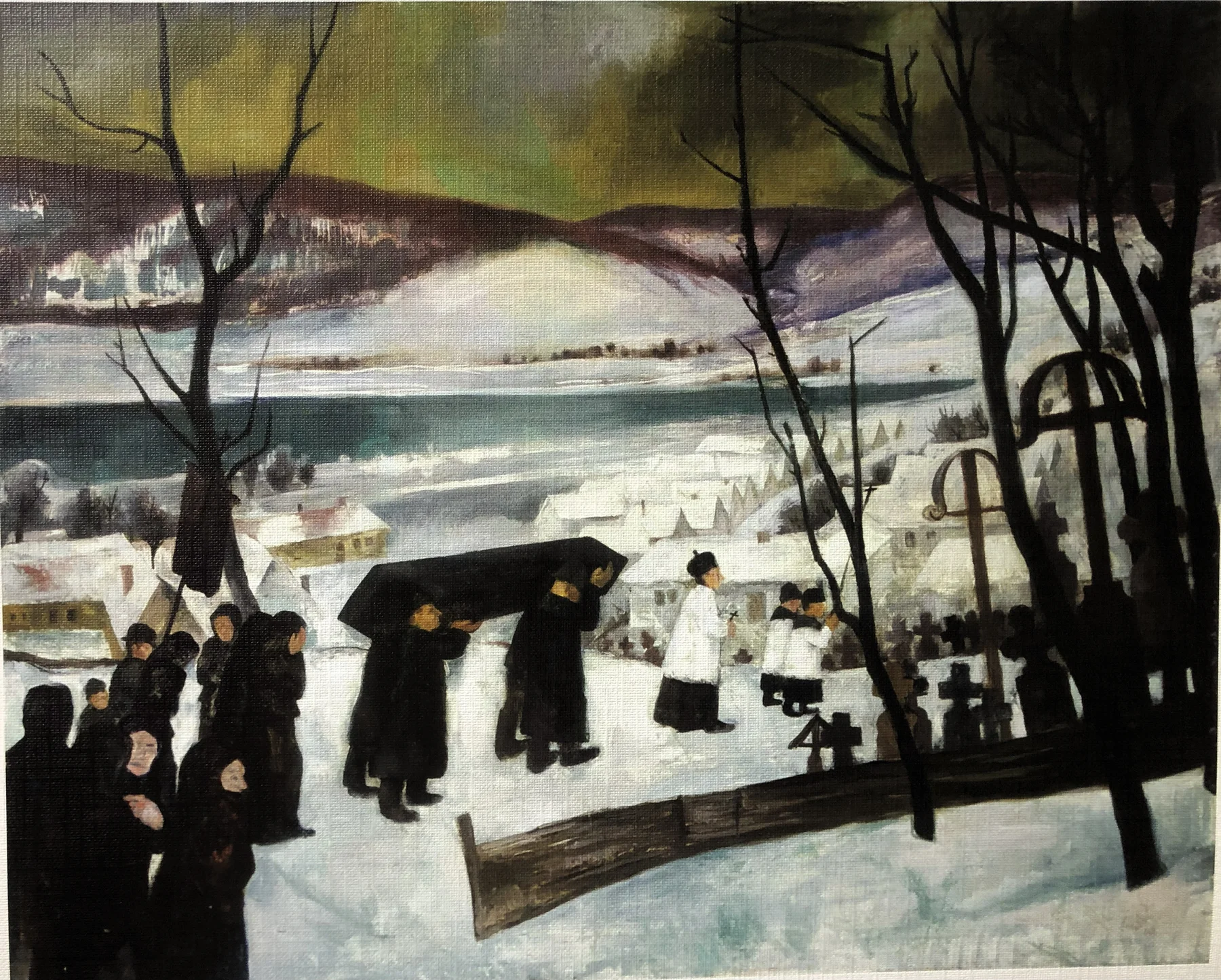
FUNERAL AT ZEBEGÉNY
István Szőnyi
- Artist
- István Szőnyi (1894–1960)
- Date
- 1928
- Dimensions
- 100 x 125 cm
- Medium
- Oil on canvas
- Location
- Hungarian National Gallery, Budapest
In the pictures of István Szőnyi, who represented the aesthetic vision of the Neoclassical Gresham circle and later of the artists’ circles of the Roman School, at the beginning of his career man towers above a landscape of timeless beauty as the descendant of ancient gods and heroes; later, however, the many-faced landscape itself becomes heroic and mythological in his works, with the human presence blending into it in classical harmony. For him this mythical landscape was represented by the picturesque Danube Bend, and within it Zebegény, the village he chose as his home.
Arcadia in the Danube Bend
Szőnyi first painted in Zebegény in 1922, and in 1923 he and his wife moved into her family’s summer house there.
Just as the Danube, slowing down in the bend surrounded and guarded by the Börzsöny and Pilis hills, comes to resemble a lake and the riverside landscape an island, so time slows down here and becomes an enclosure in which the future is identical with the past. In the Danube Bend pictures, now glowing a patinated golden brown, now fading into dimness like old photographs from a vanished golden age, the emulsion of light develops the tectonic forms of the landscape. The colours of the landscape, stylised to its lines of force, are also coaxed out by the play of light, like a luminescent radiance emanating from everything.
Man and Nature
The 1928 picture Funeral at Zebegény brought Szőnyi his breakthrough, with which he took possession of the landscape, finding in it the archetype of the village world. The work is a transition from the more constructive pictures of earlier years to the looser works of the later period. In genre it is at once a landscape and a scene. It was prompted on the one hand by the news of the tragic death of his former painter friend from Nagybánya, Jenő Pászk (Eugen Pascu), and on the other by the sight of a village funeral.
The procession moving through the cemetery seems to walk through the valley of the shadow of death spoken of in the Psalms, and the motif of the grave markers and crosses rising up on the right is echoed in the bare branches of the trees. The mood of the lifeless winter landscape reflects the mourners’ state of mind.
The figures do not appear in the heroic pose of the early years but as people experiencing everyday events. They themselves are sturdily characterful village types, not individuals. His painterly attitude has turned from pathos to participating compassion.
In the background the Danube Bend is this time an empty winter landscape backdrop behind the stage-like foreground. The winter dusk bathes the hills in a purplish light, and from the contrast of black and white only here and there do greens and browns flash darkly.
The static line of the funeral procession is intersected by the bare trees as dynamic diagonals, evoking the agitation of the sobbing that wells up again and again in grief.
The Order of Nature
The compositional prototype of the painting can be regarded as the winter piece of the Renaissance Netherlandish painter Pieter Bruegel the Elder’s Four Seasons series, The Hunters in the Snow (1565). He saw the painting in Vienna, and in the 1920s monographs on the artist appeared that created a cult of Netherlandish painting throughout Europe.
The common features of the two paintings are the grouping of silhouette-like figures, the rhythm of the movement from left to right, and the layering of the landscape in depth. At the same time Szőnyi reversed the motifs of the background, the mountain and the trees, as in a mirror image. While in Bruegel’s composition human activities fit into the cycle of nature, in Szőnyi’s the beat of inevitable death sets the rhythm of nature.
- István Szőnyi: Umbrellas
- István Szőnyi with his wife and children on the Danube bank at Zebegény
- Pieter Bruegel the Elder: The Hunters in the Snow (Winter)
- István Szőnyi with sketches and a sculpture around 1919