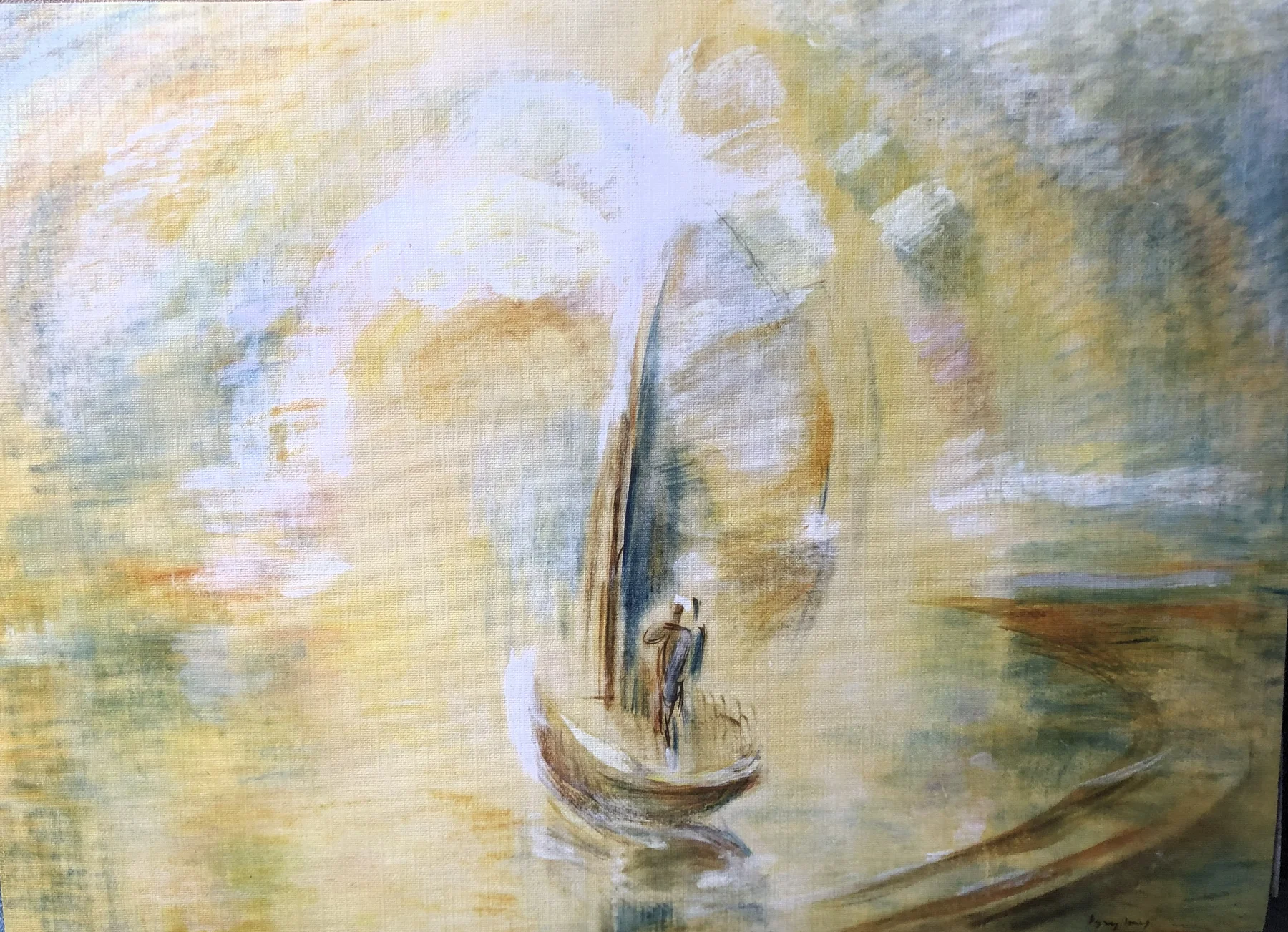
GOLDEN GATE
József Egry
- Artist
- József Egry (1883–1951)
- Date
- 1943–44
- Dimensions
- 71.3 x 103 cm
- Medium
- Oil on cardboard
- Location
- Hungarian National Gallery, Budapest
Most of József Egry’s oeuvre was defined by a single motif: the landscape of Lake Balaton, studied almost obsessively, and the light effects around the lake. His paintings are practically all landscapes, for even when a human figure appears in them it becomes one with nature rather than dominating it, and the protagonist remains the play of light, nature transforming the view.
Painter of the Margins
Authentic depictions of workers and the poor make up Egry’s first works. He was not led by social sensitivity or sympathy for the downtrodden; he simply depicted his own familiar milieu, which he saw around him day after day. Nothing shows this identification better than his 1907 picture In Front of the Night Shelter, on the right edge of which he painted himself. Renaissance painters had often slipped themselves into a religious or historical scene, hiding in a group. By contrast, in Night Shelter the young artist’s almost monumental figure stands in the foreground, dominating the right side of the composition and facing the viewer from there, so that the picture almost works as a self-portrait. The painting brought Egry his first official recognition: he received a state scholarship of 1,000 crowns for it.
The Balaton Experience
Despite his difficult financial situation, thanks to his patrons Egry was able to train in Munich, Paris and Belgium, but his life-changing experience came during the First World War. During the weeks he spent in the military hospital at Badacsony he committed himself for life to the Balaton landscape, and it was here too that he met Juliska Vízkeletyné Pauler, who divorced her husband and became Egry’s wife in 1918. After the war Juliska’s house in Keszthely became the couple’s first Balaton home; later they moved to Badacsonytomaj, to the press house belonging to the Pauler family’s vineyard, which they left only in the winter months, at first for their Keszthely house and, after it was sold, from 1928 for Budapest. In his first Balaton years he maintained close contact with Kassák, who was also hiding at Balaton after the fall of the Soviet Republic government. Although they did not agree on art, Egry regularly visited Kassák.
The Play of Golden Light
From the 1920s Egry’s painting of light gradually developed, and it enjoys enormous popularity to this day. He abandoned his early expressive style characterised by solid composition, emphatic outlines and thick strands of paint. He devoted his pictures to observing and rendering phenomena of light. From then on only one kind of structure could appear in his compositions, one that rendered the fleeting phenomena of the atmosphere. Thus his late masterpiece, Golden Gate, also captures one of those rare moments when the brilliant rays of the sun surround a sailing boat floating in the middle of the lake like a gate-shaped vision.
Egry created his own world from the motifs of the Balaton shore, and in this world every landscape is an imprint of his own feelings. Less directly than his self-portraits, but they reflect the artist’s personality just as much.
It is characteristic that the human figure is mostly dwarfed by nature or merges with it, as in the painting Echo (1936). Nor are the works in which Egry depicted saints, such as St Christopher or St John the Baptist, any different. In these cases too only the title tells the viewer what the subject is.
Late Success
During the winters spent in Budapest Egry frequented the circle at the Gresham café, which included painters such as Ödön Márffy, István Szőnyi and Aurél Bernáth, and he exhibited in well-known galleries, but he refused to move to Budapest for good. After the Second World War he was showered with awards and was chosen among the exhibitors at the prestigious Venice Biennale (1948). His style became increasingly popular, so much so that after his death a whole generation of imitators churned out Egry-style landscapes.
- József Egry: In Front of the Night Shelter, 1907
- József Egry: St John the Baptist, 1930
- Christmas cover of the humorous magazine Izé