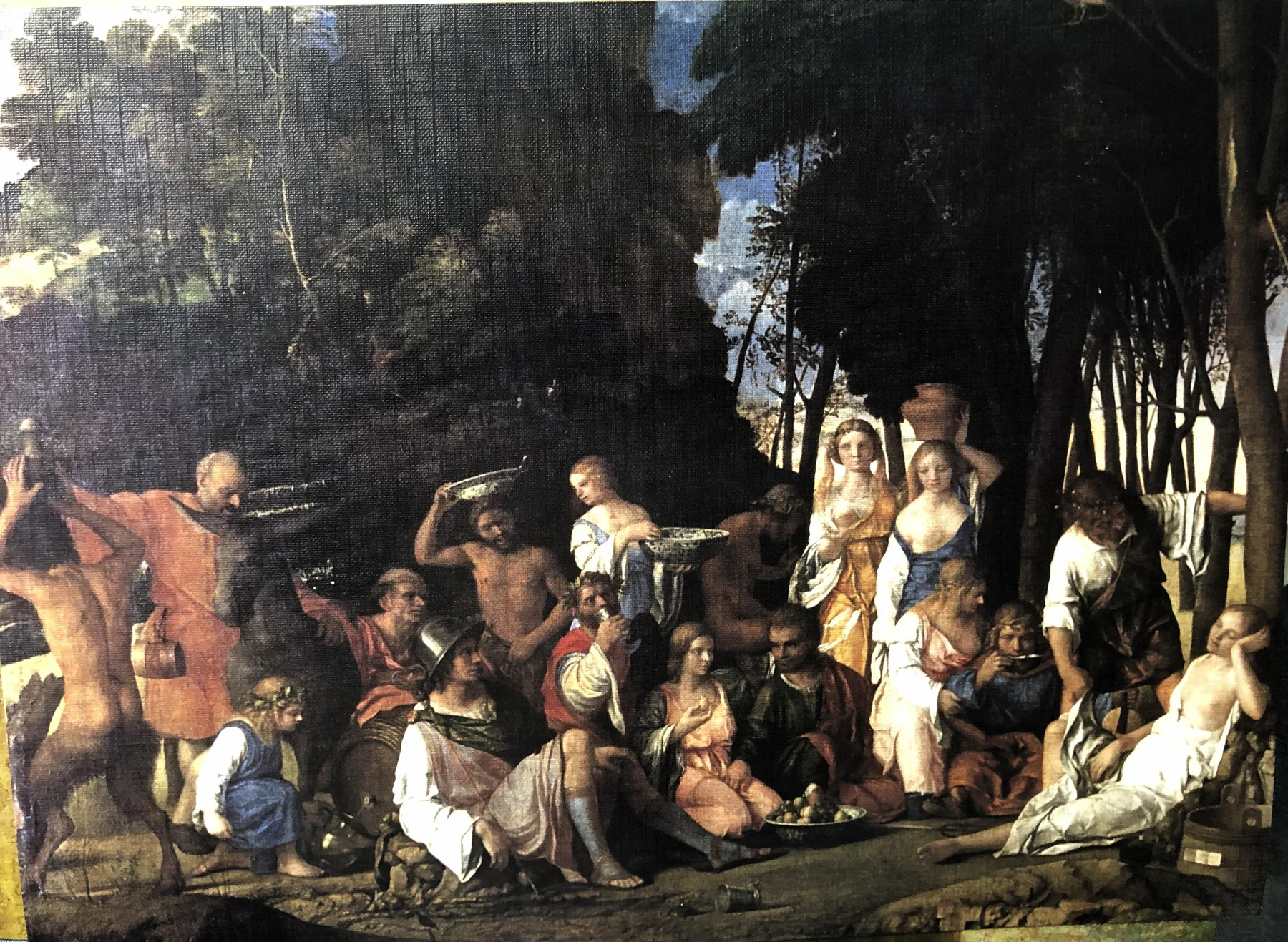
THE FEAST OF THE GODS
Giovanni Bellini
- Artist
- Giovanni Bellini (c. 1430–1516)
- Date
- 1514
- Dimensions
- 67 x 74 cm
- Medium
- Oil on canvas
- Location
- Widener Collection, National Collection of Art, Washington DC, USA
In 1506 Albrecht Dürer considered the 76-year-old Giovanni Bellini a very old man, yet described him thus: “still the best painter of them all”. Coming from a family of artists, Bellini was one of the finest Venetian painters of the period spanning the 15th and 16th centuries, master of the two outstanding northern Italian artists of the Renaissance, Giorgione and Titian. In his younger years Giovanni Bellini painted many versions of the Virgin and Child, as well as the sacra conversazione, in which he depicted Mary among saints. The Feast of the Gods, however, is a secular work and dates from Bellini’s last years (it was later reworked by Titian).
Bacchanal
The Duke of Ferrara, Alfonso I d’Este, first commissioned a painting from Giovanni Bellini for his Alabaster Room, in the castle of Ferrara south-west of Venice, considered the most beautiful room in Renaissance Italy. After the picture was finished, in November 1514, the duke sent the artist 85 gold ducats in payment. Bellini’s work depicts a pagan scene from the story of Priapus after Ovid’s poem Fasti (the Roman calendar), in which drunken gods and goddesses gather to revel in the forest.
Bellini’s painting The Feast of the Gods, also called Bacchanal, suited the Duke of Ferrara’s licentious taste. The picture presents the scene when the passions of the pagan gods, depicted in the company of nymphs and satyrs, have already been whipped up by drinking. Bacchus, god of wine, appears as a small child in blue, kneeling as he fills a jug from the large wooden barrel.
A Generous Donor
In 1598 Cardinal Pietro Aldobrandini seized The Feast of the Gods and had it taken to Rome, where the painting could be found for two centuries. In 1797 a painter named Vincenzo Camuccini acquired the picture, which remained in his family until the mid-19th century, when it passed into the collection of Algernon Percy, 4th Duke of Northumberland, at Alnwick Castle. The 7th Duke of Northumberland sold The Feast of the Gods in 1916, and it eventually came into the possession of a wealthy American collector, Joseph E. Widener. He kept the painting in Philadelphia from 1922 to 1942. Widener, a founding benefactor of the National Gallery of Art in Washington, contributed 2,000 pictures, including The Feast of the Gods, to the gallery’s collection.
The New Master of Oil Painting
The Sicilian artist Antonello da Messina (c. 1430–1479), who had lively contacts with Flemish painters and arrived in Venice in the early 1470s, became known for already using oil paint regularly in his works. According to Giorgio Vasari he brought the “secret” of oil painting to Venice, although in fact it is the Venetian Giovanni Bellini who is credited with popularising the use of oil paint. Through this new medium Bellini was perhaps the first Italian painter truly able to capture at the same time the subtleties of colours, lights and shadows, and so conjured a more natural atmosphere into his pictures than anyone before him.
A Group of Revellers
In the foreground of the picture drunken revellers stand or sit in clusters, among them gods and goddesses: on the left Silenus, god of the forests, in orange with his donkey, then Mercury, leaning his back against Bacchus’ wine barrel, Jupiter in a red cape with the eagle, Persephone with Pluto stroking her thigh, then Ceres, goddess of agriculture, supporting Apollo. At the right edge of the group is the nymph Lotis, dozing under the effect of excessive drinking, her head resting on her left hand. Her unconscious state leaves her at the mercy of the lustful desires of Priapus, god of fertility, who is just lifting her white dress. Bellini illustrates in his picture this ancient story described by Ovid as a humorous-erotic event. The next moment Silenus’ donkey brays, as if warning of Priapus’ lecherous intentions, causing merriment among the gods. Fleeing the unwanted advances of Priapus, Lotis turns into a lotus tree. Priapus finally takes revenge on the braying animal by sacrificing a donkey every year.
Masterpiece Connection
In 1483 Giovanni Bellini became the official painter of the Republic of Venice and ran a flourishing Venetian studio, where great artists of the future were trained, such as Giorgio Barbarelli da Castelfranco (pictured, Self-Portrait as David), better known as Giorgione (1477/78–1510), and Titian (c. 1488–1576). The two young artists learned the tricks of the trade from their master, but both developed their own, more flexible painting style, freeing themselves from the symmetrical manner of depiction characteristic of some of Bellini’s works.
- The castle of Ferrara
- One version of the Virgin and Child
- Alfonso d’Este, Duke of Ferrara
- Antonello da Messina