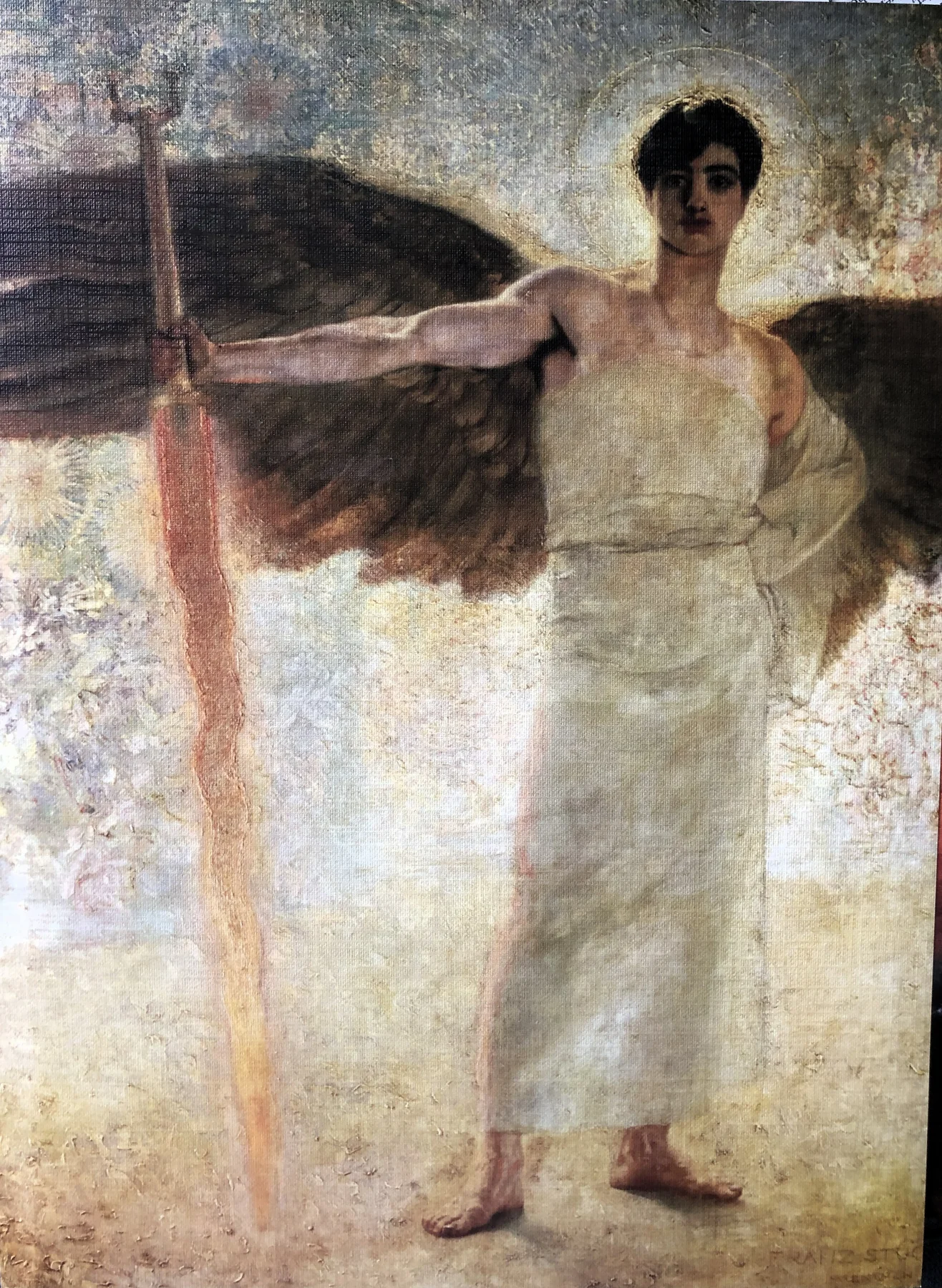
THE GUARDIAN OF PARADISE
Franz Stuck
- Artist
- Franz Stuck (1863–1928)
- Date
- 1889
- Dimensions
- 250.5 x 167.5 cm
- Medium
- Oil on canvas
- Location
- Villa Stuck Museum, Munich, Germany
Franz Stuck drew the inspiration for The Guardian of Paradise from the biblical story of Adam’s expulsion: God “drove out the man; and he placed at the east of the garden of Eden Cherubims, and a flaming sword which turned every way, to keep the way of the tree of life” (Genesis 3:24). This painting is part of a series of pictures Stuck made in the early 1890s on the loss of divine grace. The angel of Paradise Lost (1890) stands on the threshold between two huge gates; before him everything is shrouded in darkness, while behind him wonderful trees and flowers flourish. The Expulsion from Paradise (1897) shows the naked angel in profile as he drives Adam and Eve out of Paradise.
Stuck’s Symbolism
One of the broad art currents of the post-Impressionist period, Symbolism had its heyday between 1885 and 1905. It arose partly as a reaction against Naturalism: if art is merely a copy of life, what is the point? The Symbolists sought instead to convey ideas. Many Symbolist artists turned from Naturalism towards stylisation. This trend culminated in the aesthetics of the organic, sinuous lines of Art Nouveau — or, as it was called in Germany and Austria, Jugendstil, “young style”.
The Symbolism of the 1890s coincided with the age of fin-de-siècle decadence, when the end-of-the-world mood of the century’s close was combined with excited expectation of wonders at the dawn of a new age. In culture, decadence took the form of sin, death, sadness and longing. Symbolist painters (and writers) drew inspiration from literature and the legends of bygone ages, turning as sources to Homer, Shakespeare, the Bible and ancient myths, among others. One such popular subject was the story of Salome, daughter of the biblical Herod, who asked for the head of St John the Baptist on a platter. Salome, the woman of seduction and doom, the archetype of the femme fatale, appears in pictures by Gustave Moreau, Aubrey Beardsley and Gustav Klimt, and also in one of Oscar Wilde’s plays. Stuck treats the femme fatale motif through his works on Eve and the sphinx. In a prize-winning piece of 1893 from his series of paintings The Sin, the half-naked temptress, with a huge, gleaming python coiled around her body, casts a provocative sidelong glance at the viewer. (Later, around 1898, Stuck created the bizarre Altar of Sin from these paintings in the studio of his Munich villa.)
Beauty and Terror
The simple and monumental composition of The Guardian of Paradise reveals much about Stuck’s attraction to sculptural figures. A beautiful hermaphrodite angel — who would not look out of place in the works of Dante Gabriel Rossetti or even William Blake — stands before the dazzling light of Paradise, which almost obscures the profusion of flowers forming the background.
The meaning of the word “cherub” has softened greatly over the years; today we associate it with sweet, chubby child figures, but these are properly called putti. Cherubim were originally fearsome beings. John Milton, for example, writes in Paradise Lost: “…out-flew millions of flaming swords, drawn from the thighs of mighty Cherubim; the sudden blaze far round illumined Hell.” (The Hungarian text quotes István Jánosy’s translation.) This strange mixture of beauty and terror was a characteristic feature of fin-de-siècle Symbolism.
Career and Gold Medal
The huge Glass Palace in Munich, designed in the style of London’s Crystal Palace, hosted an international art exhibition every year. At its 1889 event The Guardian of Paradise won Stuck a gold medal and a cash prize of 60,000 marks. This success raised him to the front rank of the German Symbolists, in the company of Arnold Böcklin, Hans von Marées, Fritz von Uhde and Max Klinger.
Masterpiece Connection
Many Symbolists of Stuck’s generation were followers of the Swiss Arnold Böcklin (1827–1901), revered for his Italianate landscapes teeming with centaurs, sirens, fauns and other mythical beings, as well as startling allegorical figures such as Youth, Old Age, Death and Misfortune. The appeal of Böcklin’s works lies in the fusion of nature and imagination. He said he painted to make people dream. His most successful pictures leave room for the viewer’s fantasy, such as his most famous work, Isle of the Dead (1880, pictured) — an enigmatic painting reworked several times — in which a shrouded, ghostly figure is rowed across to a lonely island overgrown with cypresses.
- The Expulsion from Paradise
- Stuck: The Sin, 1893