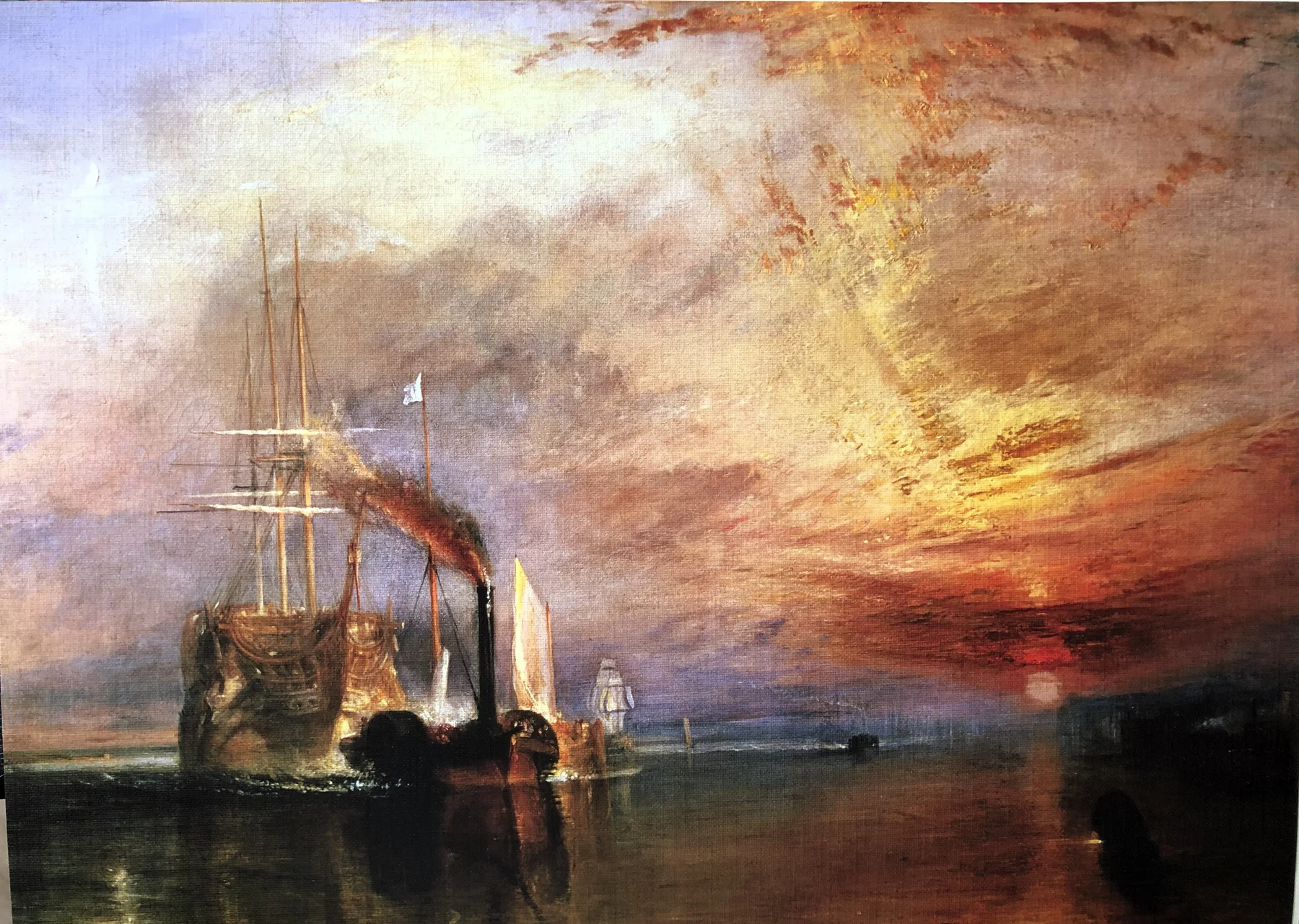
THE FIGHTING TEMERAIRE TUGGED TO HER LAST BERTH TO BE BROKEN UP
Joseph Mallord William Turner
- Artist
- Joseph Mallord William Turner (1775–1851)
- Date
- 1838
- Dimensions
- 91 x 122 cm
- Medium
- Oil on canvas
- Location
- National Gallery (Turner Bequest), London
In a 2005 poll by the BBC radio programme Today, listeners chose this painting as Britain’s greatest work of art. This strangely atmospheric scene is a special tribute to the last voyage of the warship Temeraire, a faded symbol of national pride. When Turner first showed his work in 1839, he added the following words to the picture: “The flag which braved the battle and the breeze / No longer owns her.”
The Age of Steam
As early as 1808 Turner had depicted the Temeraire in his picture The Battle of Trafalgar, celebrating her glorious role alongside Nelson’s flagship, the Victory, in the battle of 1805. Thirty years later Turner painted her decline and destruction, as the famous retired battleship is towed up the Thames to the shipbreaker’s yard at Rotherhithe in London.
At the time the writer and critic John Ruskin expressed his opinion of Turner thus: “…he very clearly alludes to the connection between the subject and the circumstances of her destruction, placing the ship against one of the deepest crimson sunsets.” Interestingly, contradictory stories circulate about the circumstances in which the scene was painted. First, in reality the Temeraire did not at all resemble the old battleship depicted in the painting — she no longer had masts or sails. Witnesses of the scene also claim that on that day in September 1839 the sunset was not crimson. Third, it is doubtful whether Turner was present at the event at all. He probably saw the ship’s remains at John Beatson’s wharf in London, where she was broken up.
Turner was famous for his artistic licence, so these inconsistencies do not really matter. He painted the scene with great empathy and devotion, expressing the symbol of a bygone age. The old wooden sailing warship ceremonially leaves the stage, her place taken by a paddle tug, the herald of the age of steam and the Industrial Revolution. The painting of the British warship aroused patriotic feelings in the public when it was shown, but Turner also favoured steamships, and the picture also shows that the painter looked forward with great expectations to the coming modern age.
A Priceless Painting
The Fighting Temeraire was first exhibited at the Royal Academy in London in 1839, where it received excellent reviews. Turner never sold the picture, which he called his “Darling”, although there was no shortage of interested buyers. In 1848 the American James Lenox offered £5,000 and then a blank cheque for the painting, but the painter turned down both. Together with several of his favourite paintings, Turner bequeathed The Fighting Temeraire to the National Gallery in London in 1851.
Master of Light and Colour
Turner’s composition creates a masterly balance between the horizontal of the horizon and the verticals of the ships and boats. The diagonal dynamic running from the Temeraire and the tug on the left to the dark buoy in the lower right corner lends the scene movement. Known to many as the “painter of light”, Turner is also a master of colour. He structures the blue sky into a triangular shape that frames the ships and contrasts with the dynamic fiery reds, oranges and lemon yellows of the sun. We see Turner at his most virtuoso, using his medium, oil paint, with great technical skill — bands of vivid colour can be seen in the sky and in the reflection of the sun. In his later years Turner went much further; his seascapes became even more “Impressionist”, making a deep impression on the French Impressionist painters.
At the centre of the picture stands the symbol of the new age, the dark tug, its jet-black funnel belching a cloud of fire and smoke, as if imitating the vibrant colours of the sun. The steamer glides easily over the water of the Thames, followed by the retired battleship, which resembles a white, skeletal ghost churning the waves. The tug’s reflection is so sharply outlined in the water that its mass seems to double.
Symbol of a Bygone Age
Like Turner’s painterly character, The Fighting Temeraire has its own enigma. The tug is pulling the ship up the Thames against the current, so the sun must be in the eastern sky, rising. Ever since Ruskin made his remark about the crimson sunset, most people have mistakenly believed it to be a dusk scene. In the end the time of day does not matter much. Turner brilliantly expressed the dawn of a new age and, in parallel, the twilight of an era. If anyone doubts the truth of Turner’s message, they need only glance at another of the artist’s paintings, made in 1844, which presents the contrast between the leisurely past and the fast-moving future: Rain, Steam and Speed – The Great Western Railway. In this scene the ugly form of the new railway bridge and the train dominates the fading beauty and peace of the old bridge and the landscape (left). Turner was able to convey passion and energy together.
- Turner: The Battle of Trafalgar
- James Lenox
- Turner: Rain, Steam and Speed – The Great Western Railway